

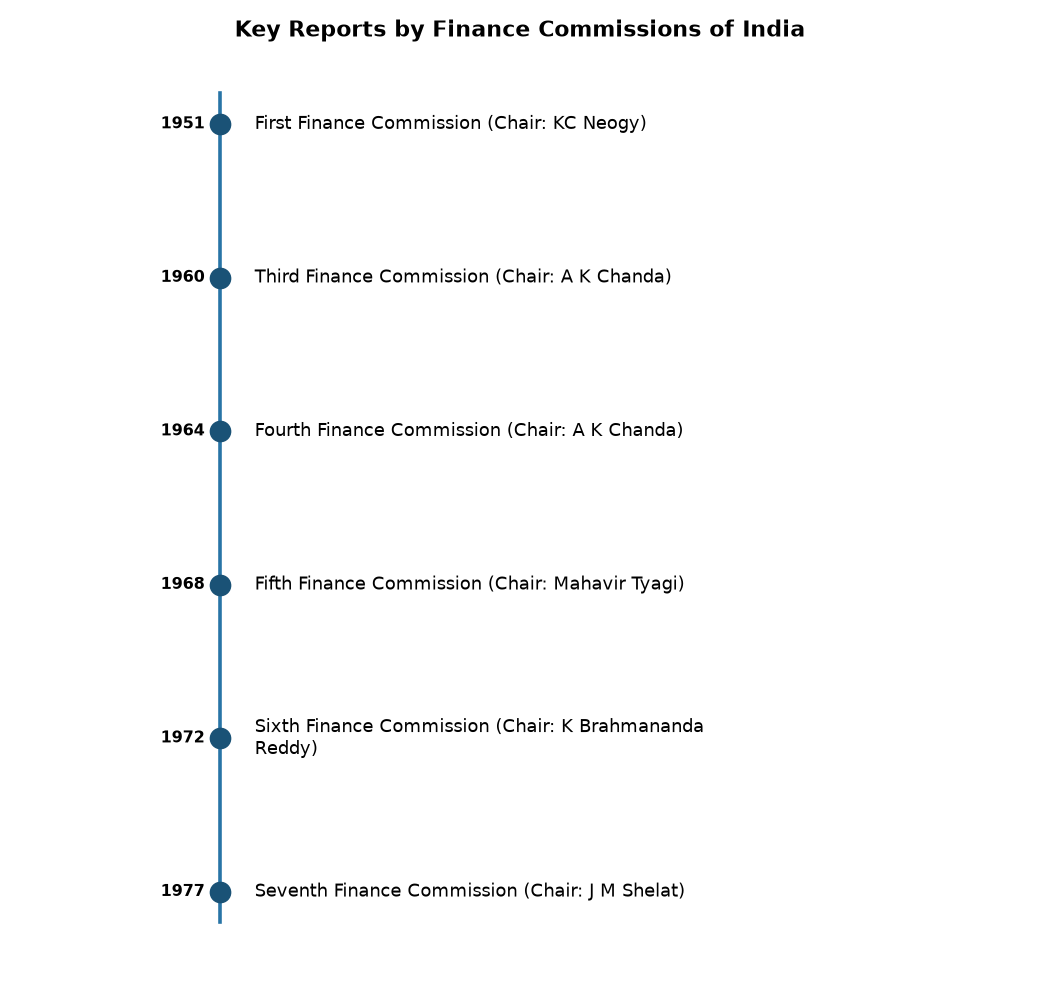
✎ Finance Commission ensures equitable tax distribution between Centre and states via constitutional recommendations.
Relevance for Banking, SSC & RBI Grade B exams: Economy/Governance
The Fifteenth Finance Commission (XVFC), chaired by N.K. Singh, submitted its final report for the period 2021-26, emphasizing fiscal consolidation, resource devolution, and performance-based incentives for states. It recommended maintaining the vertical devolution of 41% of the divisible pool of taxes to states, a slight reduction from the 42% recommended by the Fourteenth Finance Commission, to account for the Union Territories of Jammu & Kashmir, Ladakh, and Delhi. The report also introduced a performance-based incentive system for states in areas such as health, education, and governance, aligning with the government’s push for cooperative federalism and sustainable development. For banking aspirants preparing for exams like IBPS PO or SBI Clerk, understanding the Finance Commission’s role in resource allocation and fiscal federalism is crucial, as it directly impacts state budgets, tax revenues, and developmental expenditures, which in turn influence banking sector growth and credit demand. SSC aspirants, particularly in the General Studies section, must grasp the Commission’s recommendations to answer questions on fiscal policy, intergovernmental fiscal relations, and economic governance, which are frequently tested in exams like SSC CGL.
The Finance Commission’s reports are also significant for RBI Grade B officers, as they provide insights into the macroeconomic framework, including fiscal deficit targets, tax buoyancy, and expenditure priorities of the central and state governments. The XVFC’s emphasis on performance-linked grants and the use of the 2011 Census for tax devolution calculations reflects broader trends in governance and economic policy, which RBI officers must monitor for monetary policy formulation and financial stability assessments. Banking exams often feature questions on the Finance Commission’s role in determining the states’ share in central taxes, which affects liquidity in the banking system and the flow of credit to priority sectors. Similarly, SSC exams test candidates on the constitutional provisions related to the Finance Commission (Article 280) and its recommendations, making it a key topic for aspirants aiming for roles in the government or public sector.
Source: niti.gov.in
Generated by AanyaAi for educational purpose.

2 comments on “Finance Commission’s Key Recommendations for India’s Fiscal Federalism”