
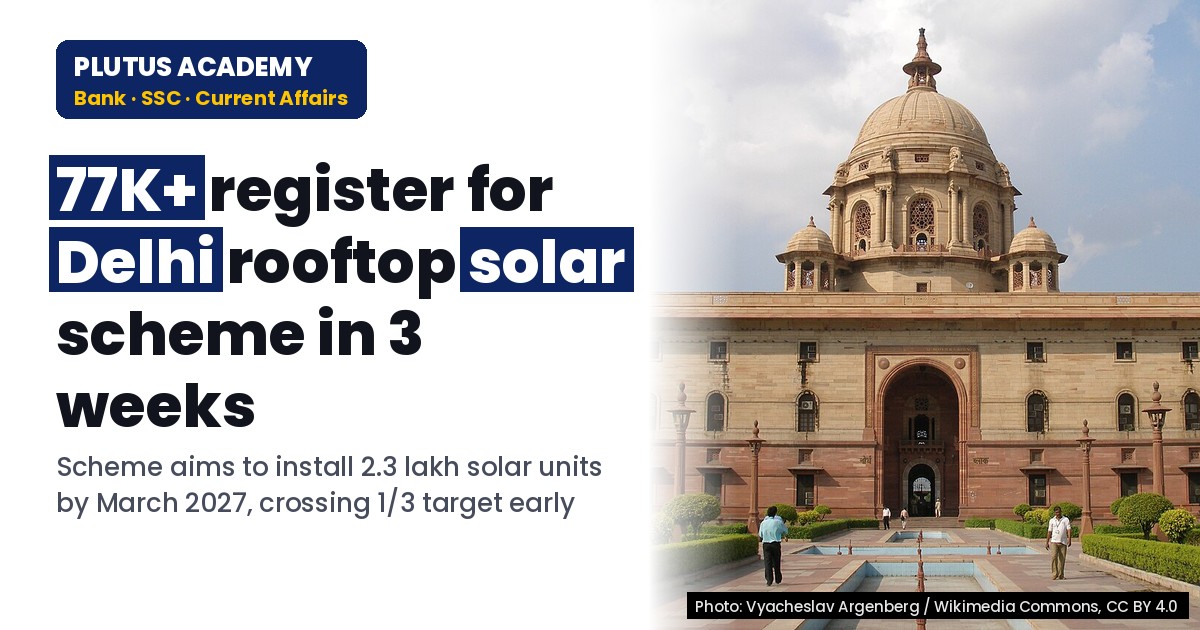
✎ Over 77,000 households registered for Delhi’s rooftop solar scheme in 3 weeks, crossing one-third of the 2.3 lakh target for installations by March 31, 2027.
Relevance for Banking, SSC & RBI Grade B exams: Polity & Governance
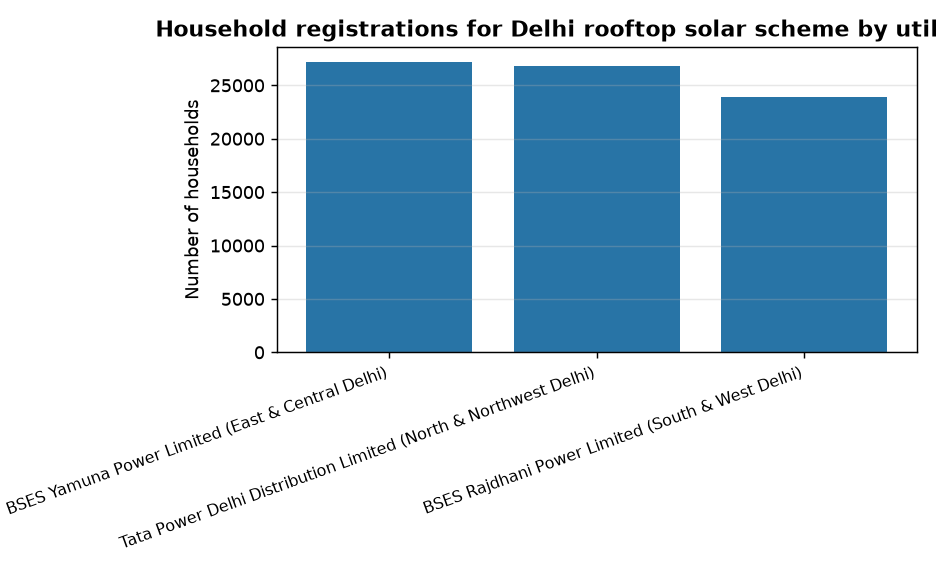
Over 77,000 households in Delhi have registered for the rooftop solar scheme within three weeks of its launch, surpassing one-third of the government’s target to install 2.3 lakh solar units by March 2027. The scheme, which offers substantial subsidies—up to ₹1.56 lakh for eligible consumers under the Pradhan Mantri Surya Ghar: Muft Bijli Yojana and Delhi’s additional incentives—has seen strong participation, particularly from rural and unauthorised colonies. This surge in registrations reflects growing public interest in renewable energy, driven by financial incentives and rising awareness about sustainable energy solutions. For banking and SSC aspirants, this initiative highlights the role of government policies in promoting green energy, a key area in both economic and environmental governance discussions. RBI Grade B candidates should note how such schemes align with India’s broader climate commitments and their potential impact on energy sector financing and subsidies.
The scheme’s success also underscores challenges like high initial costs and coordination issues in group housing societies, which policymakers are addressing through enhanced subsidies. For banking exams, this scenario is relevant to understanding the financial mechanisms behind renewable energy adoption, including subsidies, loans, and public-private partnerships. SSC aspirants preparing for polity and governance sections should focus on the intersection of state and central government policies, as seen in the dual subsidy structure, and its implications for urban planning and energy security. The data—such as the 48 lakh households receiving electricity subsidies—also provides a case study for economic surveys and governance reports, making it a valuable topic for current affairs preparation.
Source: The Indian Express
Generated by AanyaAi for educational purpose.

2 comments on “Delhi Rooftop Solar Scheme Sees 77K+ Registrations in 3 Weeks: Key Details”