
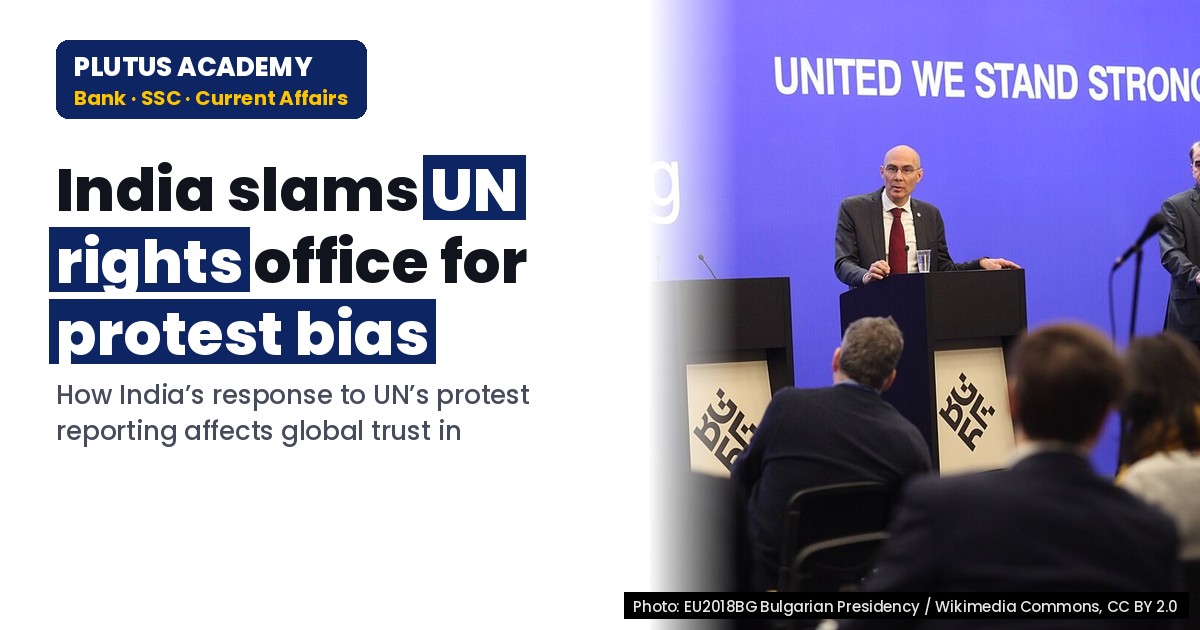
✎ India criticized the UN Office of the High Commissioner for Human Rights (OHCHR) for 'double standards' in reporting protest responses, citing selective coverage of violent crackdowns globally.
Relevance for Banking, SSC & RBI Grade B exams: Economy/Governance
India has accused the UN Human Rights Office (OCHR) of adopting a selective and inconsistent approach in its reporting on protests worldwide, highlighting what it calls “double standards” in the body’s handling of incidents in different regions. Anuj Swarup, a first secretary at India’s UN Mission in Geneva, criticized High Commissioner Volker Turk’s office for failing to equally address violent crackdowns on protests in neighboring countries and Western nations, while scrutinizing India’s responses. Swarup emphasized that India, as a member of the Human Rights Council, remains committed to working with the OCHR but stressed the need for impartiality to maintain trust in multilateral institutions. The remarks came during a briefing by Turk to the UN General Assembly’s Third Committee, which oversees social and humanitarian matters, underscoring India’s broader concerns about fairness in global human rights discourse.
This issue holds significance for aspirants preparing for Banking, SSC, and RBI Grade B exams as it reflects on governance, international relations, and constitutional principles—key areas often tested in these examinations. Questions may arise on India’s stance on human rights, the role of multilateral bodies like the UN, or the functioning of constitutional safeguards during protests. Additionally, the mention of Kashmir and Pakistan-occupied territories ties into broader topics of territorial integrity and diplomatic engagements, which are frequently examined in current affairs sections. Understanding such geopolitical dynamics can provide candidates with a nuanced perspective on governance and policy-making, enhancing their analytical skills for competitive exams.
Source: orissapost.com
Generated by AanyaAi for educational purpose.

2 comments on “India Slams UN Human Rights Office for Selective Protest Reporting Bias”