
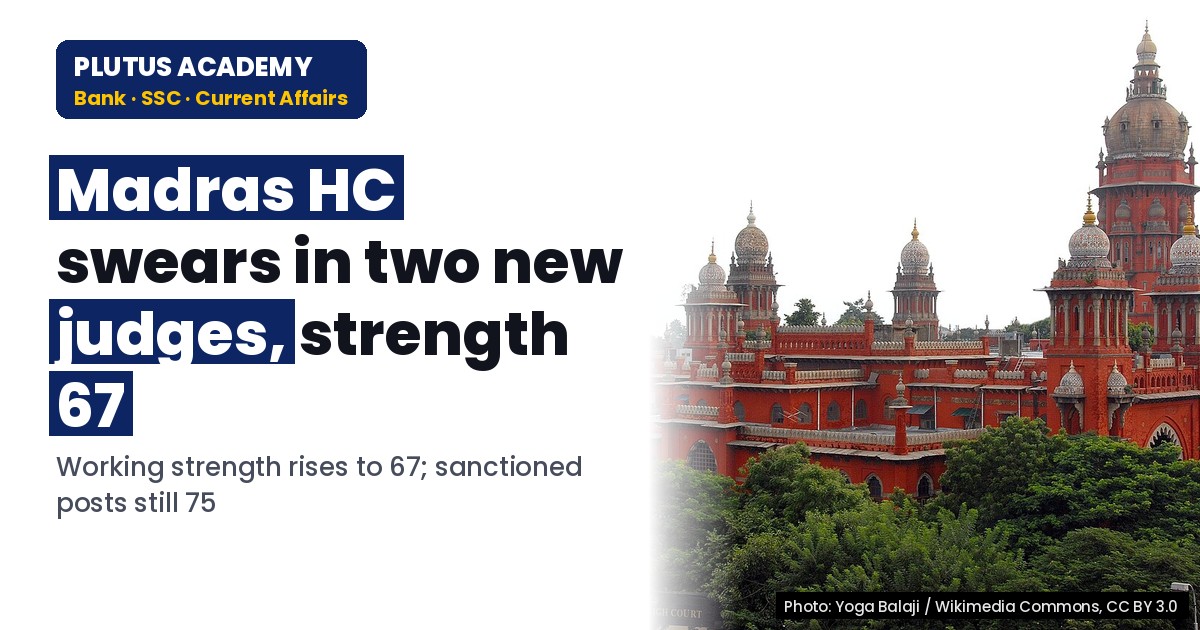
✎ Madras High Court's working strength increased to 67 judges after swearing-in of Justices D. Lingeswaran and B. Karthikeyan on October 15, 2026.
Relevance for Banking, SSC & RBI Grade B exams: Polity
The appointment of two additional judges to the Madras High Court, raising its working strength to 67, underscores the judiciary’s efforts to address backlog and expedite justice delivery. For aspirants preparing for banking, SSC, and RBI Grade B exams, this development highlights the constitutional framework governing judicial appointments, particularly under Articles 217 and 224 of the Constitution, which outline the process for appointing High Court judges from the district judiciary. The elevation of district judges like D. Lingeswaran and B. Karthikeyan—both with over a decade of experience—also reflects the judiciary’s emphasis on meritocracy and regional representation, a theme often tested in exams through questions on judicial reforms and governance.
The Madras High Court’s current strength of 67 judges against a sanctioned capacity of 75 reveals the persistent challenge of judicial vacancies, a critical issue for exam aspirants studying public administration and constitutional law. Such appointments are relevant for banking exams, where questions on legal frameworks and regulatory bodies (e.g., RBI’s role in judicial appointments) may appear, while SSC exams may focus on the judiciary’s impact on governance and policy. For RBI Grade B candidates, understanding the interplay between judicial efficiency and economic stability—such as how delays in justice delivery can affect financial sectors—adds depth to their preparation. The appointment process, involving the President’s warrant and Chief Justice’s oath, further ties into questions on separation of powers and constitutional bodies.
Source: The Hindu
Generated by AanyaAi for educational purpose.

2 comments on “Madras High Court strength rises to 67 with two new judges sworn in”