
Relevance for Banking, SSC & RBI Grade B exams: Polity & Governance
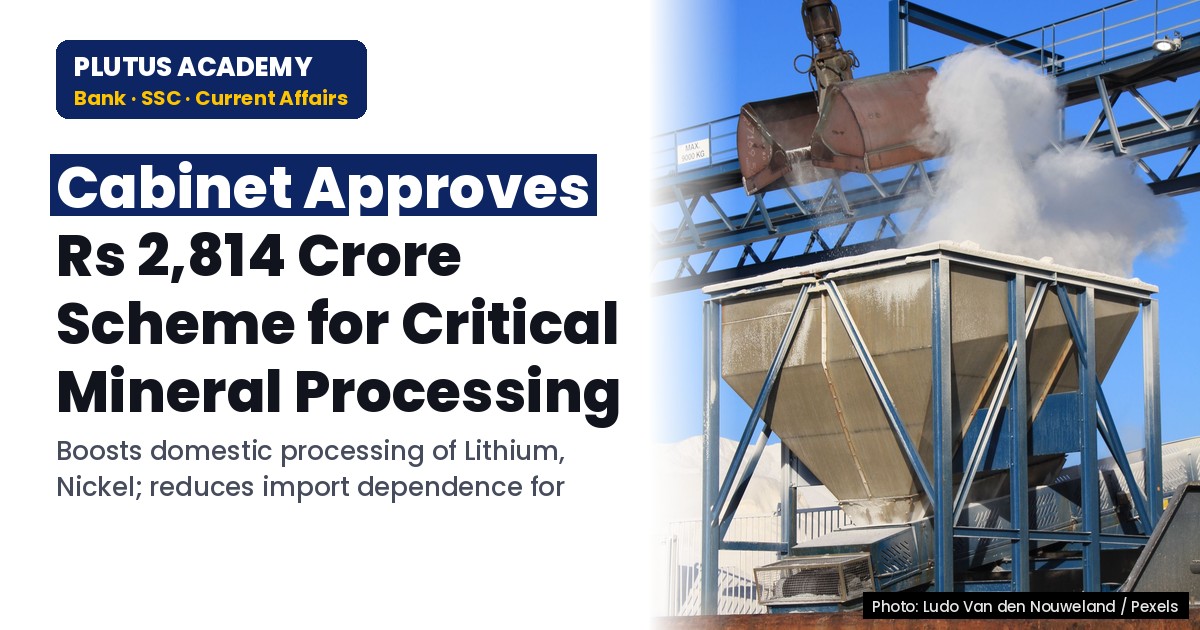
The Union Cabinet, chaired by Prime Minister Shri Narendra Modi, has approved the ‘Capital Expenditure Support Scheme to Promote Critical Mineral Processing’ with a financial outlay of Rs. 2,814 crore for a period of five years, from FY 2026-27 to 2030-31. This scheme aims to address India’s current reliance on imports for refined intermediate products and high-purity materials of critical minerals like lithium, nickel, and cobalt, due to limited domestic refining and processing infrastructure. The initiative seeks to establish processing plants for lithium and nickel, with two lithium processing plants each having a minimum capacity of 30,000 metric tons and two nickel processing plants each with a minimum capacity of 50,000 metric tons, by providing a 30 percent capital subsidy on eligible investments. The maximum capital support is capped at Rs. 500 crore for a lithium processing plant and Rs. 900 crore for a nickel processing plant, with beneficiaries selected through a two-stage process based on technical eligibility and financial bidding. This strategic move is designed to maximize value addition, promote domestic production over imports, and build robust and complete value chains within the country, thereby strengthening economic security, national security, and the ability to achieve carbon emission reduction targets.
For Banking, SSC, and RBI Grade B exams, this development is significant under Polity & Governance. Aspirants should note the scheme’s name, its financial outlay of Rs. 2,814 crore, and the five-year implementation period (FY 2026-27 to 2030-31). Key details include the focus on lithium and nickel processing, the provision of a 30 percent capital subsidy, and the specific capacities targeted for the new processing plants. Understanding the rationale behind the scheme—reducing import dependence, enhancing domestic value addition, and bolstering supply chain resilience for critical minerals essential for sectors like electric mobility, battery energy storage systems, electronics, and defense—is crucial. Questions may arise regarding the scheme’s objectives, the types of minerals covered, the financial incentives offered, and its broader implications for India’s economic sovereignty and ‘Atmanirbhar Bharat’ goals.
Source: PIB (Press Information Bureau)
Generated by AanyaAi for educational purpose.

2 comments on “Cabinet Approves Scheme for Critical Mineral Processing”