
Relevance for Banking, SSC & RBI Grade B exams: Polity
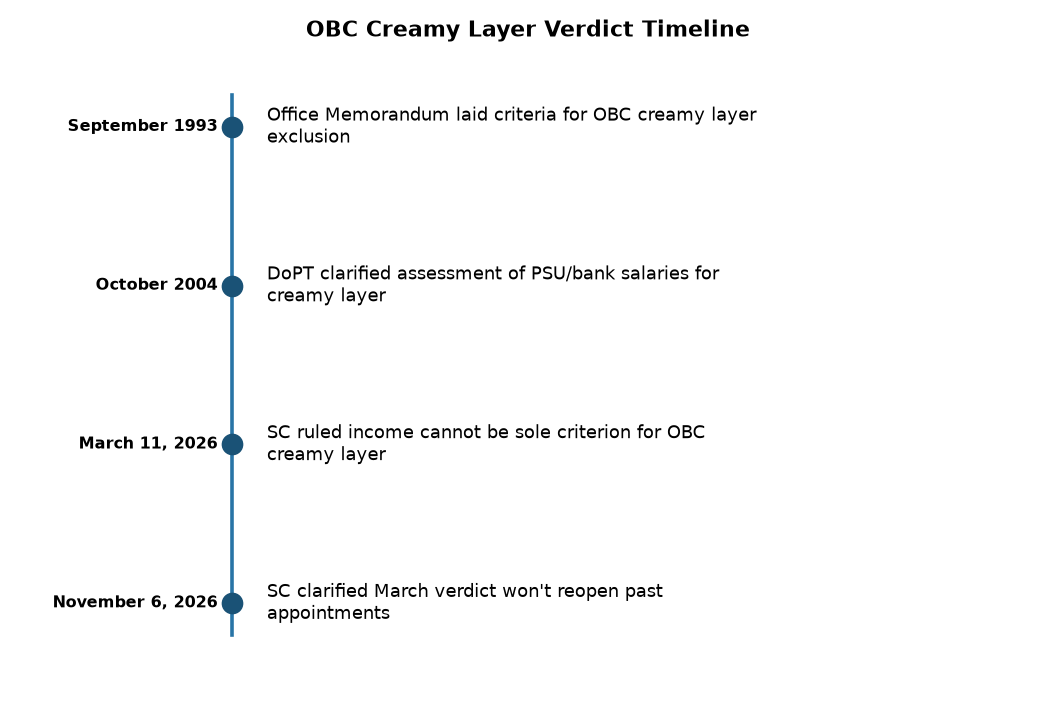
The Supreme Court recently clarified that its March 2026 verdict on the “creamy layer” among Other Backward Classes (OBCs) will not reopen selections and appointments already concluded, but will apply to the pending Civil Services Examination (CSE) 2025 service allocation. This ruling reiterates that those included in the “creamy layer,” defined as wealthier and more advanced members of OBCs, are not entitled to OBC reservation benefits. The March verdict had established that income cannot be the sole criterion to decide the OBC creamy layer, settling the long-pending question of equivalence between public sector undertakings (PSUs), private sector employees, and those in the government sector, and held that income from salaries itself cannot become the sole criterion for determining creamy layer status. The Centre had sought clarification on the verdict’s temporal reach, pointing to numerous past appointments, but the Court affirmed that its judgment does not require revisiting past appointments or revising seniority.
For aspirants of Banking, SSC, and RBI Grade B exams, understanding this development is crucial for the Polity section. The Supreme Court’s stance on the “creamy layer” and its application to reservation policies directly impacts public administration and social justice, which are key themes in these competitive exams. Questions may arise regarding the criteria for OBC reservations, the concept of the “creamy layer,” the role of the judiciary in interpreting government policies like the 1993 OM and 2004 letter, and the temporal application of judicial pronouncements. This case highlights the complexities of reservation policies and the balance between ensuring social equity and maintaining administrative stability, providing a practical example of constitutional principles in action.
Source: The Indian Express
Generated by AanyaAi for educational purpose.

2 comments on “OBC Creamy Layer: SC Verdict on Past Appointments & CSE”