
Relevance for Banking, SSC & RBI Grade B exams: Economy
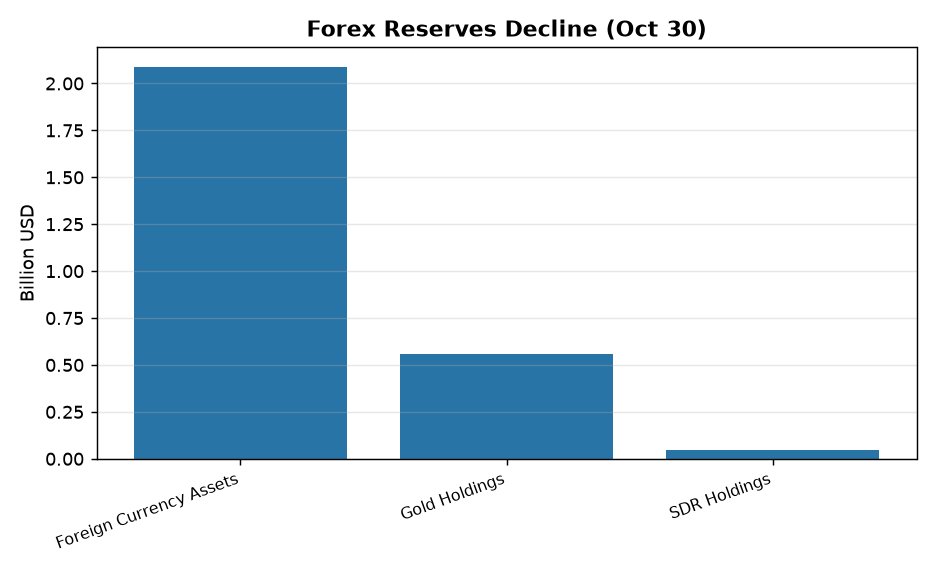
India’s foreign exchange reserves experienced a decline of $2.691 billion, settling at $717.056 billion for the week ending October 30, according to data from the Reserve Bank of India. This reduction was primarily due to decreases in foreign currency assets, which fell by $2.088 billion to $591.118 billion, and gold holdings, which decreased by $559 million to $102.591 billion. Additionally, Special Drawing Rights (SDRs) saw a drop of $47 million, bringing their value to $18.558 billion, although India’s reserve position with the International Monetary Fund (IMF) marginally increased by $3 million to $4.790 billion. Despite this weekly dip, the overall foreign exchange reserves remain higher than both their level at the end of March 2026 and a year ago, having increased by $25.949 billion since March and $27.324 billion year-on-year.
For aspirants of Banking, SSC, and RBI Grade B exams, understanding India’s forex reserves is crucial as it reflects the country’s economic stability and its ability to manage external shocks. Fluctuations in these reserves, particularly the components like foreign currency assets and gold, directly impact the rupee’s value, inflation, and the RBI’s monetary policy decisions, which are core topics for these examinations. Furthermore, the RBI’s role in managing these reserves, as highlighted by the data release, is a key function often tested in banking and RBI Grade B exams, while the economic implications of such changes are relevant for general awareness sections across all three exam types.
Source: Times of India
Generated by AanyaAi for educational purpose.

2 comments on “India’s Forex Reserves Dip: Key Facts for Banking & SSC”