
Relevance for Banking, SSC & RBI Grade B exams: International Relations
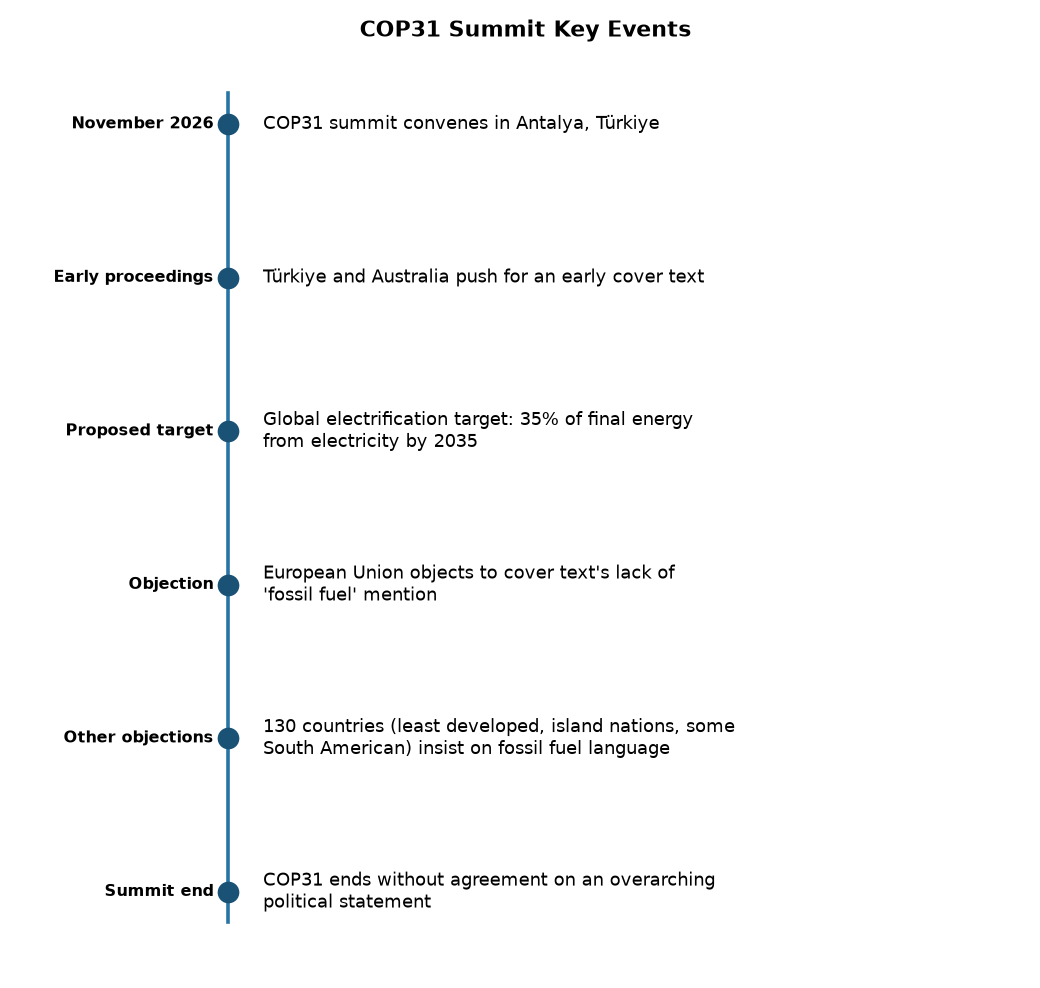
The recent COP31 summit in Antalya, Türkiye, concluded without an overarching political statement, or cover text, due to a “fatal disagreement” among the 190-odd participating nations. Despite a close to 50-hour overshoot, the summit failed to agree on a stepping stone for future collective global action on climate change, primarily because the European Union objected to the cover text’s lack of explicit mention of ‘fossil fuel’ or its phase-out. This deadlock, also supported by country-blocks of least developed countries, island nations, and some South American countries, highlights the arduously protracted nature of the COP process where even a single country’s objection can stall progress, leading to a “whimper” of an ending for the summit.
For Banking, SSC, and RBI Grade B aspirants, this development is crucial for understanding International Relations and its economic implications. The failure to progress on climate finance, despite advancements in clean energy installations by nations like India and China, underscores the challenges in diverting necessary funds towards climate change mitigation, especially given the interconnected global financial system and its inherent economic crises. The “mortal blow to multilateralism” posed by the lack of honest good-faith dialogue at COP31 could impact future global agreements, trade policies, and the stability of international markets, all of which are relevant for comprehending economic trends, policy formulation, and financial risk assessment in a globalized world.
Source: The Hindu
Generated by AanyaAi for educational purpose.

2 comments on “COP31 Summit Fails: Implications for Climate Finance & Global Targets”