
Relevance for Banking, SSC & RBI Grade B exams: Polity & Governance
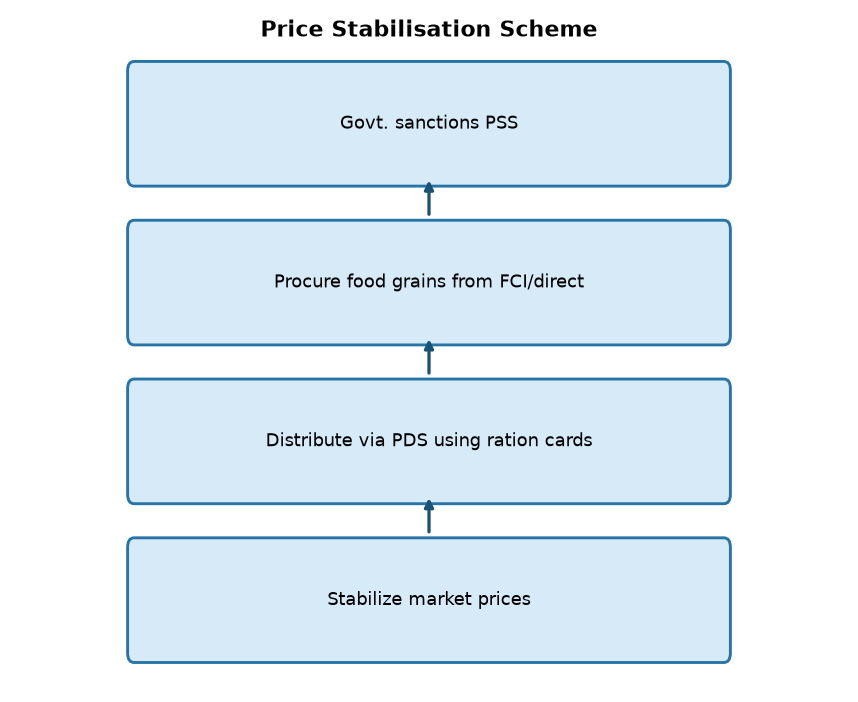
The State government has sanctioned a Price Stabilisation Scheme (PSS) to procure and distribute additional quantities of rice and other food grains through the public distribution system (PDS), aiming to stabilise market prices and protect consumer interests by increasing the availability of food grains when inflationary pressures necessitate intervention. This scheme, which enables the state to procure additional quantities from the Food Corporation of India (FCI) under the Open Market Sale Scheme (OMSS) and undertake direct procurement where necessary, is a direct response to a proposal highlighting the need for a permanent mechanism to intervene when retail rice prices surge. Beneficiaries across all five ration-card categories, including Antyodaya Anna Yojana (AAY), Priority Household (PHH), Non-Priority Subsidy (NPS), Non-Priority Non-Subsidy (NPNS) and Non-Priority Institution (NPI), will be included, with additional food grains distributed transparently through the PDS using ration cards and the AePDS portal, subject to a ceiling of 15 kg per ration card.
For Banking, SSC, and RBI Grade B aspirants, this development is crucial for understanding government intervention in economic management and social welfare. It highlights the role of the Food Corporation of India (FCI) and the Public Distribution System (PDS) in national food security, a key aspect of economic policy. Questions may arise on the mechanisms of price control, the Open Market Sale Scheme (OMSS), and the various ration card categories, testing knowledge of government schemes, their objectives, and their impact on inflation and consumer protection, all vital for comprehending the broader economic and governance landscape.
Source: The Hindu
Generated by AanyaAi for educational purpose.

2 comments on “Govt. Price Stabilisation Scheme for Food Grains: Banking & SSC”