Relevance for Banking, SSC & RBI Grade B exams: Polity & Governance
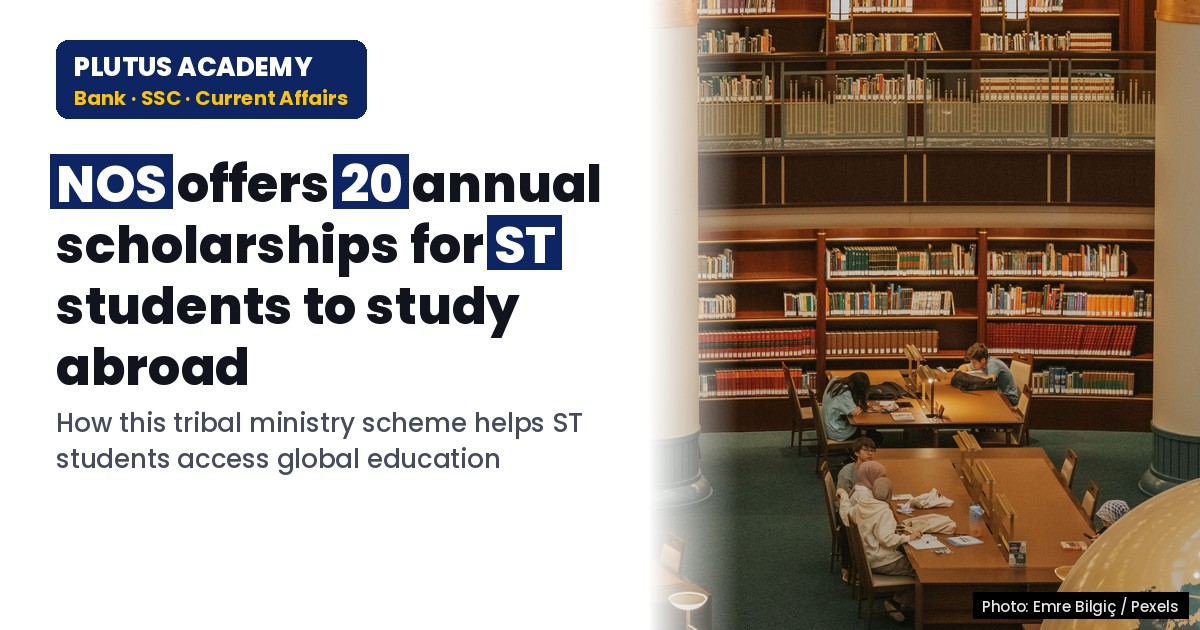
The **National Overseas Scholarship (NOS) Scheme** for Scheduled Tribe (ST) students, implemented by the Ministry of Tribal Affairs since 1954-55, provides **20 annual scholarships** to pursue **Master’s and PhD degrees** at **top 1,000 QS-ranked global universities**. The scheme prioritizes **women (30% reservation)** and **particularly vulnerable tribal groups (PVTGs, 3 seats)** while expanding financial support from **₹0.39 crore in 2015-16 to ₹8 crore in 2025-26**. Eligibility requires **55% marks in the qualifying exam** (32 years for Master’s, 35 for PhD) and a **family income cap of ₹6 lakh annually**, with selection based on **QS university rankings** and academic merit. The scheme aligns with **SDG 4 (Quality Education)** and **SDG 5 (Gender Equality)**, addressing **educational disparities** among ST communities, whose higher education enrollment rose from **21.56 lakh in 2019-20 to 28.83 lakh in 2023-24** (AISHE 2023-24).
For **Banking (IBPS/SBI/RBI Grade B) and SSC aspirants**, this scheme underscores **governance initiatives for inclusive development**, a key theme in **Polity & Governance** sections. Questions may test **scheme objectives, eligibility criteria, or budgetary allocations**, linking it to **public policy, financial inclusion, or SDG targets**. For **SSC CGL/CPO**, it highlights **government welfare schemes** and **demographic data**, while **RBI Grade B** may explore its **impact on human capital formation** or **budgetary priorities** under **tribal welfare**. The scheme also reflects **India’s global education diplomacy**, relevant for **diplomacy-related questions** in competitive exams.
Source: PIB (Press Information Bureau)
Generated by AanyaAi for educational purpose.

2 comments on “National Overseas Scholarship for ST Students: Key Facts for Banking & SSC Exams”