
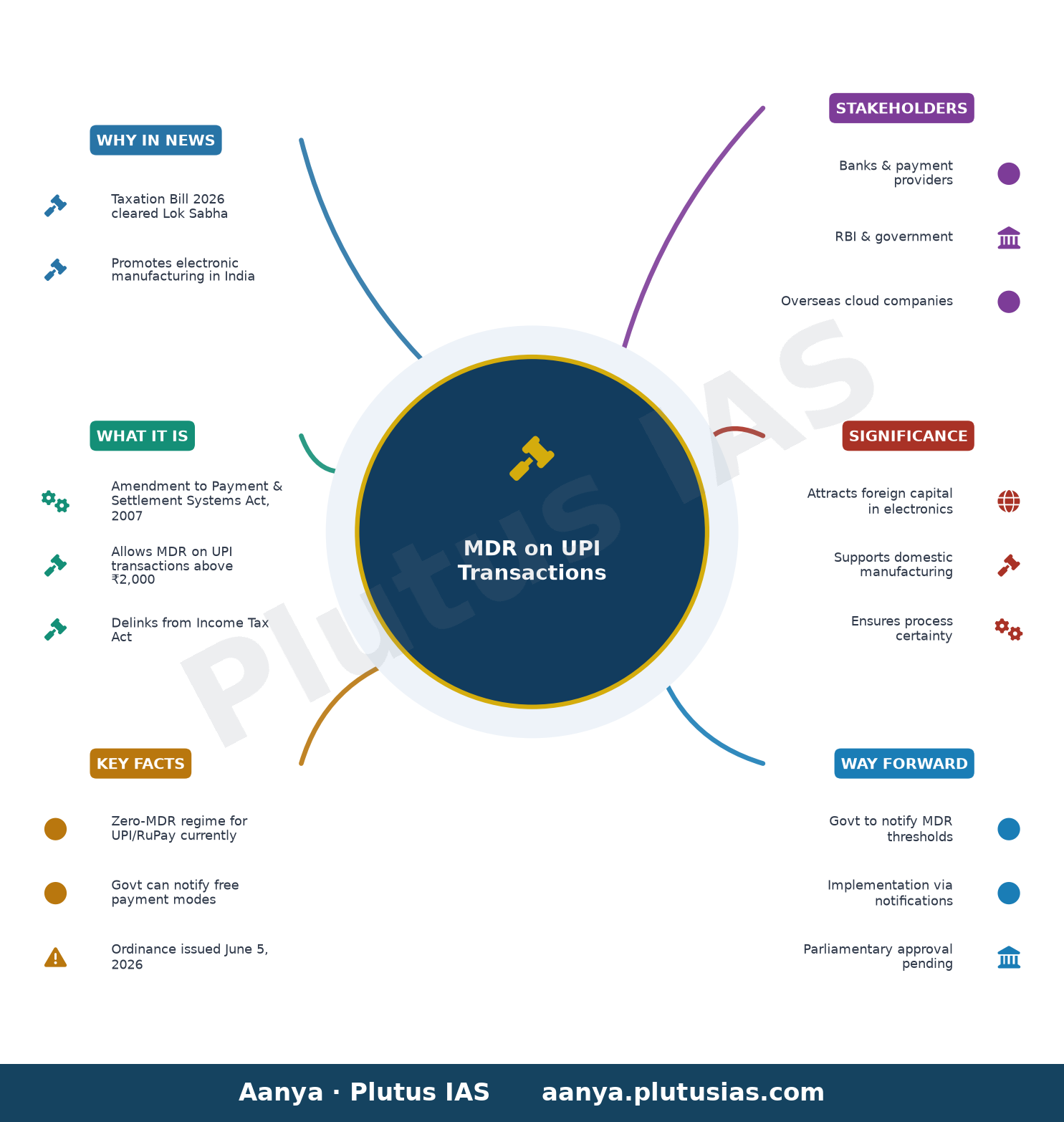
✎ MDR on UPI transactions above ₹2,000 may be introduced via Taxation Bill 2026 to boost revenue and manufacturing.
Relevance for Banking, SSC & RBI Grade B exams: Polity
The Lok Sabha recently passed the Taxation and Other Laws (Amendment) Bill, 2026, which introduces key provisions to boost foreign investment and domestic electronics manufacturing while allowing the government to reintroduce Merchant Discount Rate (MDR) charges on UPI transactions. The Bill amends the Payment and Settlement Systems Act, 2007, to delink it from the Income Tax Act and empowers the Centre to specify which UPI or RuPay transactions may attract MDR, reversing the current zero-MDR regime. This move aligns with the government’s broader push to create a predictable regulatory environment for global investors, particularly in the electronics sector, where tax exemptions for contract manufacturers and bonded warehouse facilities have been extended until 2040-41. For banking and SSC aspirants, this development is significant as it reflects the evolving policy landscape governing digital payments and foreign direct investment (FDI), areas frequently tested in exams like IBPS, SBI, and RBI Grade B. The Bill also simplifies compliance for foreign cloud service providers by easing data centre regulations, a topic relevant to the digital economy and governance sections of competitive exams.
The introduction of MDR provisions on UPI transactions holds particular relevance for RBI Grade B and banking exams, as it touches upon the Reserve Bank of India’s (RBI) role in regulating digital payment systems and its stance on transaction costs. The Bill’s passage underscores the government’s intent to balance consumer convenience with the financial sustainability of payment infrastructure providers, a debate highlighted by RBI Governor Shaktikanta Das’ earlier remarks on the need for cost-sharing in high-value UPI transactions. For SSC aspirants preparing for the General Studies paper, understanding the interplay between taxation laws, digital payment ecosystems, and FDI policies is crucial, as these themes often appear in questions related to economic reforms and government initiatives. The Bill’s focus on electronics manufacturing and data localisation also ties into broader discussions on ‘Make in India’ and India’s digital sovereignty, making it a pertinent case study for exam preparation.
Source: Times of India
Generated by AanyaAi for educational purpose.
