
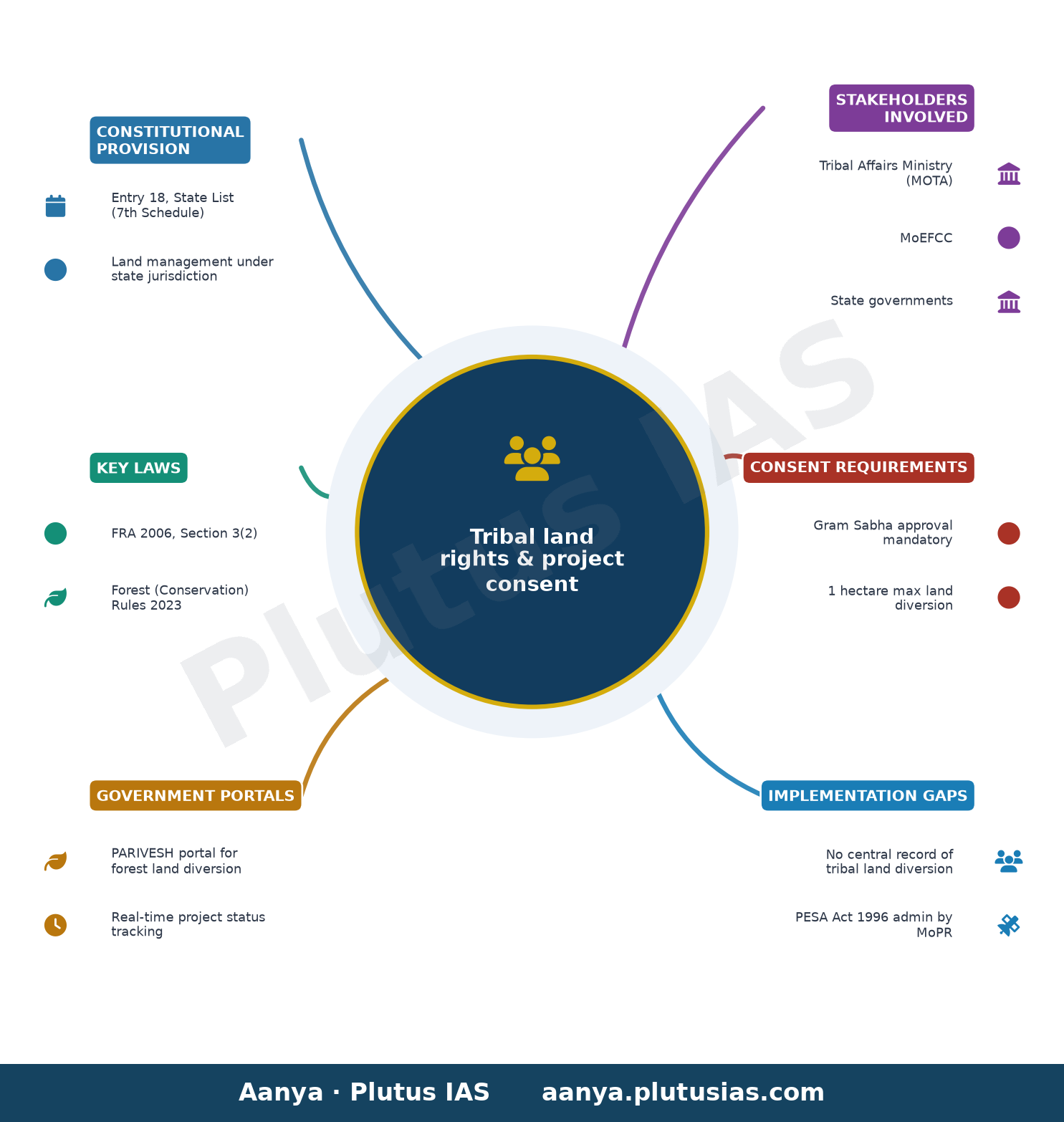
✎ Tribal land rights require Gram Sabha consent and strict adherence to FRA 2006 & Forest Conservation Rules 2023.
Relevance for Banking, SSC & RBI Grade B exams: Polity & Governance
The Press Information Bureau release highlights the constitutional and administrative framework governing tribal land rights and consent requirements for projects involving land diversion. Under the Seventh Schedule (State List, Entry 18) of the Constitution, land management falls under the exclusive jurisdiction of state governments, while land acquisition and rehabilitation are governed by central and state laws. The Ministry of Environment, Forest and Climate Change (MoEFCC) processes proposals for diverting forest land for non-forestry purposes through the PARIVESH portal, ensuring transparency in diversion proposals, user agencies, and project impacts. However, the Ministry of Tribal Affairs (MoTA) clarified that it does not maintain a central record of tribal land diversions, as implementation of the Forest Rights Act (FRA), 2006, including Gram Sabha consent and protection of tribal rights, lies with state governments. The FRA mandates that no tribal can be evicted from forest land until their rights are recognized and verified, emphasizing the need for compliance with Section 4(5) of the Act.
For aspirants preparing for Banking, SSC, and RBI Grade B exams, this issue is crucial as it intersects governance, constitutional provisions, and socio-economic policies. Questions may arise on the distribution of legislative powers between the Centre and states, the role of Gram Sabha in tribal consent, and the procedural safeguards under the FRA and Forest Conservation Act. Additionally, understanding the administrative gaps—such as the lack of centralized tracking of tribal land diversions—can be relevant for governance and policy-based questions in exams. The mention of pending legal cases, such as those in Odisha, Gujarat, and Himachal Pradesh, also underscores the judicial dimension of land rights, which could be linked to current affairs or legal governance topics in competitive exams.
Source: PIB (Press Information Bureau)
Generated by AanyaAi for educational purpose.
