
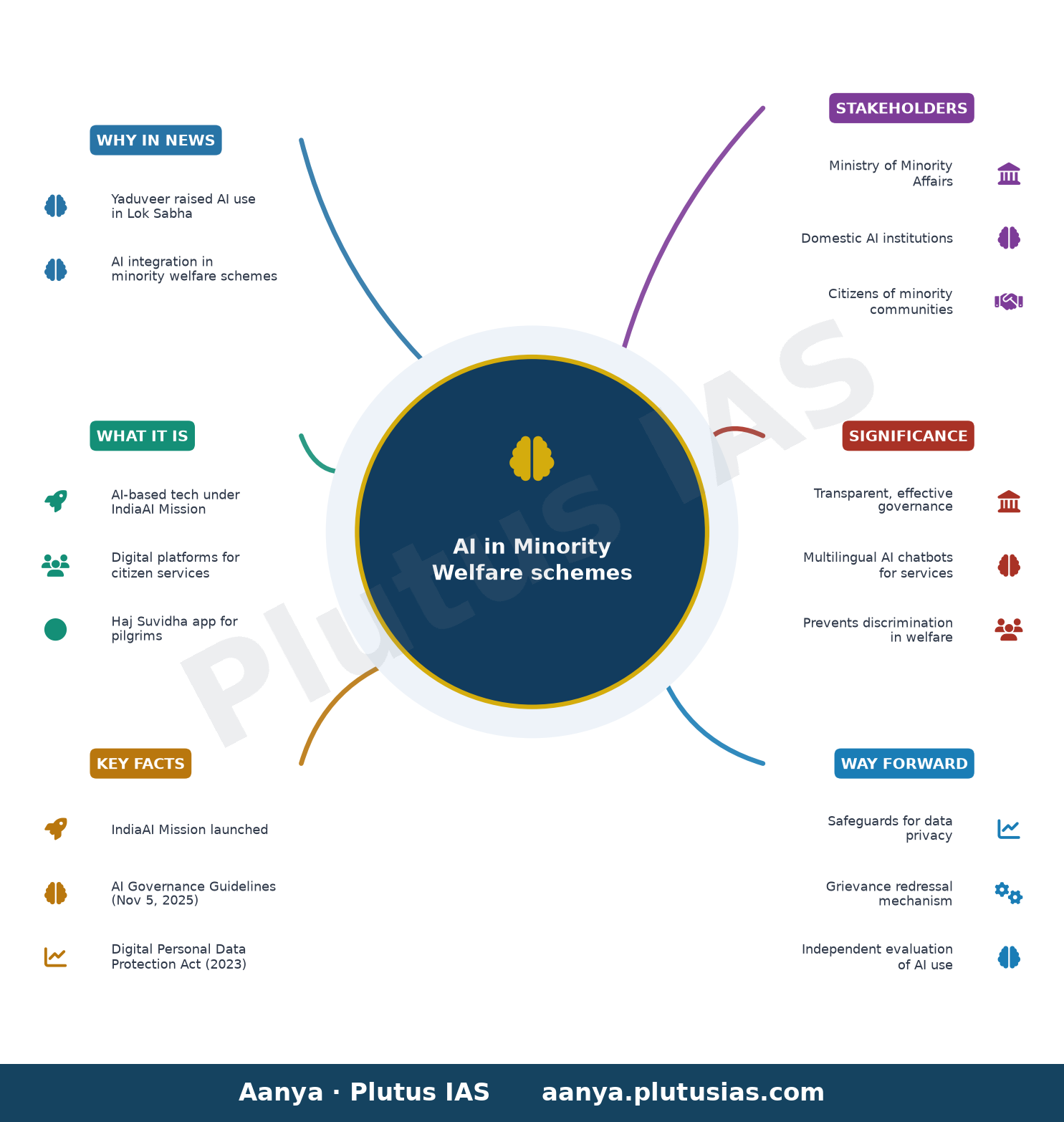
✎ AI in minority welfare schemes aims to enhance transparency, efficiency, and data security while ensuring citizen-friendly services.
Relevance for Banking, SSC & RBI Grade B exams: Polity & Governance
Yaduveer Krishnadatta Chamaraja Wadiyar, the Mysuru-Kodagu Lok Sabha MP, recently raised concerns in Parliament about the integration of Artificial Intelligence (AI) in the Ministry of Minority Affairs’ welfare schemes. The MP sought clarity on the government’s objectives behind deploying AI, the specific schemes where it would be implemented, safeguards for personal data, mechanisms to prevent algorithmic bias, and independent oversight frameworks. In response, the Union Ministry of Minority Affairs stated that AI adoption under the IndiaAI Mission is being explored in collaboration with domestic institutions to enhance digital governance, including multilingual AI chatbots, virtual assistants, and the Haj Suvidha app. The government also highlighted compliance with the India AI Governance Guidelines (2025) and the Digital Personal Data Protection Act (2023), ensuring data privacy, security, and grievance redressal mechanisms.
This development holds significant relevance for banking, SSC, and RBI Grade B exam aspirants, particularly in Polity & Governance sections. The use of AI in governance reflects India’s push toward digital public infrastructure, a topic often tested in exams like the RBI Grade B’s Economic & Social Issues paper or SSC’s General Awareness section. Questions on AI governance, data protection laws, and ethical AI practices may appear in descriptive or objective formats, testing candidates’ awareness of emerging technological policies. Additionally, the intersection of welfare schemes and AI aligns with broader themes like inclusive development and digital inclusion, which are crucial for understanding India’s socio-economic policies in competitive exams.
Source: The Hindu
Generated by AanyaAi for educational purpose.
