
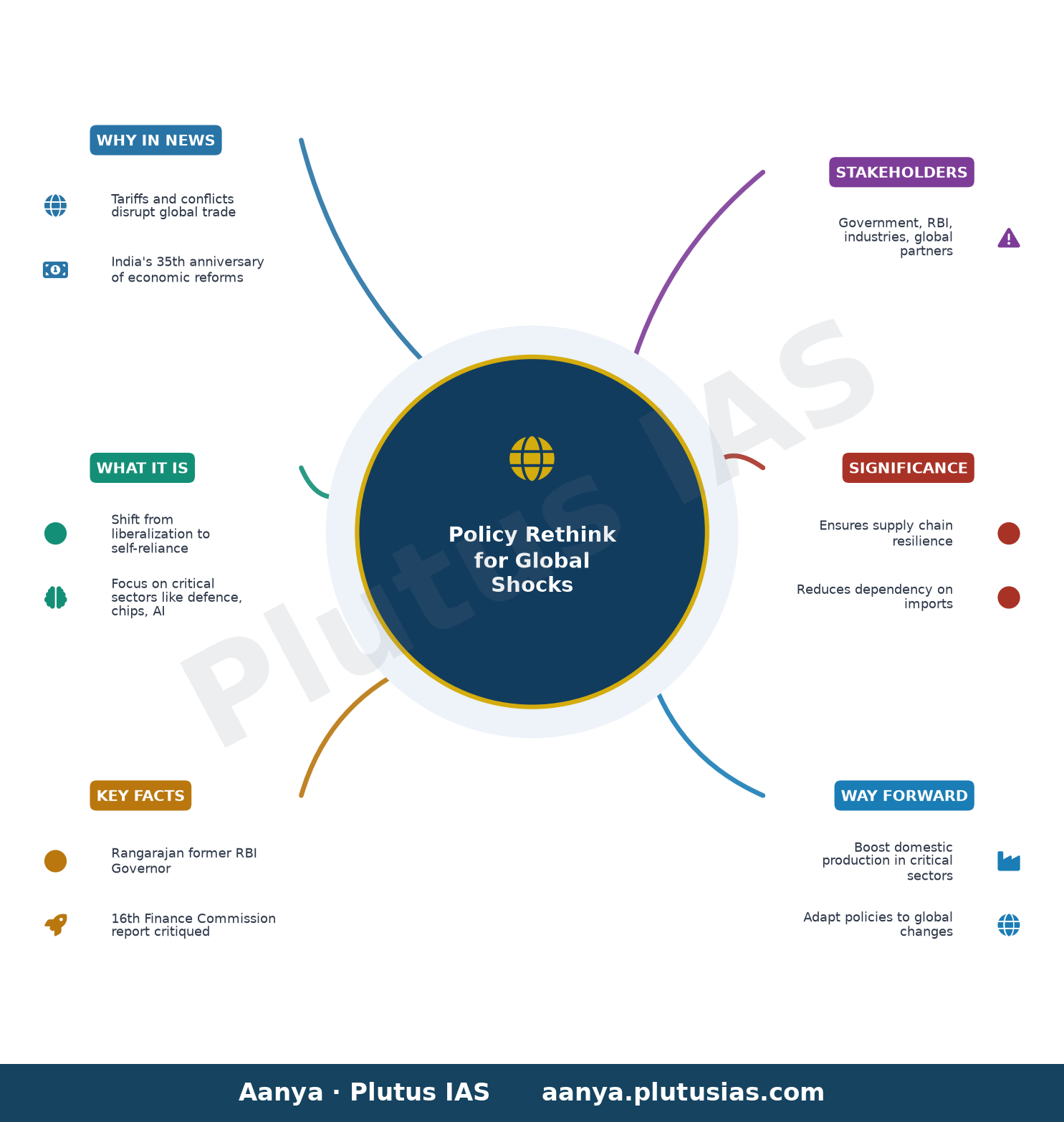
✎ India must balance liberalisation with self-reliance amid global disruptions.
Relevance for Banking, SSC & RBI Grade B exams: Polity & Governance
C. Rangarajan, former RBI Governor, has emphasized the need for a policy rethink amid rising global conflicts and the imposition of tariffs, which pose significant challenges to India’s economic liberalization. Speaking at a lecture marking 35 years of India’s New Economic Policy, he highlighted that external shocks, rather than domestic weaknesses, are driving current economic difficulties. Rangarajan argued that India must prioritize domestic production in critical sectors like defense, semiconductors, and artificial intelligence, even if it means deviating from traditional liberalization principles. This shift is necessary to adapt to the changing global landscape, where geopolitical tensions and trade barriers are reshaping economic strategies.
For banking and SSC aspirants, this underscores the importance of understanding how geopolitical factors influence economic policies and financial stability. RBI Grade B candidates should note how such external shocks can impact monetary policy, inflation, and trade dynamics. The discussion also ties into broader governance themes, relevant for UPSC and state PSC exams, where questions on economic reforms, protectionism, and strategic autonomy are increasingly common. Aspirants must grasp the balance between liberalization and self-reliance in India’s evolving economic framework.
Source: The Hindu
Generated by AanyaAi for educational purpose.
