
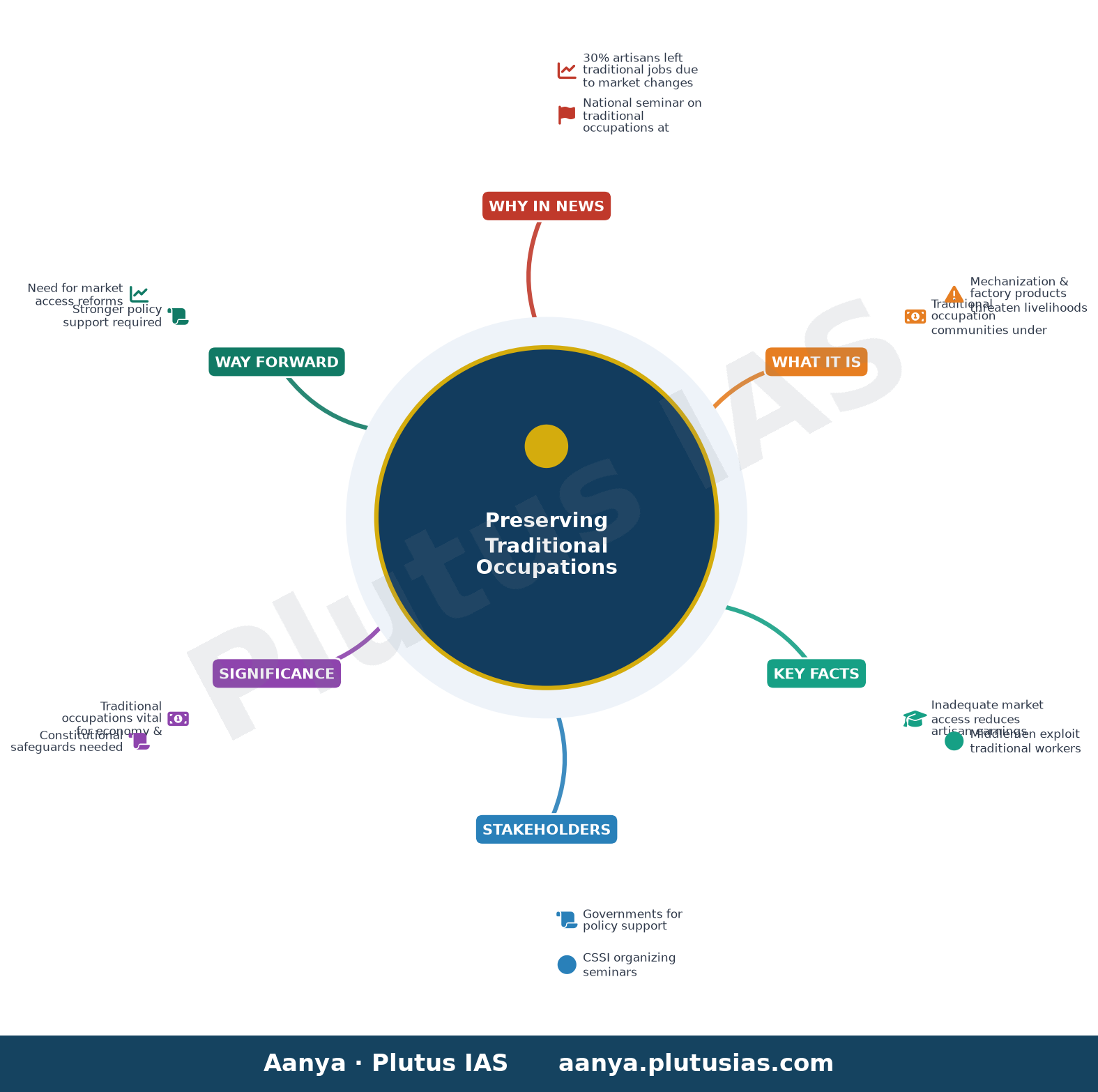
✎ Traditional occupations need policy support, market access, and constitutional safeguards to survive economic and social challenges.
Relevance for Banking, SSC & RBI Grade B exams: Polity & Governance
A two-day national seminar on *Traditional Occupation Communities in a Changing Economy* highlighted the urgent need for policy interventions to protect India’s traditional livelihoods, as mechanisation, factory-made products, and market distortions threaten artisans’ survival. Speaking at Andhra University’s Centre for Study of Social Inclusion (CSSI)-organised event, VIT-AP School of Law Dean Benarji Chakka noted that nearly 30% of artisans had abandoned their trades due to shrinking market access and middlemen exploitation, while social discrimination further marginalised these communities. The seminar underscored that governments must play a proactive role—not just through welfare schemes but by ensuring fair wages, market linkages, and constitutional safeguards—to sustain these occupations that are vital to India’s cultural and economic fabric.
For banking and SSC aspirants, this issue ties into broader themes like inclusive growth, rural development, and policy interventions, which are frequently tested in exams. The Reserve Bank of India (RBI) and financial institutions often assess candidates on their understanding of socio-economic challenges, making awareness of traditional sector vulnerabilities relevant for policy-related questions. Similarly, SSC exams, including the CGL and CHSL, may feature questions on government schemes, constitutional provisions, or economic surveys, where the preservation of traditional occupations could be cited as a case study in sustainable development or social justice.
Source: The Hindu
Generated by AanyaAi for educational purpose.
