
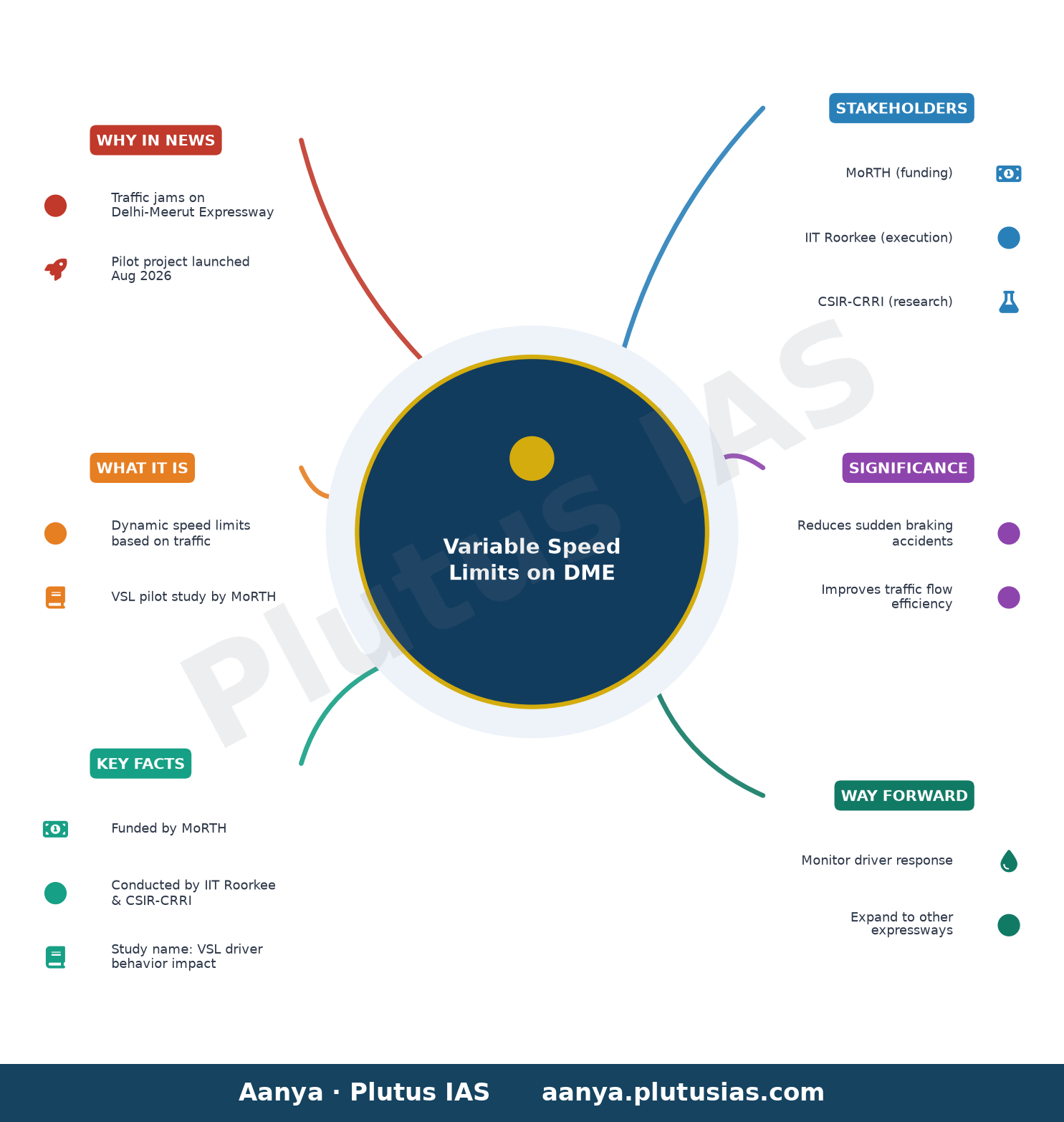
✎ Variable Speed Limits on DME aim to optimize traffic flow and reduce accidents by dynamically adjusting speed based on real-time congestion.
Relevance for Banking, SSC & RBI Grade B exams: Polity & Governance
The Delhi-Meerut Expressway (DME) is set to implement a pilot project under the Ministry of Road Transport and Highways (MoRTH), introducing **Variable Speed Limits (VSL)** to dynamically adjust speed restrictions based on real-time traffic conditions. Unlike fixed speed limits, this system will use sensors and cameras to monitor congestion, weather, and vehicle density, automatically updating electronic signboards to reduce speeds during peak hours or jams and restore them when conditions improve. The study, led by IIT Roorkee and CSIR-CRRI, aims to enhance traffic flow, reduce sudden braking incidents, and improve road safety—a model already successful in countries like the US, UK, and Germany. For banking and SSC aspirants, this reflects **governance innovation in public infrastructure**, highlighting the government’s focus on **smart mobility solutions** and **data-driven policymaking**, key themes in exams like RBI Grade B (economic governance) and SSC CGL (current affairs).
The project’s phased evaluation—monitoring average speeds, congestion levels, and driver behavior at 30, 90, and 120 days—could pave the way for nationwide adoption if successful. For banking exams, this underscores the **intersection of technology and governance**, a critical area in **Polity & Governance** (e.g., digital public infrastructure). SSC aspirants should note how such initiatives align with **sustainable urban development** and **traffic management policies**, often tested in descriptive papers. The pilot also ties to broader themes like **road safety** and **MoRTH’s role in policy implementation**, making it relevant for **RBI Grade B’s economic and social development sections**.
Source: amarujala.com
Generated by AanyaAi for educational purpose.
