
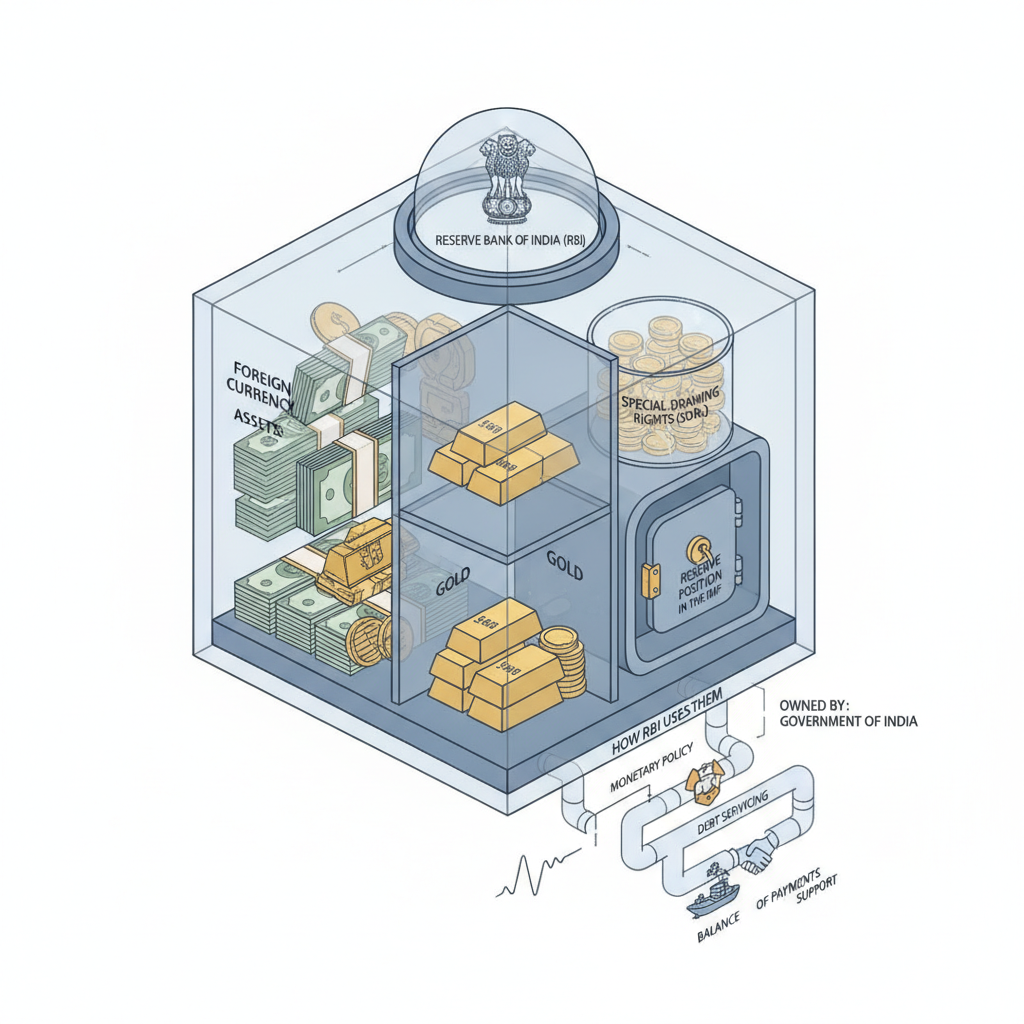
✎ Forex reserves are RBI's external asset pool ensuring rupee stability and external payment security, crucial for UPSC aspirants.
Relevance for Banking, SSC & RBI Grade B exams: Economy
India’s foreign exchange (forex) reserves are a critical component of the country’s economic stability, often making headlines during periods of currency volatility, rising oil prices, or global financial uncertainty. As of July 31, 2026, India’s forex reserves stood at approximately $692.87 billion, though this figure fluctuates due to market movements, gold price changes, and interventions by the Reserve Bank of India (RBI). For banking and competitive exam aspirants, understanding forex reserves is essential as it bridges multiple economic concepts—external sector management, exchange rate dynamics, balance of payments, and monetary policy—which frequently appear in Bank PO, IBPS, SBI, RBI Grade B, and SSC examinations. The reserves act as a financial cushion, ensuring India can meet its international payment obligations, stabilize the rupee, and maintain investor confidence during external shocks.
The composition of India’s forex reserves includes Foreign Currency Assets (FCA), gold, Special Drawing Rights (SDRs), and the Reserve Tranche Position (RTP) in the IMF, each serving distinct purposes. The RBI prioritizes safety and liquidity over high returns when managing these reserves, as they may be urgently needed during crises. For exam purposes, candidates should note that while the government sets the policy framework, the RBI holds and manages these reserves under the Reserve Bank of India Act, 1934, and the Foreign Exchange Management Act (FEMA), 1999. This distinction is vital for questions on fiscal-monetary interactions and institutional roles in competitive exams, where conceptual clarity on forex reserves can directly impact scores in economy-related sections.
Source: Times of India
Generated by AanyaAi for educational purpose.
