
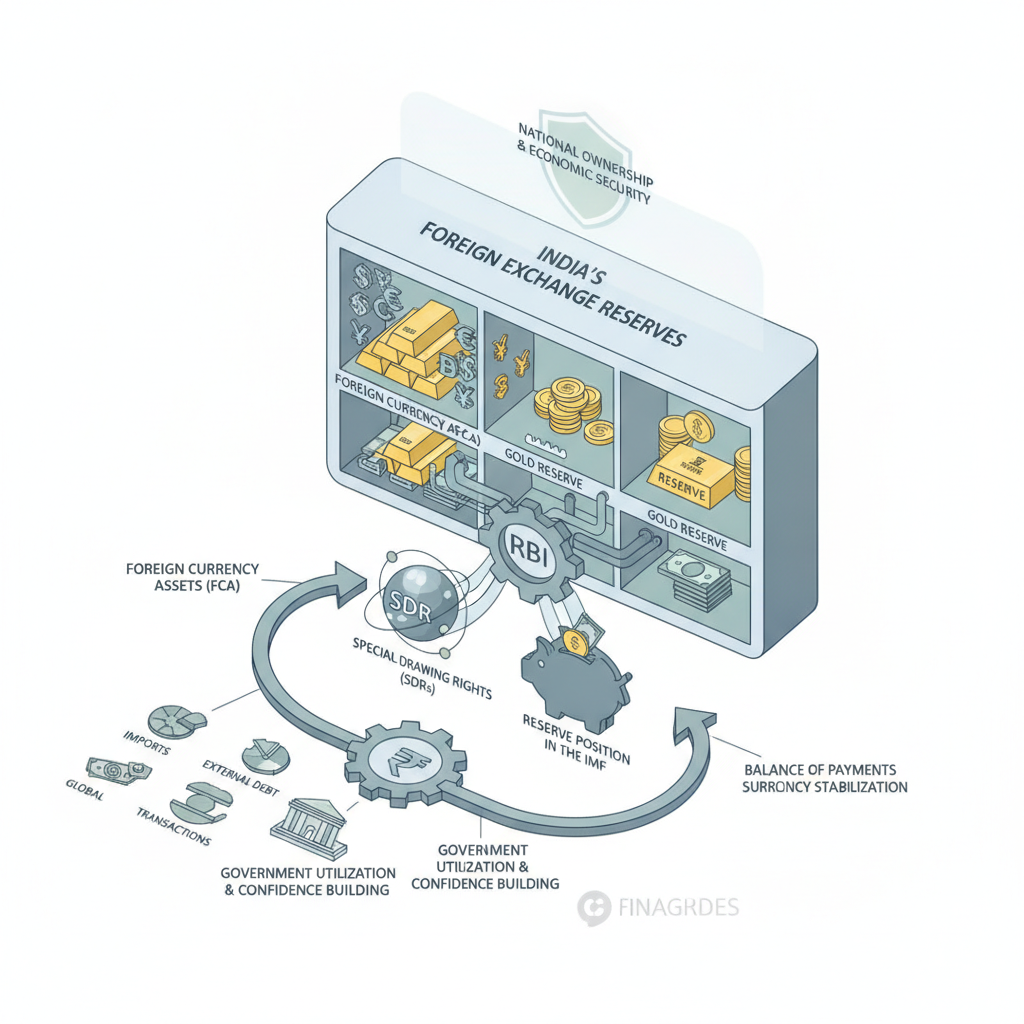
✎ Forex reserves are RBI-managed buffers safeguarding India's external sector stability and rupee value.
Relevance for Banking, SSC & RBI Grade B exams: Economy
India’s foreign exchange reserves are a critical component of the country’s economic stability, often making headlines during currency fluctuations, oil price volatility, or global financial turbulence. These reserves, currently standing at around $692.87 billion as of July 31, 2026, are managed by the Reserve Bank of India (RBI) and serve as a financial cushion to meet international payment obligations and intervene in foreign exchange markets when necessary. For banking and SSC aspirants, understanding the composition and management of these reserves is essential, as it directly impacts monetary policy, exchange rate stability, and India’s balance of payments—key areas frequently tested in competitive exams. The RBI’s reserves comprise foreign currency assets, gold, Special Drawing Rights (SDRs), and the Reserve Tranche Position (RTP) in the IMF, each playing a distinct role in maintaining liquidity and confidence in the rupee. For RBI Grade B candidates, this topic is particularly relevant as it ties into broader macroeconomic policies, including inflation control, liquidity management, and India’s external sector performance, all of which are pivotal in the exam’s economic and financial awareness sections.
The distinction between who owns these reserves and how they are utilized is crucial for exam preparation. Unlike a government fund, India’s forex reserves are assets on the RBI’s balance sheet, governed by the Reserve Bank of India Act, 1934, and the Foreign Exchange Management Act (FEMA), 1999. This legal framework ensures that the reserves are managed prudently, prioritizing safety and liquidity over speculative returns. For banking aspirants, this underscores the RBI’s role in safeguarding financial stability, a concept tested in exams like IBPS and SBI PO, where questions on central bank functions and forex management are common. SSC candidates, particularly in the General Awareness section, may encounter questions on the components of forex reserves or their impact on the economy, making this topic a strategic addition to their study plan. The interplay between these reserves, global market dynamics, and domestic economic policies also highlights their significance in shaping India’s economic resilience, a theme that resonates across multiple competitive exam syllabi.
Source: Times of India
Generated by AanyaAi for educational purpose.
