✎ Parliamentary panel recommends digital, inclusive, and sustainable bus transport policies with clear timelines for implementation.
Relevance for Banking, SSC & RBI Grade B exams: Economy/Governance
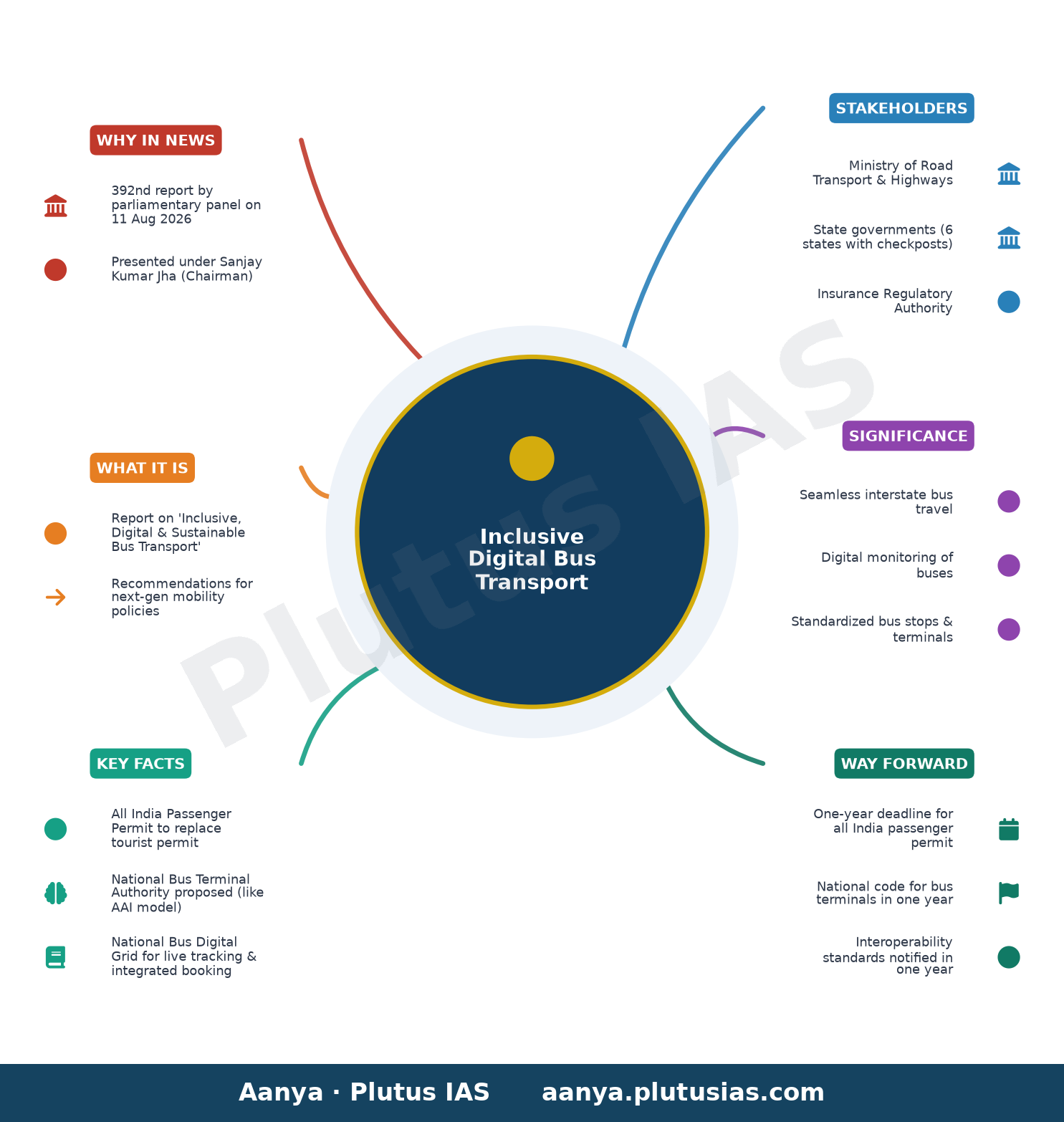
The Parliamentary Standing Committee on Transport, Tourism and Culture, chaired by Rajya Sabha MP Sanjay Kumar Jha, recently submitted its 392nd report titled *“Enabling Inclusive, Digital and Sustainable Bus Transport: Policies, Regulations and Public-Private Partnerships for Next-Generation Mobility”*. The report, adopted on 6 August 2026, outlines critical recommendations to modernise India’s bus transport ecosystem, including the replacement of All-India Tourist Permits with a unified All-India Passenger Permit system, the establishment of a National Bus Terminal Authority on the lines of the Airport Authority of India, and the creation of a National Bus Digital Grid for real-time tracking and integrated booking. These reforms are crucial for improving operational efficiency, enhancing passenger safety, and promoting eco-friendly mobility—key areas often tested in banking and SSC exams under governance and infrastructure segments.
For banking aspirants preparing for exams like SBI PO, RBI Grade B, and IBPS, the report’s focus on digital integration, public-private partnerships (PPP), and regulatory frameworks aligns with themes tested in economic surveys and governance sections. The emphasis on standardised terminals, digital monitoring, and safety certifications reflects broader trends in infrastructure financing and policy implementation, which are frequently cited in RBI and SSC examinations. Similarly, SSC aspirants may encounter questions on transport policies, fiscal allocations for public infrastructure, or inter-state coordination—all directly addressed in the report’s recommendations on budgetary provisions and state-wise rankings. The proposal for a dedicated terminal authority and digital tracking systems also underscores the importance of technology-driven governance, a recurring topic in current affairs for competitive exams.
Source: PIB (Press Information Bureau)
Generated by AanyaAi for educational purpose.
