
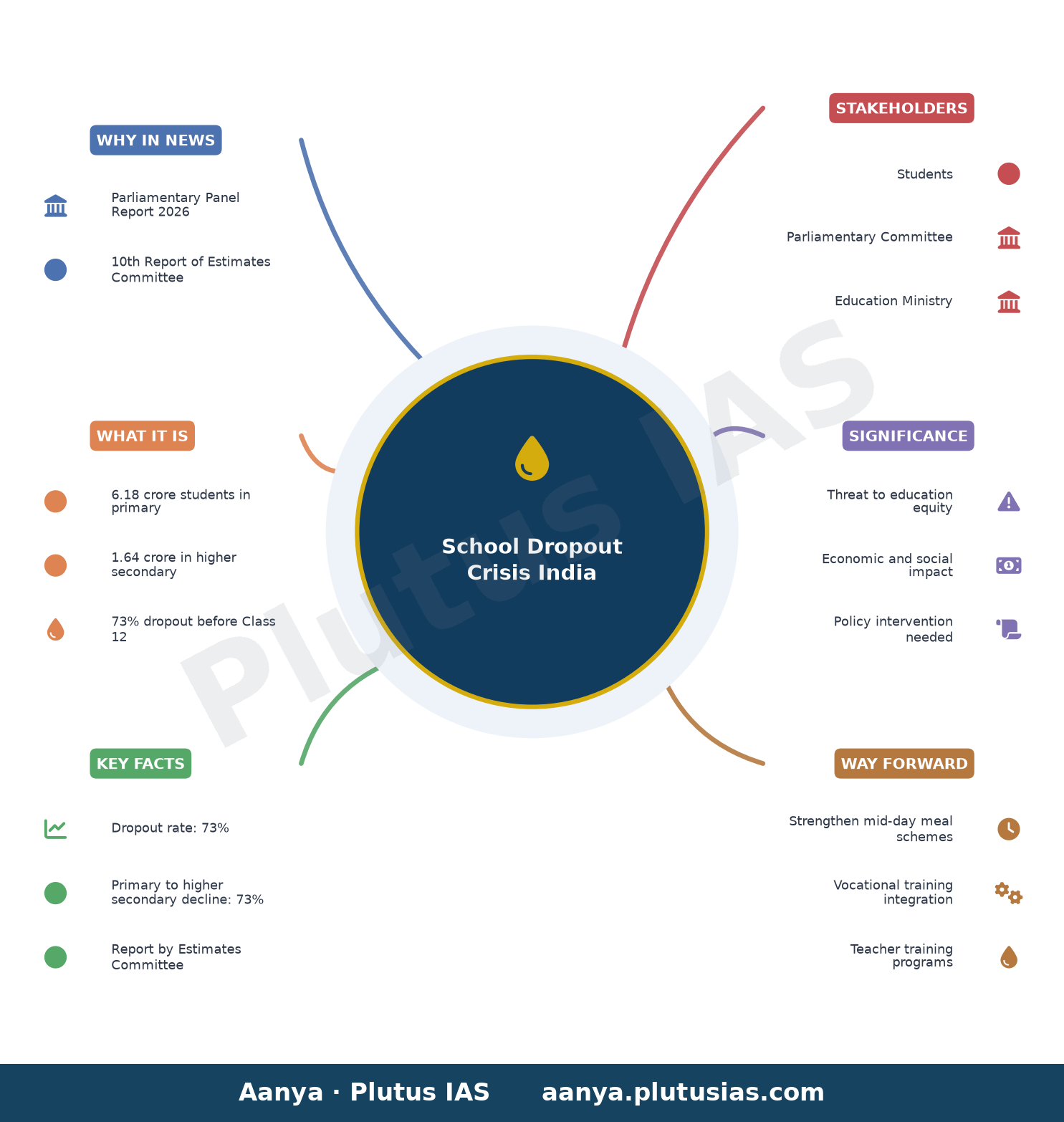
✎ 73% Indian students drop out before higher secondary, demanding urgent policy reforms to ensure education continuity.
Relevance for Banking, SSC & RBI Grade B exams: Economy/Governance
A parliamentary panel report has highlighted a severe dropout crisis in India’s school education system, revealing that while 6.18 crore students are enrolled at the primary level, the number plummets to just 1.64 crore by higher secondary education. The report, presented in the Lok Sabha, indicates that 73% of students drop out before completing higher secondary education, exposing systemic gaps in access, infrastructure, and policy implementation. The committee found that secondary and higher secondary schools are significantly fewer in number compared to primary schools, with most government-run institutions catering only up to primary levels. This disproportionate decline, especially among marginalized groups, raises concerns about equitable educational opportunities and long-term human capital development.
For banking and financial services aspirants, this data underscores the need for inclusive growth policies and targeted social sector investments, as a poorly educated workforce limits economic productivity and financial inclusion. SSC and RBI Grade B exams often test knowledge of government schemes, budget allocations, and socio-economic indicators; understanding such reports helps candidates analyze policy gaps and their macroeconomic implications. The committee’s recommendations—like upgrading existing schools to higher secondary levels and improving infrastructure for children with special needs—align with broader goals of skill development and poverty alleviation, making this a critical governance issue for competitive exams.
Source: amarujala.com
Generated by AanyaAi for educational purpose.
