
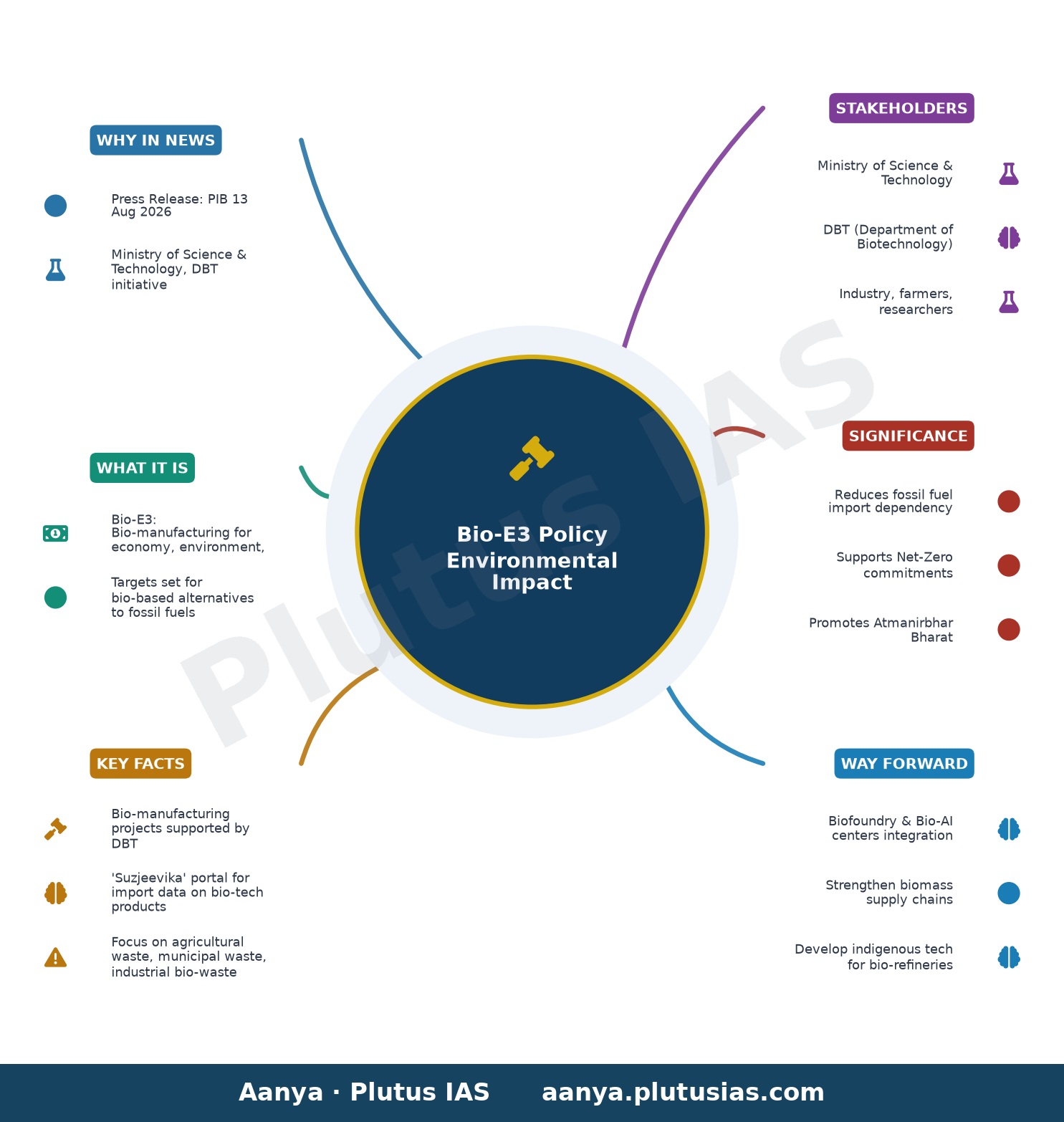
✎ Bio-E3 policy leverages biotechnology to replace fossil fuels, boost economy, and meet climate goals through sustainable bio-manufacturing.
Relevance for Banking, SSC & RBI Grade B exams: Polity & Governance
The Department of Biotechnology (DBT), under the Ministry of Science and Technology, has outlined measurable targets under the Bio-E3 (Biotechnology for Economy, Environment, and Employment) policy to promote bio-manufacturing solutions that replace fossil-based raw materials with bio-based alternatives. The policy focuses on scaling up technologies, improving yields, and enhancing technological readiness to reduce import dependence on fossil-derived chemicals, fuels, and materials. The DBT’s digital portal ‘Sujeevika’ tracks import data to identify indigenous bio-based products, aligning with the ‘Atmanirbhar Bharat’ initiative while advancing circular economy principles and sustainability in manufacturing. These initiatives are particularly relevant for banking and finance aspirants, as they highlight India’s push for self-reliance in critical sectors, which can influence credit policies, investment frameworks, and risk assessments in financial institutions.
For SSC and RBI Grade B examinations, the Bio-E3 policy underscores India’s commitment to reducing carbon emissions and achieving net-zero targets through bio-manufacturing innovations. Key initiatives include converting agricultural residues, municipal organic waste, and industrial bio-waste into advanced fuels, chemicals, and materials, supported by indigenous technologies like biomass pre-treatment, bio-catalysts, and integrated bio-refineries. Such policies reflect broader environmental governance trends that aspirants must understand, as they impact regulatory frameworks, sustainable development goals, and economic policies—areas frequently tested in competitive exams. The policy’s emphasis on circular economy principles and indigenous clean technologies also aligns with global sustainability agendas, making it a critical topic for current affairs preparation.
Source: PIB (Press Information Bureau)
Generated by AanyaAi for educational purpose.
