✎ ICP 2.0 enhances digital access to India's cultural heritage via AI, multilingual support, and multi-device compatibility.
Relevance for Banking, SSC & RBI Grade B exams: Art & Culture
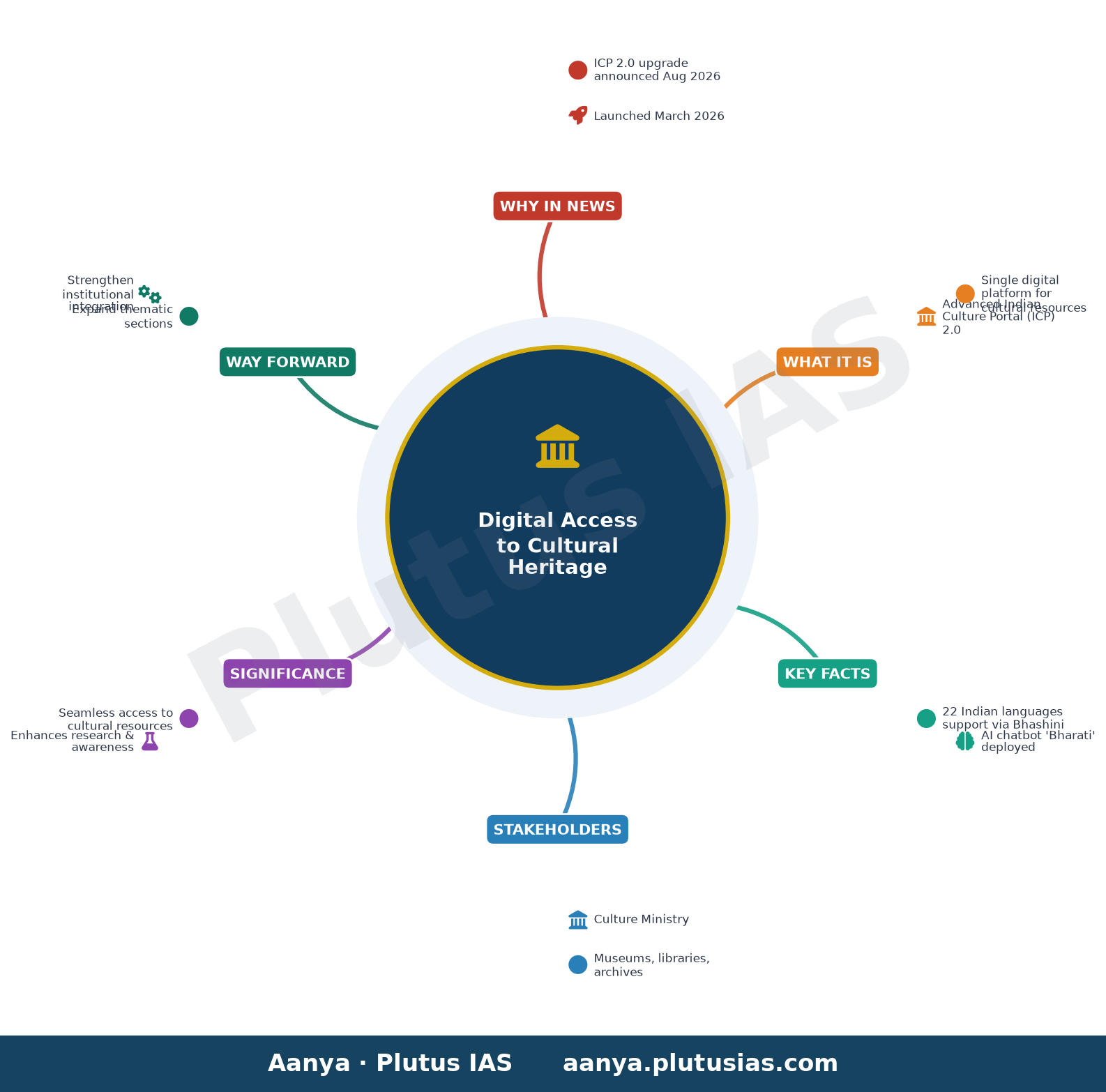
The Union Ministry of Culture has taken a significant step to enhance digital access to India’s cultural heritage through the Advanced Indian Culture Portal (ICP) 2.0, launched in March 2026. The revamped portal, built on a modern, scalable and secure architecture, integrates advanced search capabilities, multilingual support across 22 Indian languages via the Bhashini platform, AI-enabled chatbot Bharati for intelligent content discovery, and Progressive Web App (PWA) functionality for seamless access across devices. By aggregating digital resources from museums, libraries, archives and other cultural institutions under the Ministry, the portal serves as a unified search platform aimed at preserving heritage and promoting wider public engagement. Its responsive design, metadata-based search tools and thematic collections not only facilitate research for students and scholars but also support teachers and the general public in exploring India’s tangible and intangible cultural assets virtually.
For banking, SSC and RBI Grade B examinations, this initiative reflects the government’s emphasis on leveraging technology for inclusive growth and digital governance. Questions may arise on how such portals contribute to cultural preservation, ease of access and public participation, or their role in supporting research and education—key themes relevant to economic and social development. The portal’s integration with multiple cultural institutions and use of AI-driven tools could also be linked to broader topics like digital public infrastructure, multilingual empowerment and data-driven governance, which are increasingly featured in current affairs sections of competitive exams.
Source: PIB (Press Information Bureau)
Generated by AanyaAi for educational purpose.
