
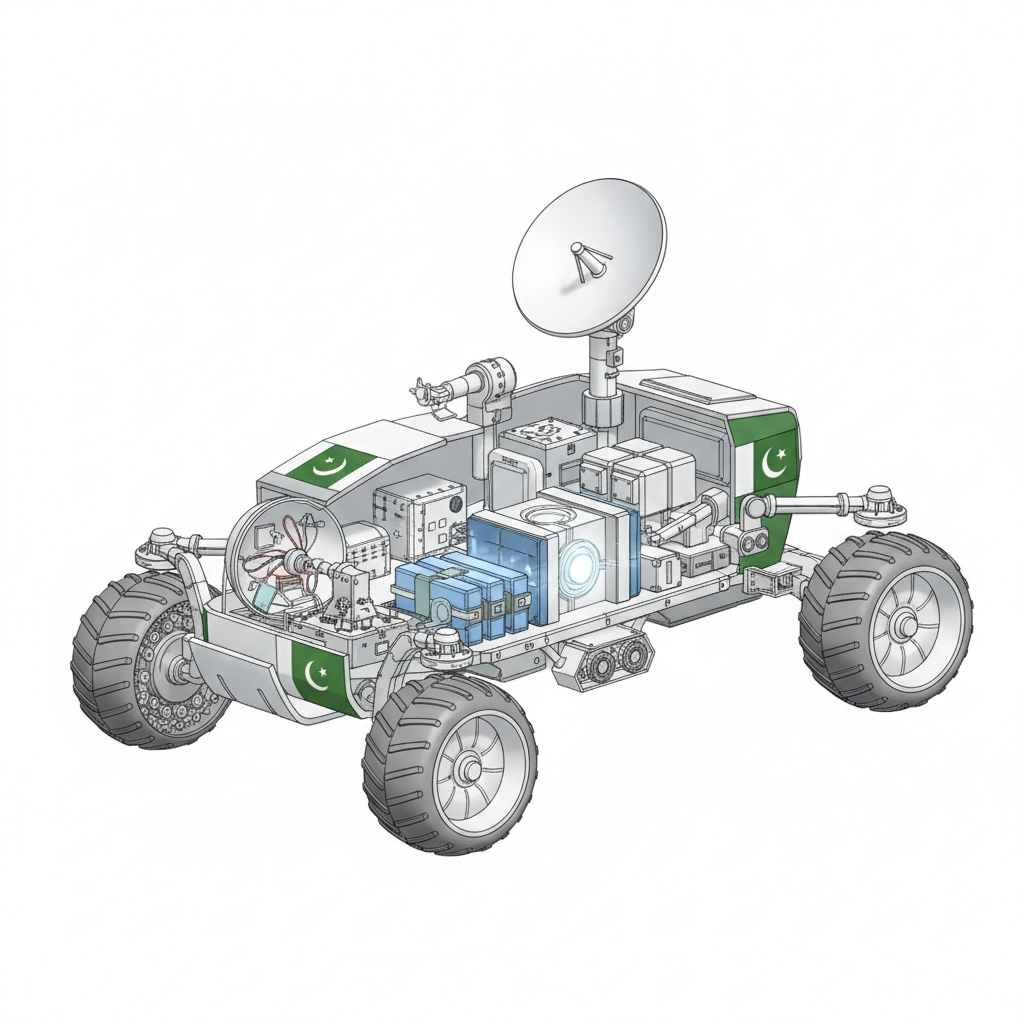
 Jinnah-1 roverPlasma sensorRadiation detectorGeology instruments
✎ Pakistan’s Jinnah-1 rover, part of China’s 2029 Chang’e-8 mission, marks a milestone in lunar south pole exploration and indigenous space tech.
Relevance for Banking, SSC & RBI Grade B exams: Polity & Governance
Pakistan’s space agency, Suparco, has announced its first lunar rover, *Jinnah-1*, which will be part of China’s Chang’e-8 mission scheduled for 2029. The rover, named after Pakistan’s founder Muhammad Ali Jinnah, will study lunar plasma, radiation, and geology at the Moon’s south pole—a region of strategic interest due to potential water ice deposits and future human exploration. This collaboration highlights Pakistan’s growing role in global space exploration, aligning with China’s broader lunar ambitions. For banking and competitive exams like IBPS, SBI, and SSC, such developments underscore the importance of international cooperation in science and technology, a recurring theme in current affairs sections. The mission also reflects the geopolitical dynamics of space exploration, where emerging economies like Pakistan are leveraging partnerships to advance their technological capabilities.
The *Jinnah-1* rover, weighing around 35 kg, will carry instruments to analyze lunar soil, radiation, and terrain, contributing to China’s broader goals of testing 3D printing with lunar regolith for future base construction. This aligns with India’s recent success with Chandrayaan-3 and NASA’s Artemis programme, all targeting the Moon’s south pole. For RBI Grade B and SSC aspirants, questions on space missions, international collaborations, and their economic or strategic implications are common. Understanding such missions helps in analyzing how technological advancements in space exploration can impact sectors like defense, telecommunications, and global diplomacy—key areas often tested in these exams.
Source: Times of India
Generated by AanyaAi for educational purpose.
