
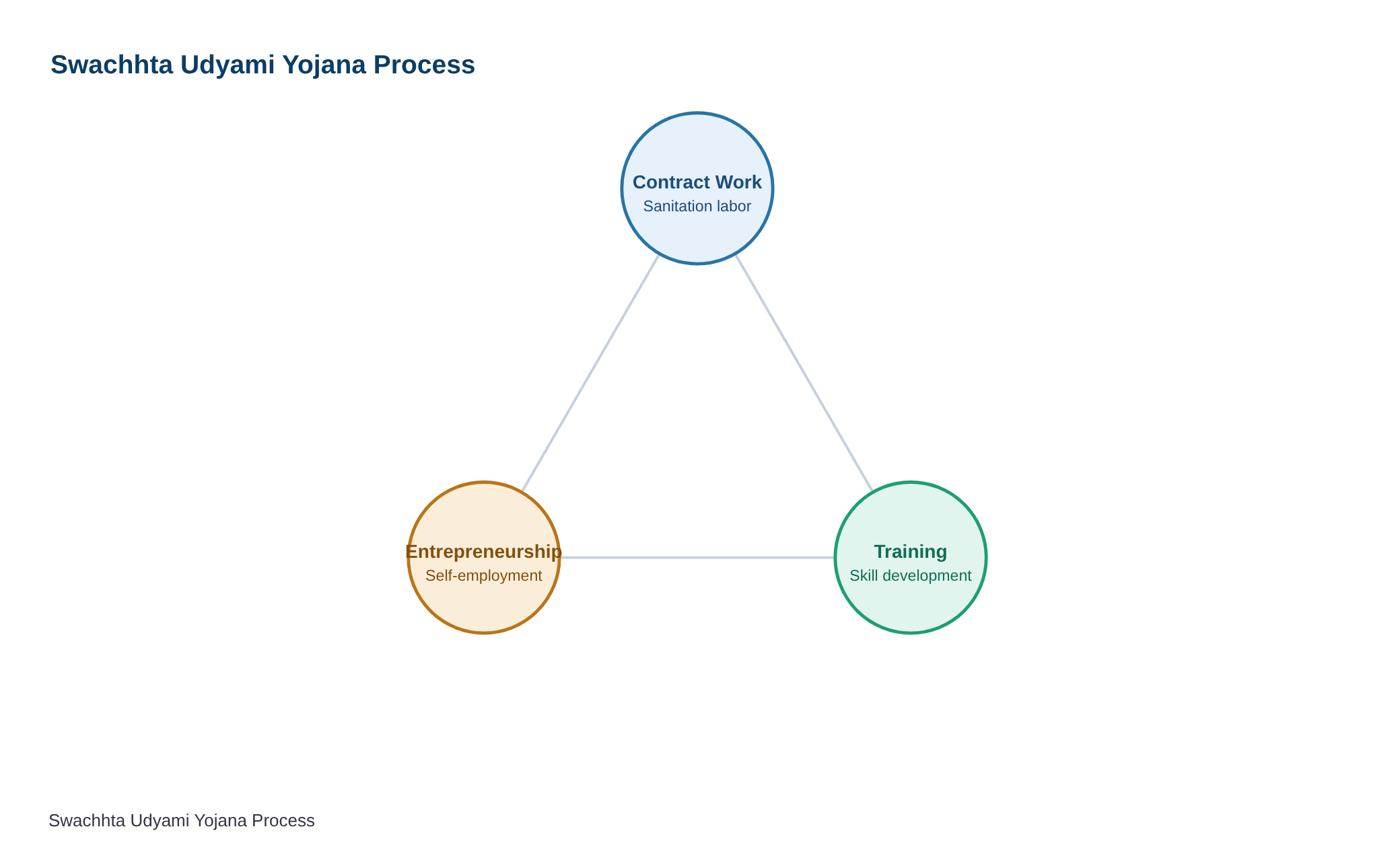
✎ SUY under NAMASTE empowers contractual sanitation workers with loans and subsidies to transition to self-employment.
Relevance for Banking, SSC & RBI Grade B exams: Polity & Governance
The **Swachhta Udyami Yojana (SUY)**, a component of the **NAMASTE (National Action for Mechanized Sanitation Ecosystem)** scheme under the Ministry of Social Justice and Empowerment, has emerged as a transformative initiative for sanitation workers like Satish Kumar from Ghaziabad, Uttar Pradesh. Before availing SUY’s financial assistance, Satish earned a meagre ₹13,000–15,000 per month as a contractual sanitation worker, struggling to meet household expenses or save for the future. Limited income and lack of access to mechanized equipment trapped him in a cycle of financial instability. However, through SUY, he secured a ₹5.91 lakh loan from Canara Bank and a ₹3.64 lakh capital subsidy from the National Safai Karamchari Finance and Development Corporation (NSKFDC), enabling him to purchase a sewer suction machine. This shift from contractual labor to self-employment boosted his monthly earnings to ₹50,000, with savings of ₹25,000 after expenses, significantly improving his economic security and family well-being. The scheme’s model—combining timely credit access with mechanization support—highlights its role in fostering entrepreneurship among marginalized sanitation workers, aligning with broader goals of inclusive growth and skill development.
For banking and SSC aspirants, Satish Kumar’s case underscores the **policy-practice nexus** in governance, particularly how schemes like SUY address structural barriers (e.g., credit constraints, skill gaps) to empower vulnerable sections. RBI Grade B candidates should note the **financial inclusion** aspect, where targeted subsidies (e.g., NSKFDC’s support) and bank loans mitigate risks for low-income borrowers, reflecting the central bank’s mandate to promote equitable credit access. For SSC exams, the example illustrates **government welfare schemes** (NAMASTE/SUY) as tools for socio-economic upliftment, while banking exams may test knowledge of **priority sector lending** or **subsidized credit schemes** for marginalized groups. The case also ties to broader themes like **sustainable livelihoods** and **entrepreneurship development**, relevant for both prelims and mains in these examinations.
Source: PIB (Press Information Bureau)
Generated by AanyaAi for educational purpose.
