
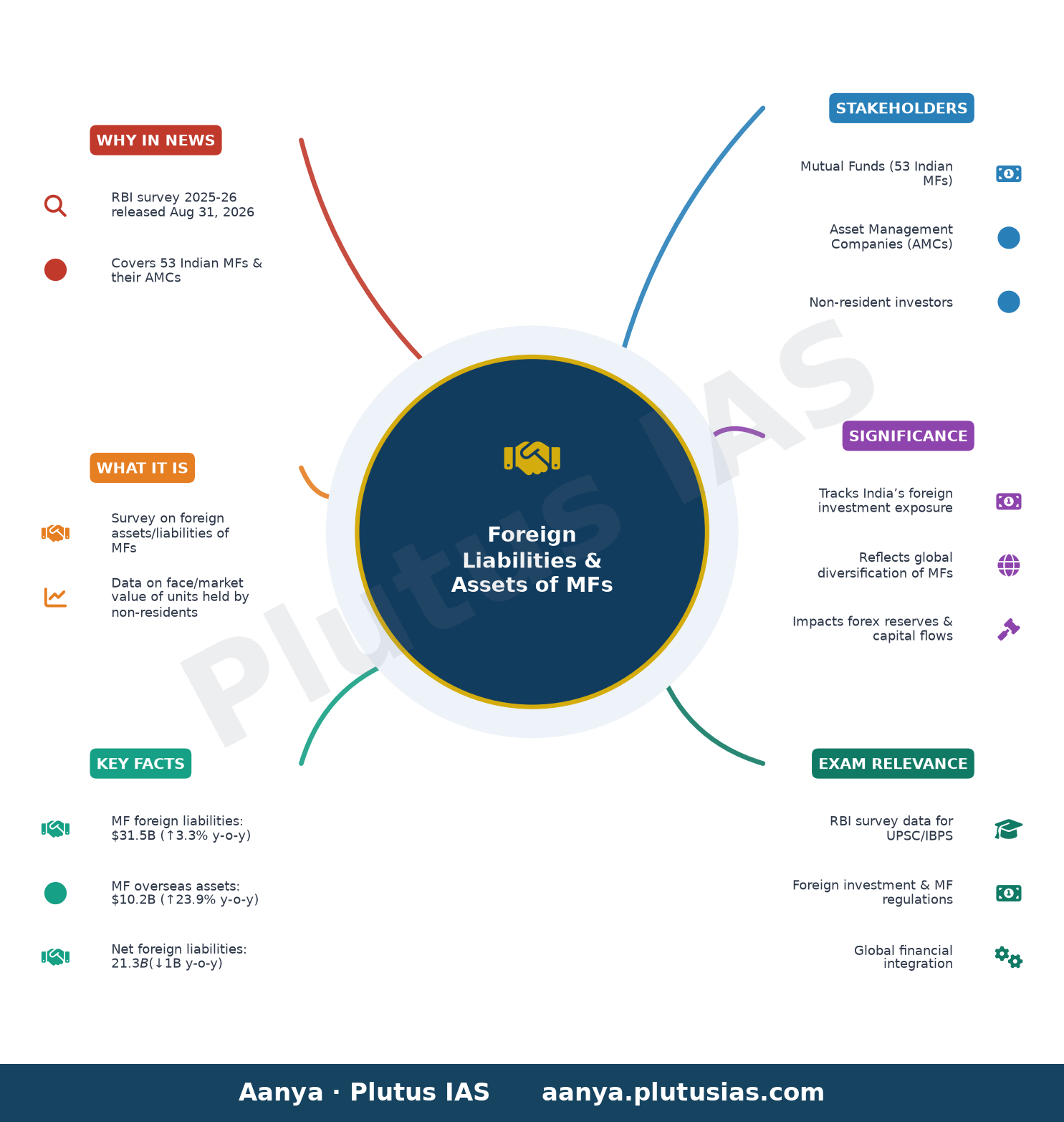
✎ MF foreign liabilities rose 3.3% to $31.5B while overseas assets surged 23.9% to $10.2B in 2025-26, reducing net foreign liabilities to $21.3B.
Relevance for Banking, SSC & RBI Grade B exams: Economy/Governance
The Reserve Bank of India’s *Survey of Foreign Liabilities and Assets of Mutual Funds – 2025-26* provides critical insights into the evolving cross-border financial exposure of India’s mutual fund (MF) industry, making it highly relevant for banking, SSC, and RBI Grade B exam aspirants. The survey highlights a 3.3% year-on-year increase in MF foreign liabilities to $31.5 billion, driven by higher market valuations of units held by non-residents, while overseas assets surged 23.9% to $10.2 billion, reflecting increased holdings of foreign equities. This data is crucial for understanding India’s balance of payments dynamics, capital flows, and the role of MFs in global asset allocation—key themes often tested in financial awareness sections of competitive exams. For banking aspirants, the survey underscores the interconnectedness of domestic financial institutions with global markets, a topic frequently examined in RBI Grade B’s economic and social issues sections, where questions on foreign investments, currency risks, and regulatory oversight are common.
For SSC and banking exams, the survey’s breakdown of top investment destinations—like the UAE, US, UK, and Singapore—offers a practical lens to analyze geopolitical and economic trends affecting India’s financial sector. The 37.5% rise in overseas equity investments by MFs, concentrated in the US, Luxembourg, and Ireland, aligns with broader discussions on diversification of foreign reserves and the impact of global monetary policies on Indian investors. Such insights are invaluable for framing answers in descriptive papers or group discussions, where candidates are expected to link macroeconomic indicators to real-world financial trends. The survey’s provisional nature and RBI’s role in data compilation also reflect the importance of regulatory frameworks in managing capital flows, a recurring subject in governance and economic governance segments of competitive exams.
Source: RBI
Generated by AanyaAi for educational purpose.
