✎ Dewas’s zero heritage waste success under SBM-U 2.0 showcases scientific waste management and collaborative governance.
Relevance for Banking, SSC & RBI Grade B exams: Polity & Governance
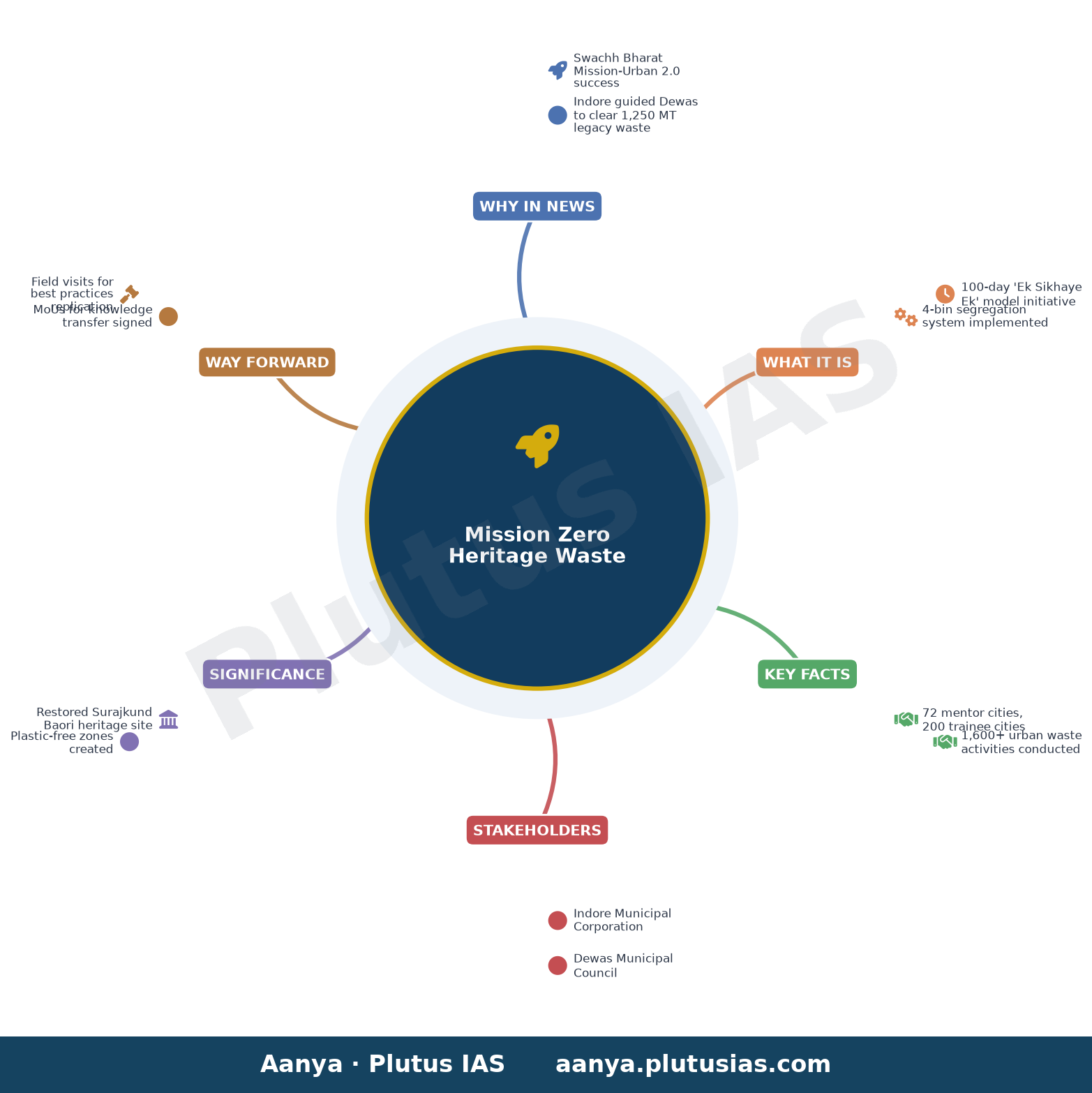
The successful elimination of 1,250 tonnes of legacy waste in Depalpur through a rigorous four-bin waste segregation system exemplifies how structured governance and community participation can transform urban waste management. This achievement, guided by Indore Municipal Corporation under the Swachh Shahr Jodi initiative, underscores the role of scientific precision and leadership in achieving zero legacy waste—a key objective of Swachh Bharat Mission-Urban 2.0. The initiative’s structured 100-day guidance program, based on the ‘ek seekhaye ek’ model, facilitated knowledge transfer between 72 mentor cities and 200 apprentice cities, demonstrating how capacity-building and best practices can bridge gaps in solid waste management (SWM) and urban waste management (UWM). For banking and SSC aspirants, this highlights the importance of policy implementation, inter-governmental collaboration, and sustainable urban development—critical themes in governance and public administration exams. RBI Grade B candidates should note how such waste management reforms align with broader financial inclusion goals by improving public health and environmental sustainability, which are prerequisites for economic stability and long-term growth.
The Depalpur model’s success—marked by 4.5 tonnes of recyclable material recovery and 50-60 tonnes of waste-derived fuel (RDF) repurposed for cement plants—illustrates the economic viability of circular economy principles in urban governance. This case study is particularly relevant for banking exams, where questions on sustainable finance, ESG (Environmental, Social, and Governance) criteria, and public-private partnerships often feature. For SSC aspirants preparing for polity and governance sections, the initiative serves as a practical example of how flagship missions like SBM-U 2.0 integrate grassroots participation with top-down policy execution. RBI Grade B candidates may draw parallels between such waste management successes and the central bank’s role in promoting green finance, as clean urban environments reduce systemic risks and enhance productivity. The transformation of a former dumpsite into a community space further underscores the socio-economic multiplier effects of effective governance, a concept increasingly tested in competitive exams.
Source: PIB (Press Information Bureau)
Generated by AanyaAi for educational purpose.
