
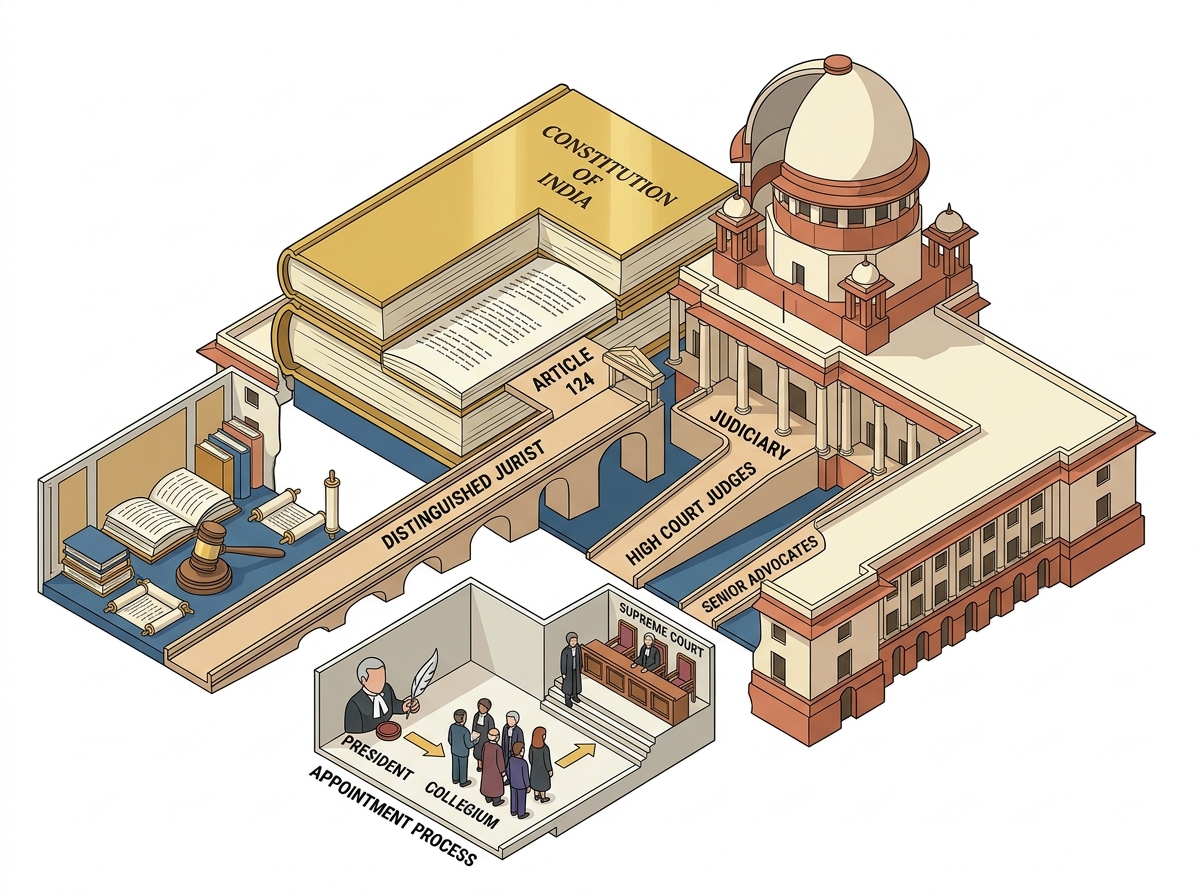
✎ Article 124(3) allows Supreme Court appointments of distinguished jurists, but the clause remains unused for 76+ years despite constitutional intent.
Relevance for Banking, SSC & RBI Grade B exams: Polity
The Constitution of India, under Article 124(3), provides three pathways for appointing Supreme Court judges: serving as a High Court judge for at least five years, practising as an advocate in a High Court for at least 10 years, or being a “distinguished jurist” as per the President’s opinion. While the provision explicitly allows jurists—such as legal academics—to be appointed, it has never been used in the 76-year history of the Supreme Court. Justice Ujjal Bhuyan recently highlighted this underutilised clause, questioning why no legal scholar has been elevated despite its inclusion in the Constitution. The framers of the Constitution intended this route to diversify judicial expertise, drawing inspiration from global examples like Felix Frankfurter, a Harvard law professor appointed to the U.S. Supreme Court in 1939. However, concerns persist about the practical challenges jurists might face, including limited courtroom experience and procedural familiarity, which could hinder their judicial functioning.
For banking and SSC examinations, this provision is relevant as it tests knowledge of constitutional provisions and judicial appointments, a recurring theme in polity sections. For RBI Grade B aspirants, understanding the balance between judicial expertise and practical experience in appointments can be crucial for questions on governance and institutional frameworks. The provision also underscores the importance of constitutional flexibility in judicial appointments, a concept often examined in competitive exams to assess candidates’ grasp of constitutional amendments and historical debates.
Source: The Hindu
Generated by AanyaAi for educational purpose.
