
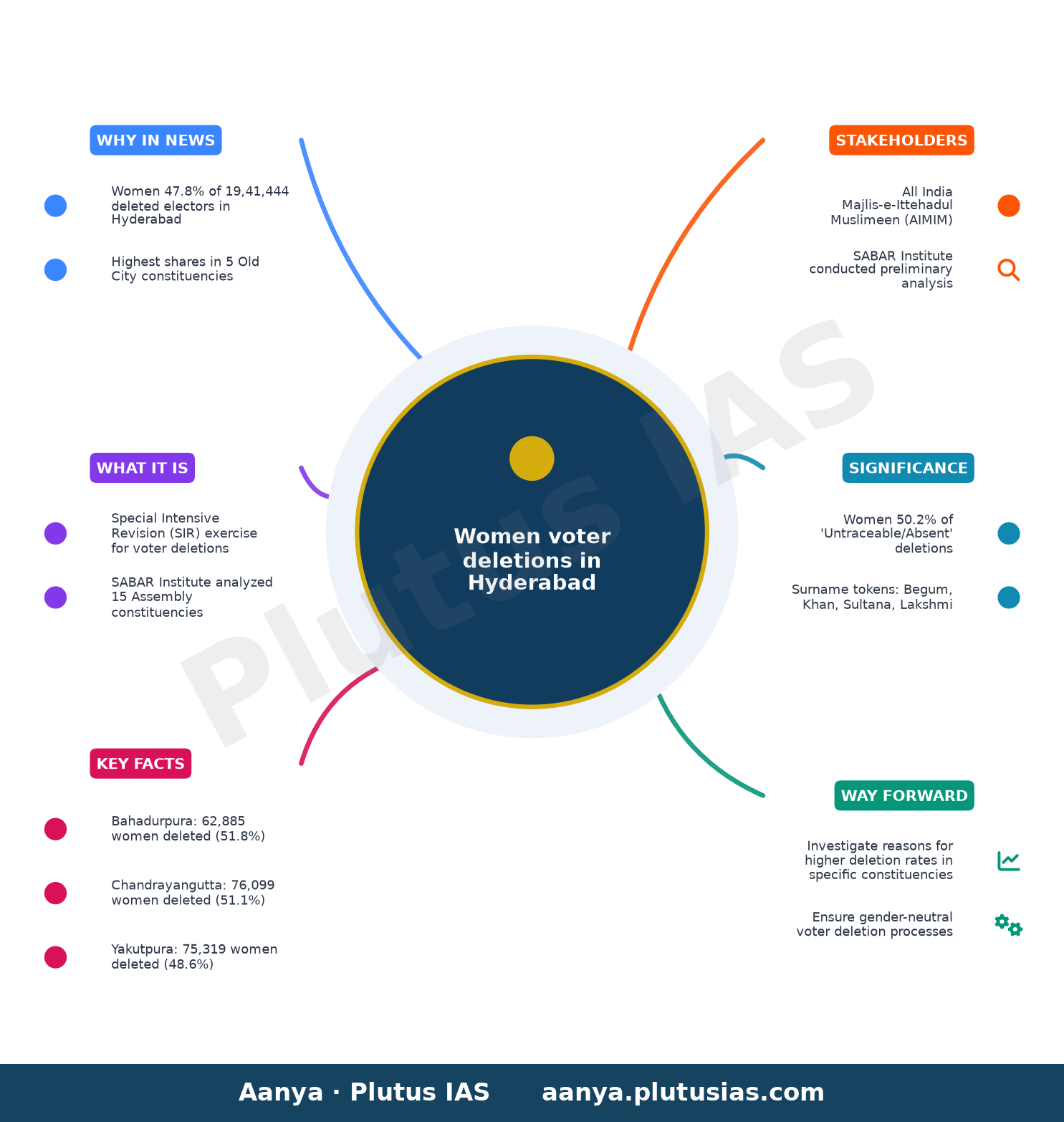
✎ Women constitute nearly half of deleted electors in Hyderabad's SIR exercise, with highest shares in AIMIM-held constituencies.
Relevance for Banking, SSC & RBI Grade B exams: Economy/Governance
A recent report by *The Hindu* highlights that women accounted for nearly 47.8% of the 19,41,444 voter deletions in Hyderabad during the ongoing Special Intensive Revision (SIR) exercise, with five Old City constituencies—Bahadurpura, Chandrayangutta, Karwan, Yakutpura, and Malakpet—recording the highest shares. The data, analyzed by the SABAR Institute, reveals that in Bahadurpura alone, 62,885 women were deleted out of 1,21,350 total deletions, while Yakutpura saw 75,319 women deleted from 1,54,982 deletions. The report also notes that Muslim-classified electors constituted 40.7% of deletions, with concentrations as high as 85.9% in Bahadurpura, reflecting demographic patterns rather than deliberate targeting. The findings underscore concerns over voter deletion processes, particularly in densely populated urban areas, where discrepancies in deletion rates across gender and community lines raise questions about electoral transparency and inclusivity.
For banking and SSC aspirants, this report is relevant as it touches upon governance, electoral processes, and demographic data analysis—key areas in public administration and policy-making. The RBI Grade B exam, which emphasizes economic and social development, may require candidates to understand how voter deletions impact electoral representation and governance. Additionally, the mention of surname-token analysis highlights the intersection of data science and governance, a topic increasingly relevant in modern administrative practices. Aspirants should note the role of the Election Commission of India in maintaining electoral rolls and the challenges in ensuring fair voter registration and deletion processes.
Source: The Hindu
Generated by AanyaAi for educational purpose.

1 comment on “Women Lead Voter Deletions in Hyderabad’s Old City: SIR Data Analysis”