
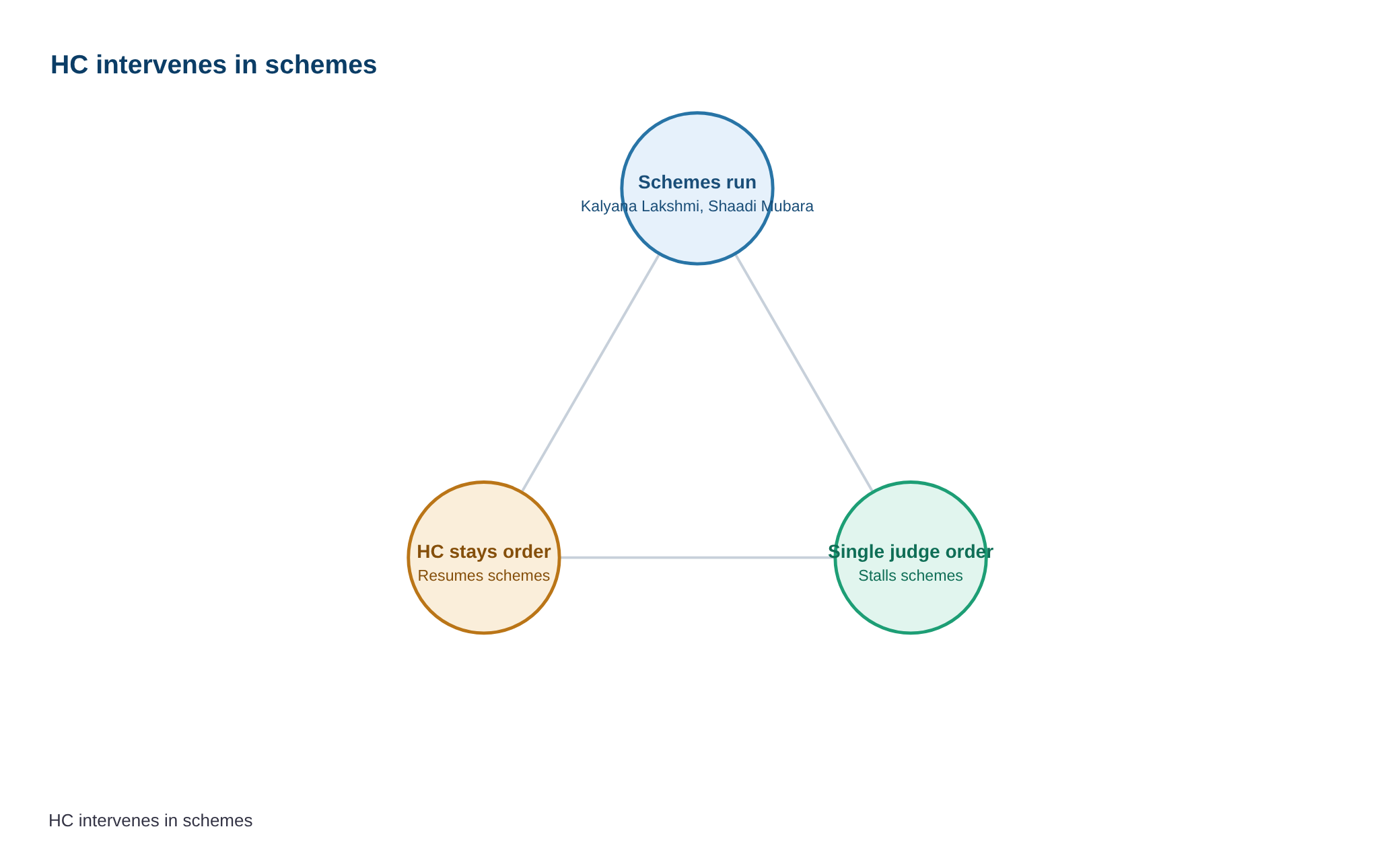
✎ Kalyana Lakshmi and Shaadi Mubarak schemes remain operational as HC stays single judge order stalling them.
Relevance for Banking, SSC & RBI Grade B exams: Polity & Governance
The Telangana High Court’s division bench on September 1, 2026, stayed a single judge’s order that had stalled the implementation of the Kalyana Lakshmi and Shaadi Mubarak schemes, which provide financial assistance to marginalised communities for marriages. The state government, represented by principal secretaries of various welfare departments, argued that the schemes, operational since 2014, lacked legal sanctity due to their enforcement through executive orders rather than legislative backing. The advocate general countered that the apex court had previously praised similar welfare schemes, while the petitioner, a practicing advocate, contended that the single judge’s interim order was not appealable. The bench’s stay ensures the schemes continue pending further judicial scrutiny, highlighting the balance between executive welfare policies and judicial oversight.
For Banking, SSC, and RBI Grade B aspirants, this case underscores the interplay between governance, constitutional validity, and judicial intervention in welfare schemes—key themes in Polity & Governance. Questions on executive vs. legislative powers, judicial review of welfare policies, and the role of the judiciary in economic governance may appear in exams, as such cases test understanding of federalism, fundamental rights, and policy implementation. The schemes themselves, aimed at reducing financial burdens on marginalised sections, reflect socio-economic priorities often discussed in current affairs sections of competitive exams.
Source: The Hindu
Generated by AanyaAi for educational purpose.
