
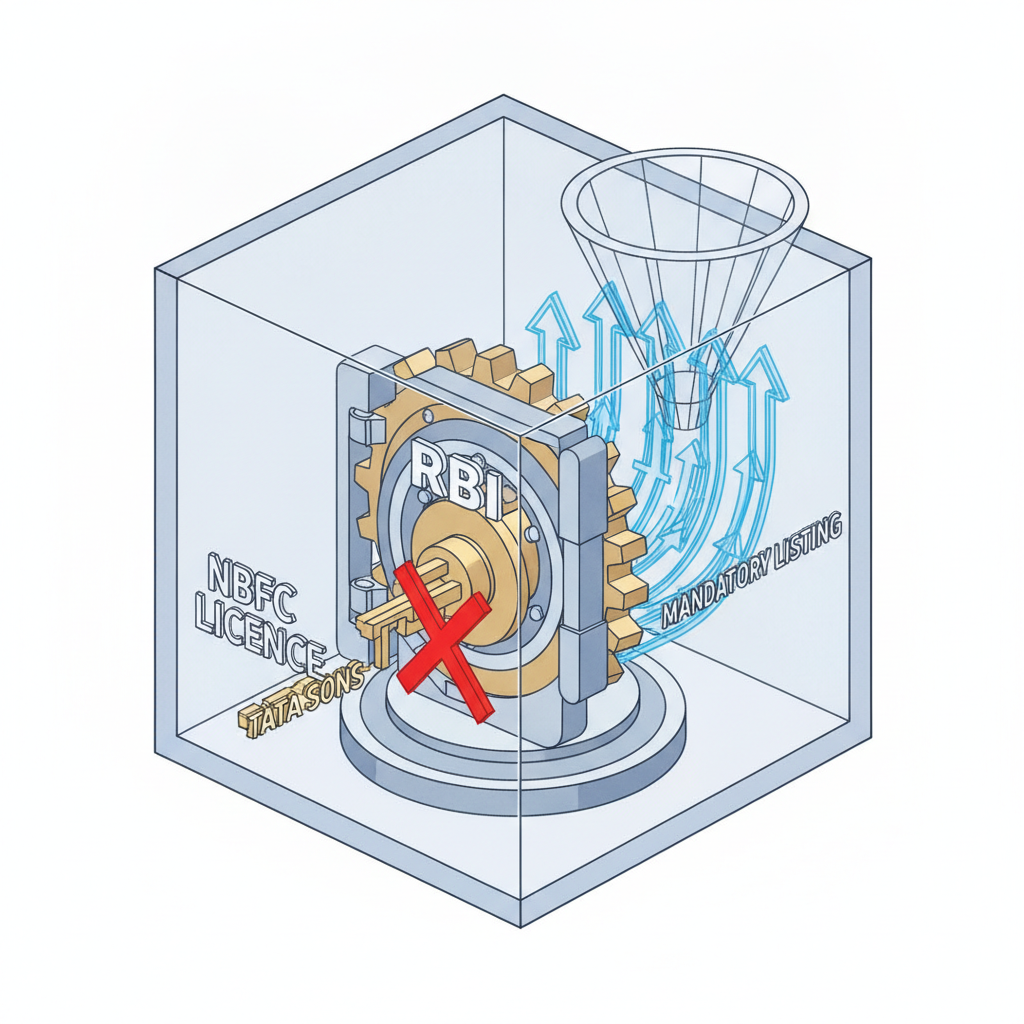
✎ RBI's rejection forces Tata Sons to list publicly under Upper Layer NBFC norms.
Relevance for Banking, SSC & RBI Grade B exams: Economy
The Reserve Bank of India (RBI) has rejected Tata Sons’ application to surrender its Non-Banking Financial Company (NBFC) licence, effectively mandating the holding company of the Tata Group to list on stock exchanges. The RBI conveyed its decision through a letter to Tata Sons’ company secretary and CFO, closing its application filed in March 2024 to deregister as a Core Investment Company (CIC). Tata Sons had sought to exit the NBFC framework by repaying over ₹21,000 crore in debt in 2024 and applying for deregistration, aiming to operate as an unregulated private holding company. However, the RBI classified Tata Sons as an Upper Layer NBFC in September 2022, subjecting it to enhanced regulatory requirements, including a mandatory listing within three years. With the original deadline of September 30, 2025, lapsing, the RBI’s rejection leaves Tata Sons with no regulatory route to avoid listing, given its assets exceed ₹2 lakh crore, far surpassing the ₹1 lakh crore threshold for automatic Upper Layer classification under revised RBI norms.
This development holds significant relevance for banking and financial services aspirants preparing for exams like Bank PO, IBPS, SBI, RBI Grade B, and SSC. For banking exams, understanding the RBI’s regulatory framework for NBFCs, particularly the scale-based classification and listing mandates, is crucial as it reflects the central bank’s evolving oversight of systematically important non-bank lenders. The case of Tata Sons highlights the RBI’s stringent enforcement of norms, including the bright-line rule for asset thresholds, which aspirants must grasp for questions on financial regulations and governance. For SSC aspirants, especially in the General Awareness section, the RBI’s decision underscores the interplay between corporate governance, regulatory compliance, and market dynamics, offering insights into real-world applications of economic policies. Additionally, the internal corporate dynamics at Tata Sons—such as the dispute between Tata Trusts and the Shapoorji Pallonji Group—provide context for questions on business ethics, shareholder rights, and the impact of regulatory decisions on corporate structures, making it a pertinent topic for both banking and SSC examinations.
Source: orissapost.com
Generated by AanyaAi for educational purpose.
