
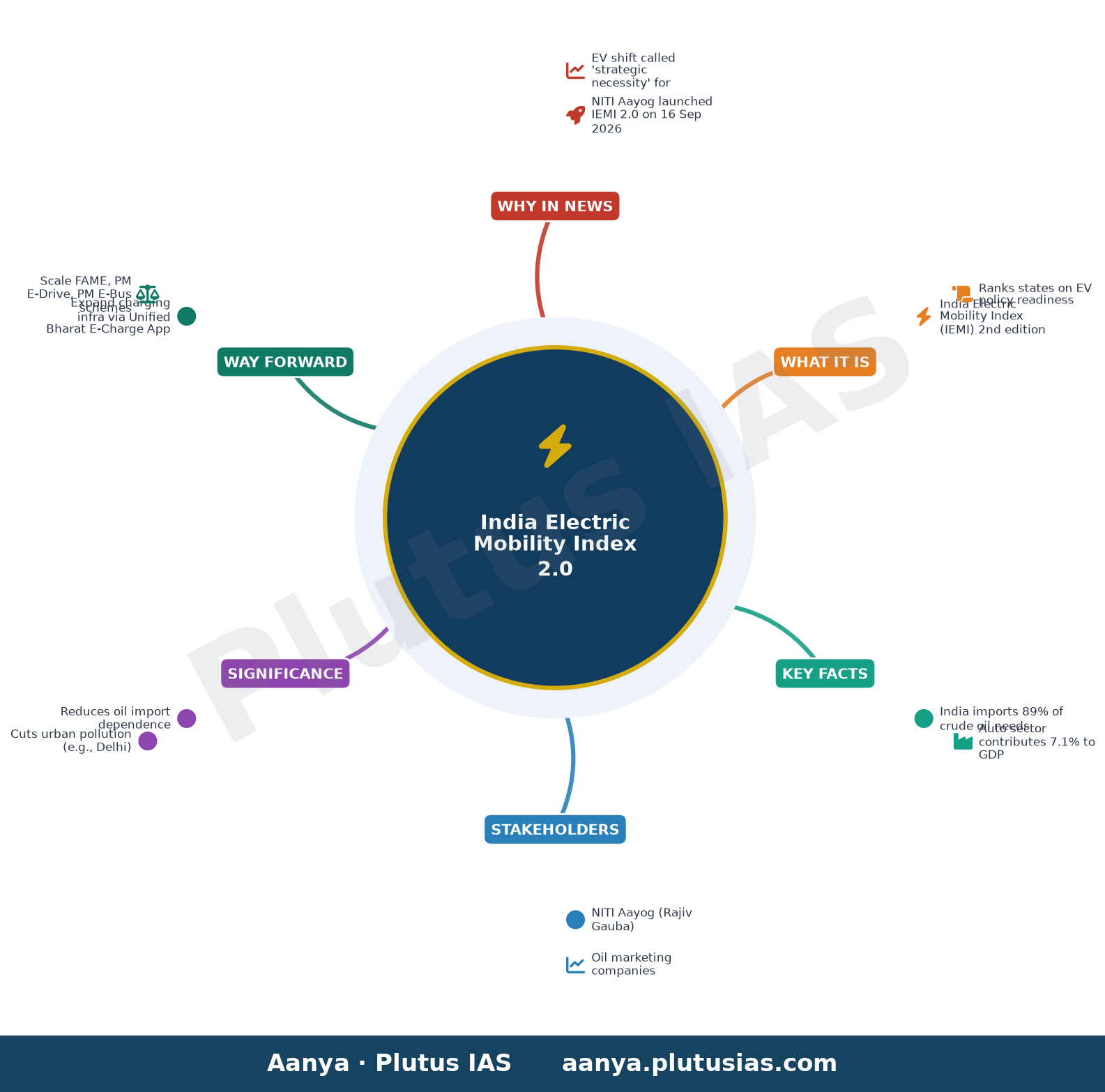
✎ IEMI 2.0 highlights India's strategic shift to EVs for energy security, pollution control, and economic growth by 2047.
Relevance for Banking, SSC & RBI Grade B exams: Polity & Governance
The India Electric Mobility Index (IEMI) 2025, launched by NITI Aayog, assesses state-level progress in electric vehicle (EV) adoption, highlighting its strategic importance for India’s goal of becoming a developed nation by 2047. NITI Aayog Member Rajiv Gauba emphasized that EV adoption is not just an environmental necessity but also an economic and strategic imperative, given India’s 89% dependence on oil imports. With the automobile sector contributing 7.1% to GDP and employing 1.9 crore people, transitioning to EVs aligns with global trends—where the US, EU, and China saw EV sales share of 10%, 25%, and 50% respectively in 2025—and mitigates risks like geopolitical oil crises. The index, which improved state scores from 36 to 40 on average, provides a data-driven framework for policymakers to track progress and tailor strategies, ensuring balanced development across regions.
For banking and SSC aspirants, this initiative underscores the government’s push for sustainable mobility, linking it to financial inclusion through schemes like FAME, PM e-Drive, and PLI for battery storage, which offer investment opportunities in green finance. RBI Grade B candidates should note how EV adoption impacts inflation (via reduced fuel imports), employment (auto sector’s 7.1% GDP contribution), and monetary policy, as subsidies like the ₹92,000 crore outlay may influence fiscal deficits. Additionally, the expansion of EV charging infrastructure—supported by oil marketing firms and the Unified Bharat e-Charge app—highlights the role of public-private partnerships in nation-building, a key theme in governance and economic policy exams.
Source: PIB (Press Information Bureau)
Generated by AanyaAi for educational purpose.

1 comment on “NITI Aayog Launches India Electric Mobility Index 2.0 for EV Transition”