
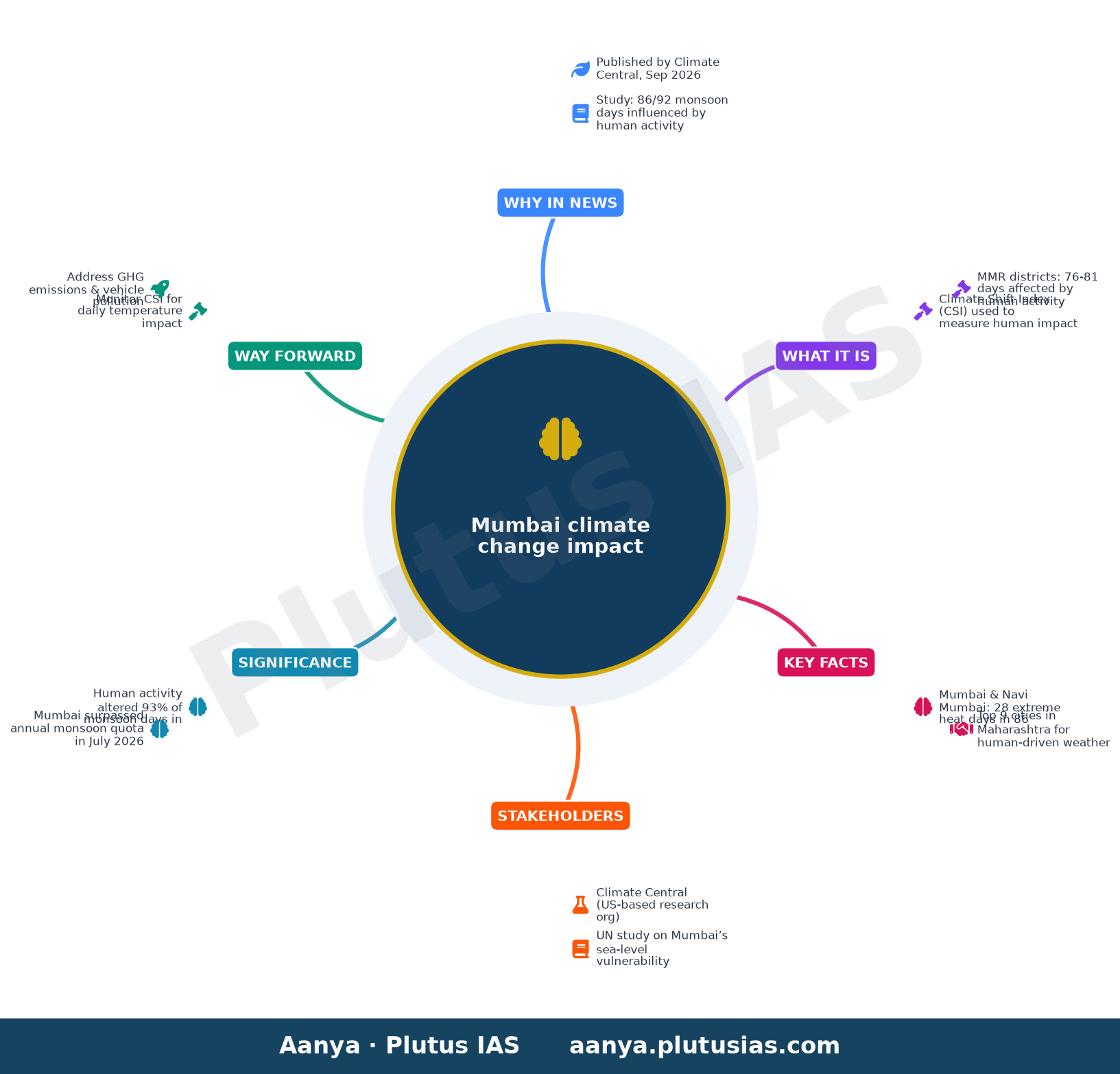
✎ Human activities like GHG emissions and vehicle pollution significantly altered Mumbai’s monsoon climate in 2026.
Relevance for Banking, SSC & RBI Grade B exams: Environment
A recent study by Climate Central, a US-based climate research organisation, highlights how human activities like vehicular emissions and industrial practices have significantly altered Mumbai’s monsoon climate. Out of 92 days between June and August 2026, Mumbai and Navi Mumbai experienced 86 days where extreme heat and rainfall were directly influenced by man-made climate change. The Mumbai Metropolitan Region (MMR) recorded the highest impact, with districts like Dombivali and Thane facing 81 such days, followed by Kalyan (79 days) and Pimpri, Pune, and Shivaji Nagar (76 days each). The study used a Climate Shift Index (CSI) to measure the severity of human-induced weather changes, with Mumbai’s average markings ranging between 4 and 5—indicating severe impact. This aligns with global concerns about rising temperatures, as Indian cities saw an average day temperature increase of 0.7 degrees during this period. For banking and SSC aspirants, this underscores the economic implications of climate change, such as infrastructure damage, insurance risks, and policy interventions, which are crucial for exams like RBI Grade B and IBPS.
The report also links Mumbai’s erratic monsoon patterns to the absence of Alto Stratus clouds, which traditionally ensured uniform rainfall. Instead, industrial emissions and vehicular pollution have heated the lower atmosphere, disrupting cloud formation and leading to extreme rainfall events. With Asia accounting for 58% of the global population exposed to risky heat days due to climate change—India alone contributing 117 million—this phenomenon has broader socio-economic consequences. For banking and SSC aspirants, understanding such environmental shifts is vital, as they influence sectors like agriculture, disaster management, and sustainable finance. RBI Grade B exams often test candidates on climate-related risks to financial stability, while SSC exams may include questions on environmental policies and their economic impact.
Source: The Indian Express
Generated by AanyaAi for educational purpose.

1 comment on “Mumbai Monsoon 2026: Human Activity Drove 86 Days of Extreme Weather”