✎ Govt plans ₹7.86L cr borrowing in H2 FY26-27 via dated securities and T-bills to manage fiscal deficit.
Relevance for Banking, SSC & RBI Grade B exams: Polity & Governance
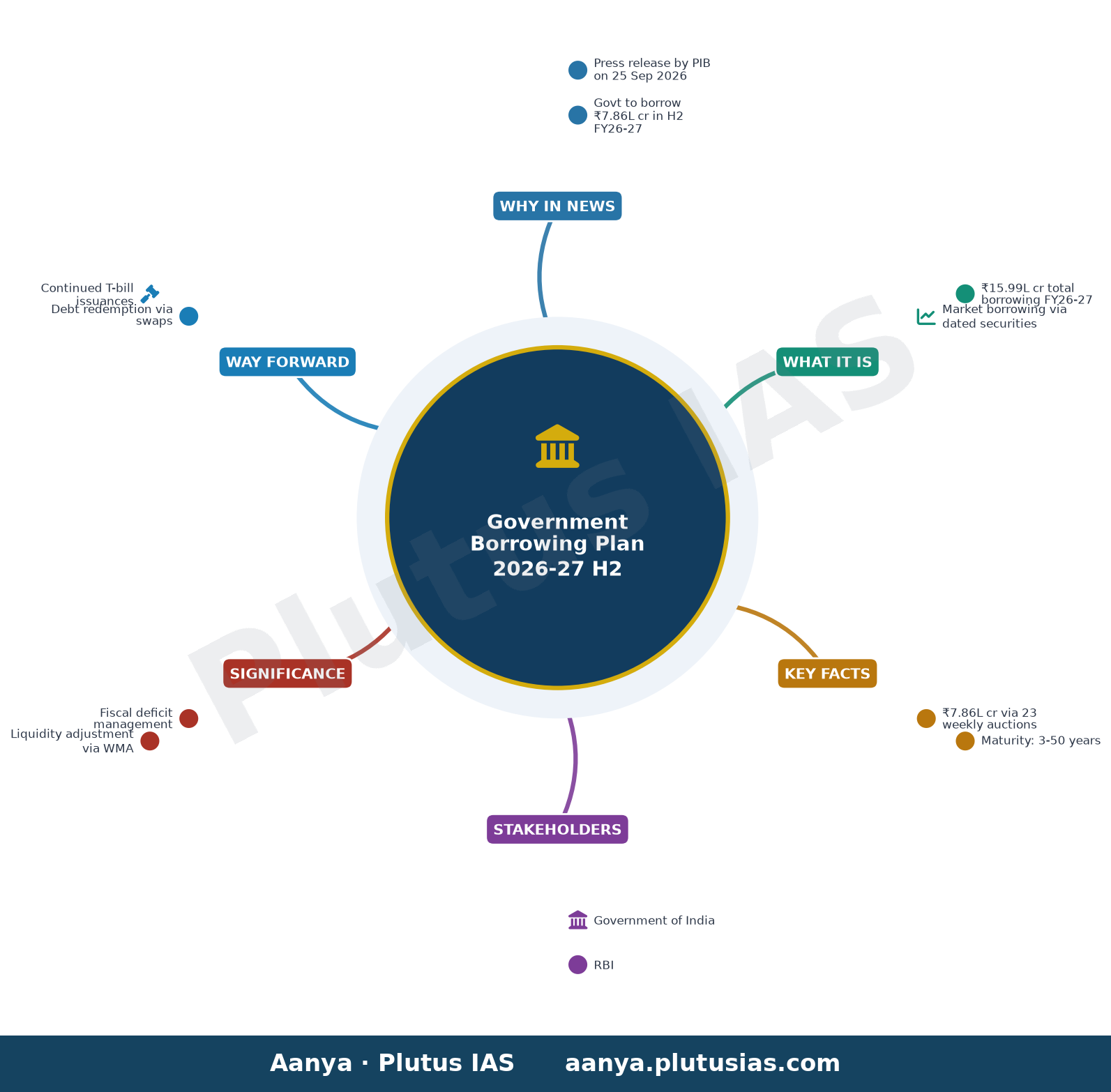
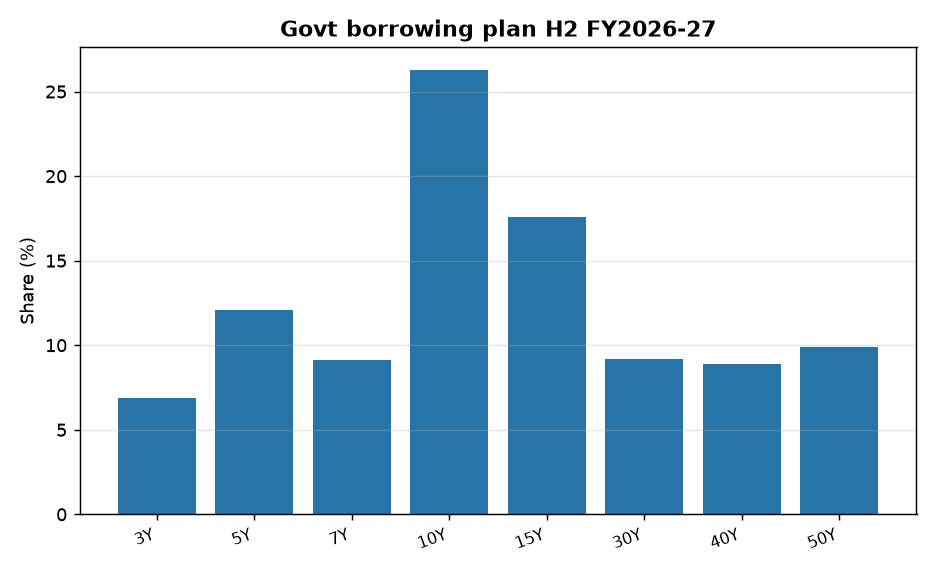
The Government of India, in consultation with the Reserve Bank of India (RBI), has finalized a borrowing plan of ₹7,86,000 crore for the second half of the financial year 2026-27 (H2 FY27). This borrowing will be raised through dated securities across maturities of 3, 5, 7, 10, 15, 30, 40, and 50 years, distributed as 3-year (6.9%), 5-year (12.1%), 7-year (9.1%), 10-year (26.3%), 15-year (17.6%), 30-year (9.2%), 40-year (8.9%), and 50-year (9.9%). The borrowing will be conducted through 23 weekly auctions, with an additional ₹2,000 crore greenshoe option per security to manage subscription demand. For the third quarter of FY27, the government plans to borrow ₹23,000 crore weekly through Treasury Bills (T-Bills) of 91, 182, and 364 days, amounting to ₹8,000 crore, ₹8,000 crore, and ₹7,000 crore respectively. The RBI has set a Ways and Means Advances (WMA) limit of ₹50,000 crore for H2 FY27 to address temporary mismatches in government accounts. The total market borrowing for FY27 is estimated at ₹15,99,506 crore, slightly below the budgeted ₹17,20,000 crore.
This borrowing strategy holds significant relevance for Bank PO, IBPS, SBI, RBI Grade B, and SSC aspirants as it reflects the government’s fiscal management and monetary policy coordination. For banking exams, understanding the structure of government securities, auction mechanisms, and the role of RBI in managing liquidity is crucial, as these concepts frequently appear in descriptive and objective sections. SSC aspirants preparing for General Studies or Economics sections will benefit from insights into fiscal policy, borrowing instruments, and their impact on inflation, interest rates, and economic stability. RBI Grade B candidates must grasp the nuances of WMA, T-Bills, and dated securities, as these topics are integral to the economic and financial awareness syllabus, often tested in both Phase I and Phase II examinations.
Source: PIB (Press Information Bureau)
Generated by AanyaAi for educational purpose.
