
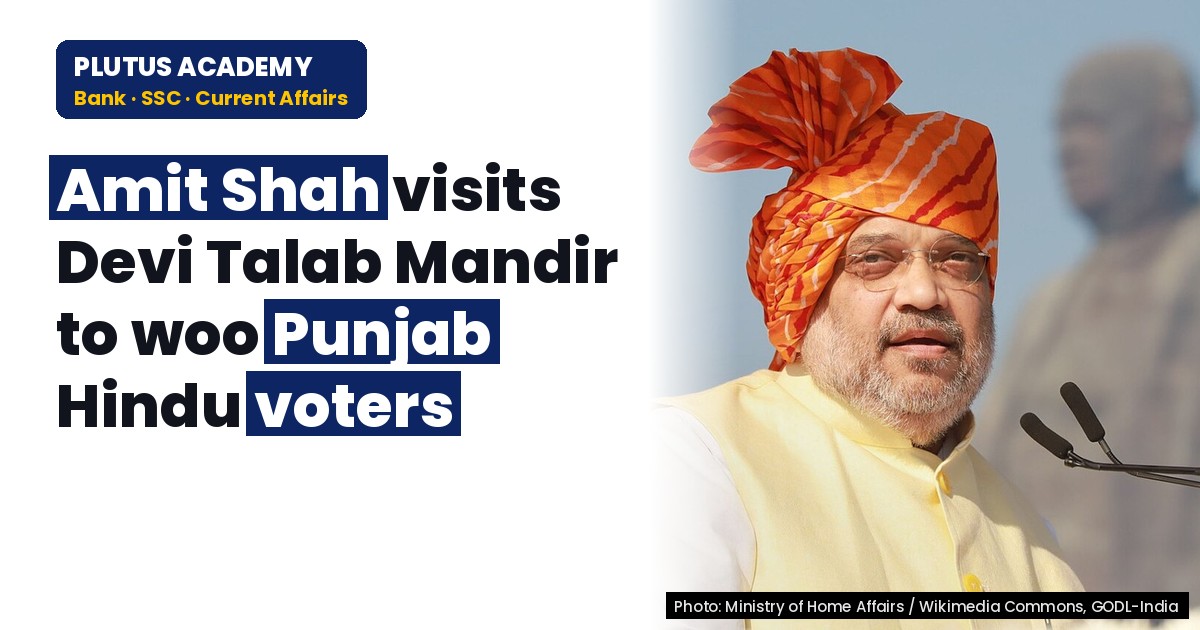
✎ Amit Shah's visit to Devi Talab Mandir in Jalandhar highlights BJP's strategy to target the Hindu vote bank (38.49% of Punjab's population) ahead of 2027 Punjab Assembly elections.
Relevance for Banking, SSC & RBI Grade B exams: Polity & Governance
The strategic outreach of the Bharatiya Janata Party (BJP) in Punjab ahead of the 2027 Assembly elections has intensified, with Union Home Minister Amit Shah’s recent visit to the Devi Talab Mandir in Jalandhar symbolizing the party’s renewed focus on consolidating the Hindu vote bank. With Hindus constituting 38.49% of Punjab’s population and holding sway in key urban and semi-urban constituencies like Jalandhar, Ludhiana, and Amritsar, the BJP is leveraging religious symbolism—such as temple visits and cultural initiatives—to reconnect with its traditional urban base. This shift comes amid the Aam Aadmi Party’s (AAP) aggressive religious outreach, including free theatrical performances of *Hamare Ram* and subsidized pilgrimage schemes, which has further complicated the electoral calculus. For banking and competitive exam aspirants, this political maneuvering underscores the interplay between electoral strategies, demographic shifts, and governance, a recurring theme in polity and governance sections of exams like RBI Grade B and SSC CGL.
The BJP’s gamble on the Hindu vote bank in Punjab reflects broader national trends where identity politics and welfare schemes intersect with electoral outcomes. While the party’s vote share surged to 18.56% in the 2024 Lok Sabha elections from 9.63% in 2019, its seat tally remains limited due to the fragmented nature of Punjab’s electorate, where religious identity alone does not guarantee electoral success. Analysts highlight that Punjab’s Hindu voters do not align uniformly with the Hindi heartland’s political behavior, making it imperative for parties to balance religious symbolism with local socio-economic concerns. For aspirants preparing for exams like IBPS PO or SBI Clerk, understanding such regional dynamics—where cultural outreach, coalition politics, and demographic calculations shape governance—can provide critical insights into India’s evolving political landscape.
Source: amarujala.com
Generated by AanyaAi for educational purpose.

2 comments on “Amit Shah’s Temple Visit: BJP’s New Strategy for Punjab 2027 Polls”