
Relevance for Banking, SSC & RBI Grade B exams: Polity & Governance
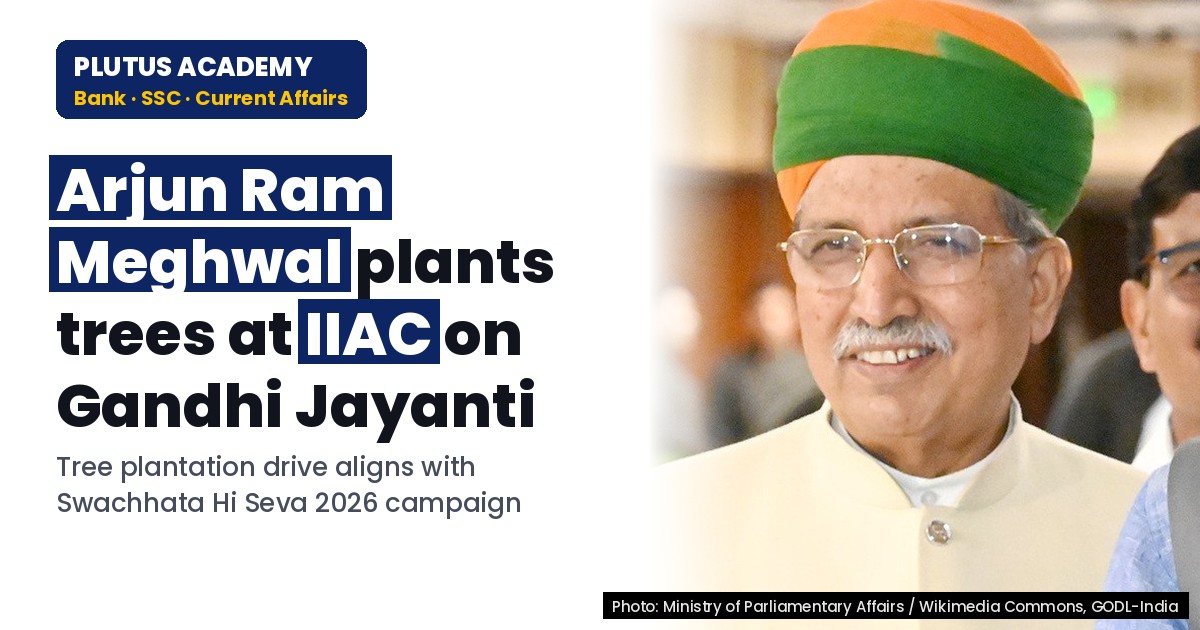
The recent tree-plantation drive led by Union Minister of State (Independent Charge) for Law and Justice Shri Arjun Ram Meghwal at the India International Arbitration Centre (IIAC) in New Delhi on October 1, 2026, underscores the government’s commitment to environmental sustainability and citizen participation in governance. The event, organized under the *Swachhata Hi Seva (SHS) 2026* campaign and *Mission 6* of the Special Campaign, aligned with Gandhi Jayanti, emphasized the theme *“One Tree for Mother”* while drawing parallels to Mahatma Gandhi’s Champaran Satyagraha of 1917. The minister highlighted that true cleanliness begins with a clean mind and collective responsibility, reinforcing the idea that environmental stewardship is integral to national progress. For aspirants preparing for Bank PO, IBPS, SBI, RBI Grade B, and SSC exams, this initiative reflects the intersection of governance, public welfare, and constitutional duties, as well as the role of institutions like IIAC in promoting transparency and sustainable practices—key themes often tested in polity and governance sections.
The event also highlights the government’s focus on institutional accountability and citizen-centric policies, which are critical for exams like RBI Grade B and SSC CGL. The emphasis on *Swachh Bharat Mission* objectives and the IIAC’s role as a global arbitration hub demonstrates how governance extends beyond traditional frameworks to include environmental and ethical dimensions. Aspirants should note the significance of such campaigns in shaping India’s socio-economic landscape, as questions on government schemes, constitutional provisions, and institutional roles frequently appear in competitive exams. The minister’s invocation of Gandhi’s Champaran movement further ties the event to India’s freedom struggle and the evolution of participatory governance, a recurring topic in polity syllabi.
Source: PIB (Press Information Bureau)
Generated by AanyaAi for educational purpose.

2 comments on “Arjun Ram Meghwal Leads Tree Plantation Drive at IIAC on Gandhi Jayanti”