✎ Bihar's liquor ban policy faces U-turn due to NCAER's revenue-focused recommendations after a decade of prohibition.
Relevance for Banking, SSC & RBI Grade B exams: Economy/Governance
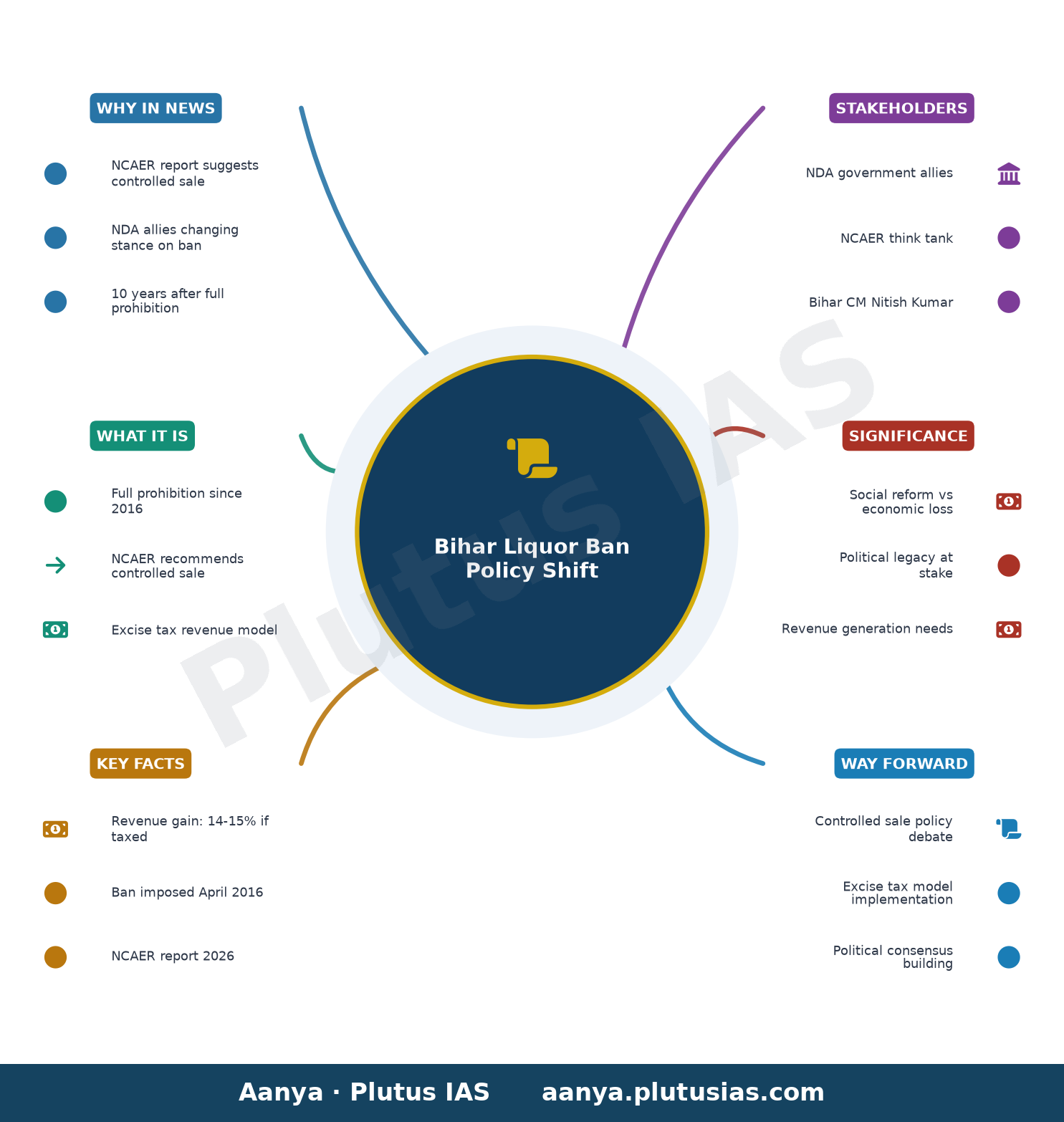
Bihar’s decade-old total liquor ban is facing a potential reversal as the National Council of Applied Economic Research (NCAER) has recommended controlled sale of alcohol, citing significant revenue gains for the state. The report suggests that reintroducing excise tax on regulated liquor could boost state revenue by 14-15%, while also addressing challenges like illegal bootlegging and rising drug abuse that have surged post-ban. This economic rationale has intensified political debates, with NDA allies adopting divergent stances—JDU insists on maintaining prohibition, central minister Chirag Paswan opposes lifting the ban, while leaders like Jitan Ram Manjhi advocate a Gujarat-style partial relaxation. The shift in stance reflects the growing pressure on governance models reliant solely on social morality, pushing policymakers to weigh fiscal sustainability against public welfare goals—a critical consideration for civil service aspirants preparing for exams like RBI Grade B or SSC CGL.
The NCAER report’s findings challenge the efficacy of Bihar’s blanket prohibition, which was framed as a women’s safety measure but now faces scrutiny over its limited impact on domestic violence and enforcement costs. For banking and SSC exam candidates, this case study underscores the interplay between policy economics and governance, highlighting how fiscal constraints (e.g., revenue leakage from prohibition) can reshape political narratives. Questions on tax buoyancy, excise duty structures, and the role of think tanks like NCAER in policy formulation are increasingly relevant for exams testing awareness of economic governance and administrative reforms.
Source: amarujala.com
Generated by AanyaAi for educational purpose.
