
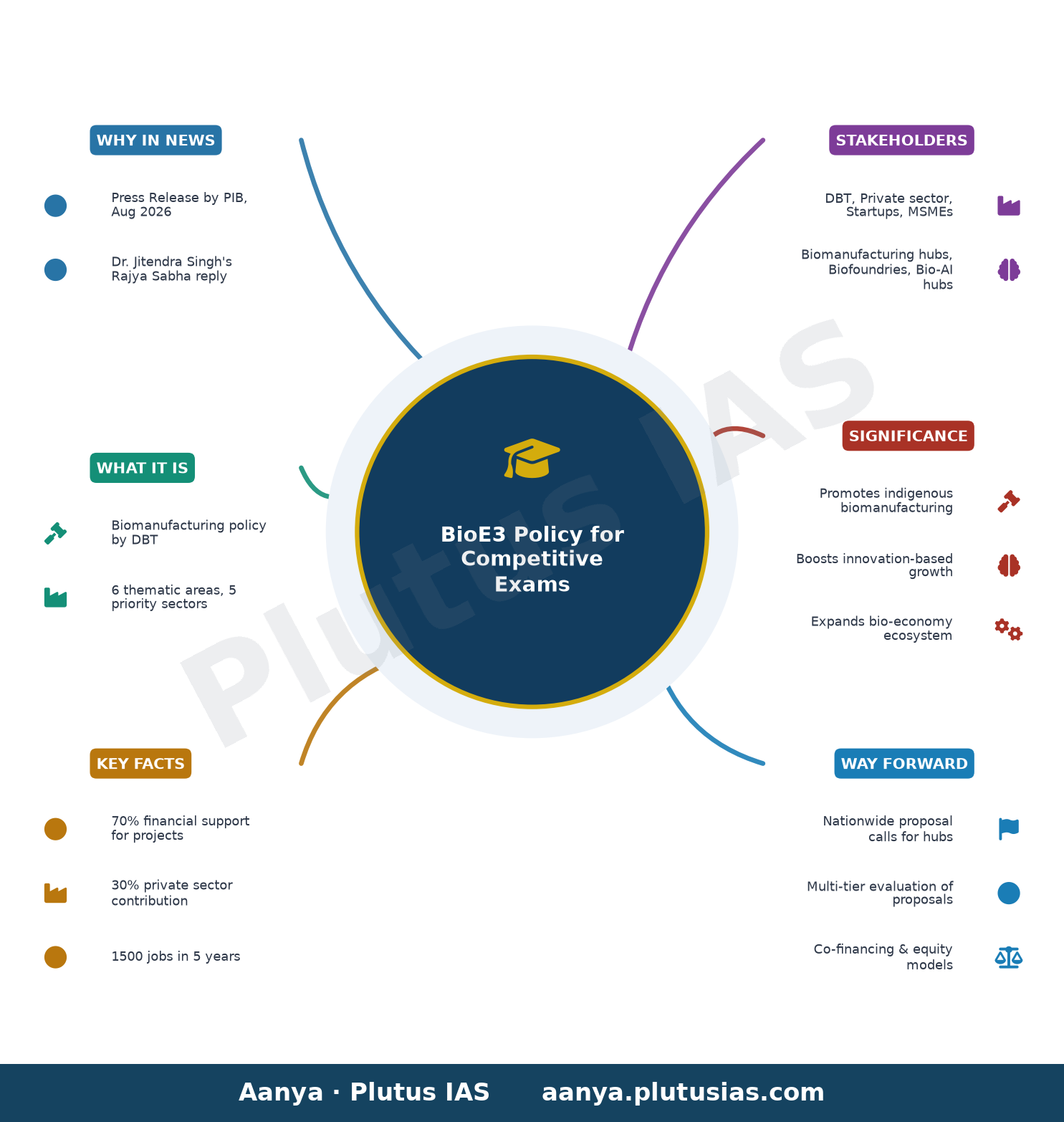
✎ BioE3 policy aims to strengthen indigenous biomanufacturing, create jobs, and achieve a $300B bio-economy by 2030 through 70% financial support and multi-tier evaluation.
Relevance for Banking, SSC & RBI Grade B exams: Polity & Governance
The *BioE3* policy, launched by the Department of Biotechnology (DBT), aims to boost high-potential bio-manufacturing by identifying six thematic areas—bio-based chemicals, bioplastics, active pharmaceutical ingredients, enzymes, functional foods, and smart proteins—alongside precision biomedicine, climate-resilient agriculture, biofuels, carbon capture, and futuristic marine/space biotechnology. The policy also prioritizes five emerging domains: Ayurveda agriculture innovations, genome diagnostics, synthetic biology, biomolecular design, and bio-AI hubs. Under this initiative, bio-manufacturing hubs, biofoundries, and bio-AI centers are being established through a rigorous multi-layered evaluation process, ensuring technical feasibility and financial viability. The selection criteria involve national-level expression of interest, eligibility checks, technical and financial assessments, and expert evaluations, with the top committee recommending proposals based on defined objectives, cost, and funding mechanisms. This structured approach aligns with the government’s *Make in India* vision, fostering indigenous capabilities and expanding the biotechnology ecosystem.
For banking, SSC, and RBI Grade B aspirants, the *BioE3* policy holds significant relevance as it underscores the intersection of governance, innovation, and economic growth. The policy’s emphasis on financial incentives—such as 70% project cost funding for startups, MSMEs, and private players—highlights the government’s role in promoting self-reliance (*Atmanirbhar Bharat*) and sustainable development. With an expected creation of 1,500 direct and indirect jobs in tier-II and tier-III cities over five years and a commitment of ₹602.09 crore in private investments, the policy reflects broader themes of employment generation and fiscal prudence, crucial for exam discussions on economic policies and governance. Additionally, the policy’s focus on precision biomedicine and smart proteins ties into India’s healthcare and food security priorities, making it a potential case study for questions on policy-driven innovation in competitive exams.
Source: PIB (Press Information Bureau)
Generated by AanyaAi for educational purpose.
