✎ GobarDhan scheme transforms organic waste into clean energy, boosting rural economy and energy security.
Relevance for Banking, SSC & RBI Grade B exams: Polity & Governance
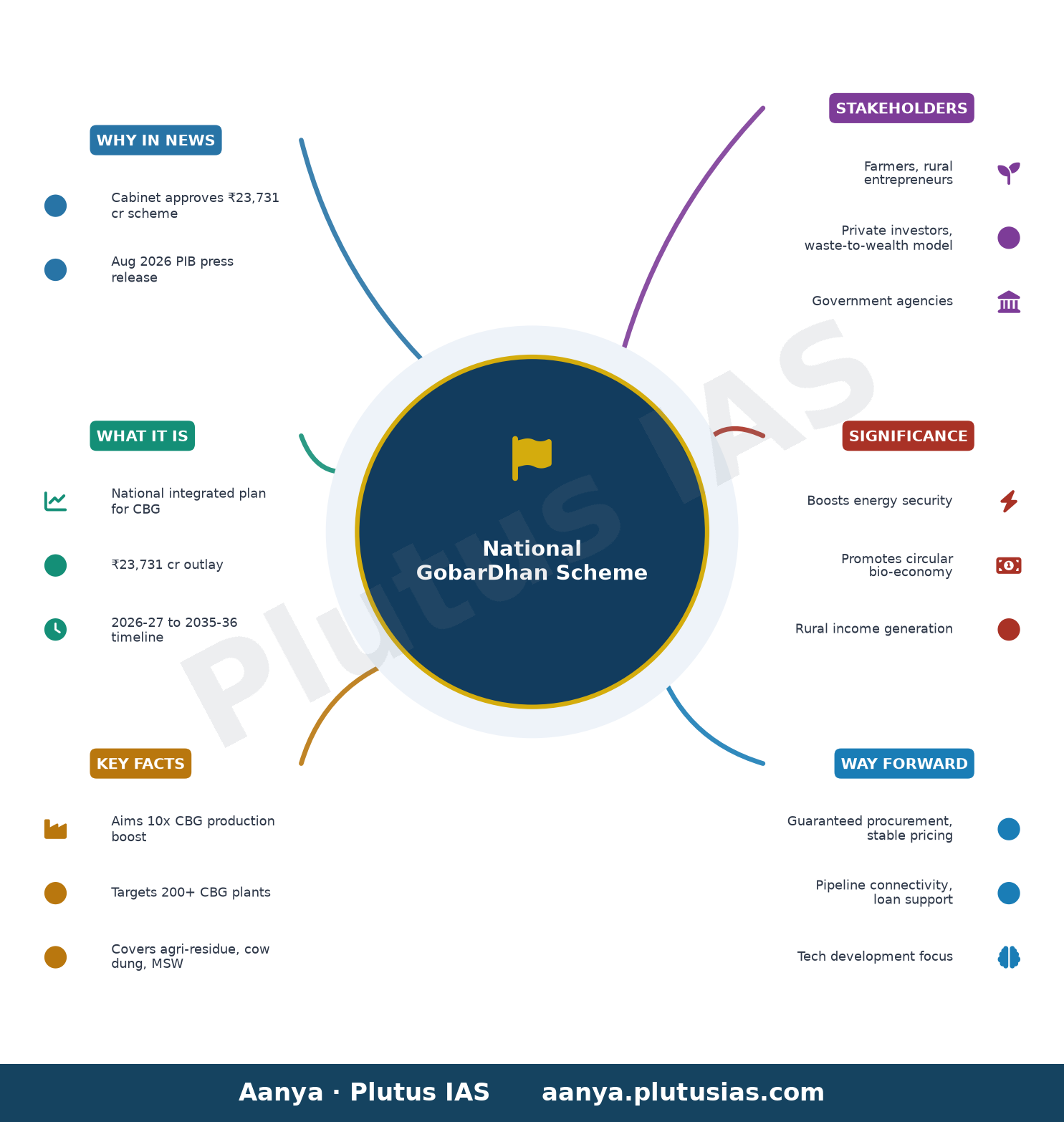
The Union Cabinet, chaired by Prime Minister Narendra Modi, has approved the **Gobardhan (Galvanizing Organic Bio-Agro Resources Dhan) scheme**, a national integrated plan for compressed biogas (CBG) with a total outlay of **Rs 23,731 crore**. The scheme aims to convert India’s abundant agricultural residues, cattle dung, municipal organic waste, and other biomass into clean fuel, organic fertilizer, rural income, and economic value while strengthening energy security. By ensuring guaranteed procurement, stable pricing, capital subsidies, pipeline connectivity, and easier access to finance, the scheme seeks to **boost domestic CBG production tenfold**, attract private investment, and build a vibrant circular bio-economy. It will be implemented from **FY 2026-27 to FY 2035-36** and aligns with India’s push for self-reliance, clean energy transition, and rural transformation.
For **Banking, SSC, and RBI Grade B aspirants**, this scheme is highly relevant as it reflects **government-led infrastructure development, financial incentives, and policy-driven economic growth**—key themes in competitive exams. The **Rs 23,731 crore allocation** highlights fiscal priorities, while the focus on **private investment, MSMEs, and rural entrepreneurship** ties into banking and financial inclusion policies. The scheme’s emphasis on **energy security, import substitution, and sustainable development** also mirrors broader economic goals tested in exams like **RBI Grade B (Economic & Social Issues), SSC CGL (Economics), and Bank PO (Government Schemes)**. Additionally, the integration of **waste-to-wealth models** and **circular economy principles** may appear in **Polity & Governance** sections, testing awareness of flagship initiatives.
Source: PIB (Press Information Bureau)
Generated by AanyaAi for educational purpose.
