
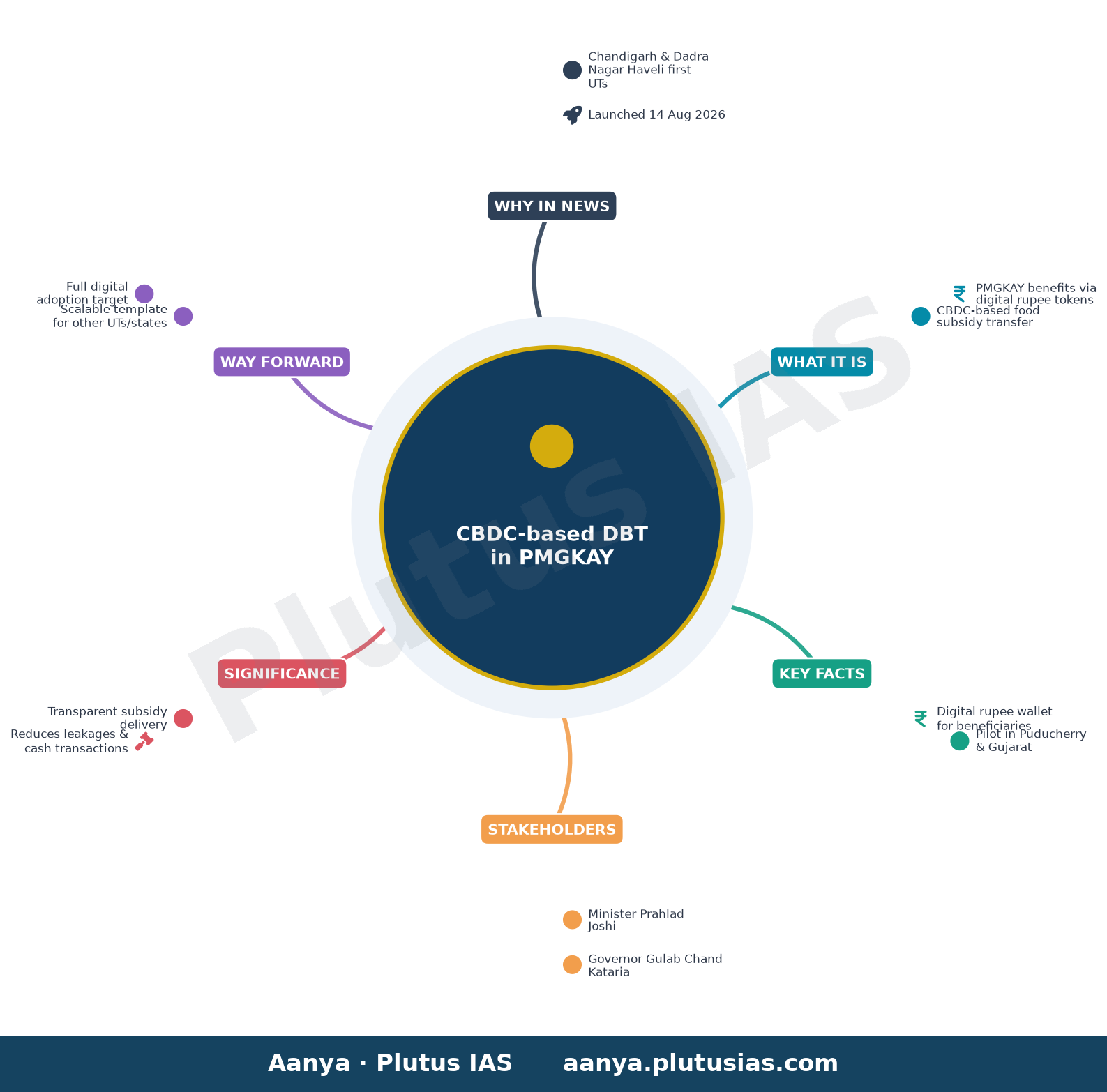
✎ CBDC-based DBT under PMGKAY enhances transparency, reduces leakages, and promotes financial inclusion in Chandigarh and Dadra Nagar Haveli.
Relevance for Banking, SSC & RBI Grade B exams: Polity & Governance
The Government of India will launch a Central Bank Digital Currency (CBDC)-based Direct Benefit Transfer (DBT) scheme under the Pradhan Mantri Garib Kalyan Anna Yojana (PMGKAY) in Chandigarh and Dadra & Nagar Haveli on 14 August 2026. This initiative marks a significant step toward a modern, transparent, and technology-driven welfare delivery system, making these Union Territories the first to transfer food subsidies directly into the CBDC wallets of all eligible PMGKAY beneficiaries as programmable CBDC tokens. The model, piloted earlier in Puducherry and Gujarat, aims to eliminate leakages, fraud, and cash transactions while ensuring faster, secure, and traceable transfers. By integrating CBDC with welfare schemes, the government seeks to enhance financial inclusion, strengthen accountability, and demonstrate the potential of digital public infrastructure for citizen-centric services.
For banking and SSC aspirants, this development highlights the evolving role of CBDC in public welfare schemes, a key topic in governance and digital payments. RBI Grade B candidates should note how CBDC-based DBT aligns with the RBI’s push for a cashless economy and its pilot projects in wholesale and retail segments. The scheme also underscores the importance of financial inclusion, transparency in subsidy distribution, and the integration of emerging technologies in governance—concepts frequently tested in competitive exams. Understanding CBDC’s mechanism and its policy implications will be crucial for answering questions on digital currency, welfare reforms, and regulatory frameworks in upcoming examinations.
Source: PIB (Press Information Bureau)
Generated by AanyaAi for educational purpose.
