
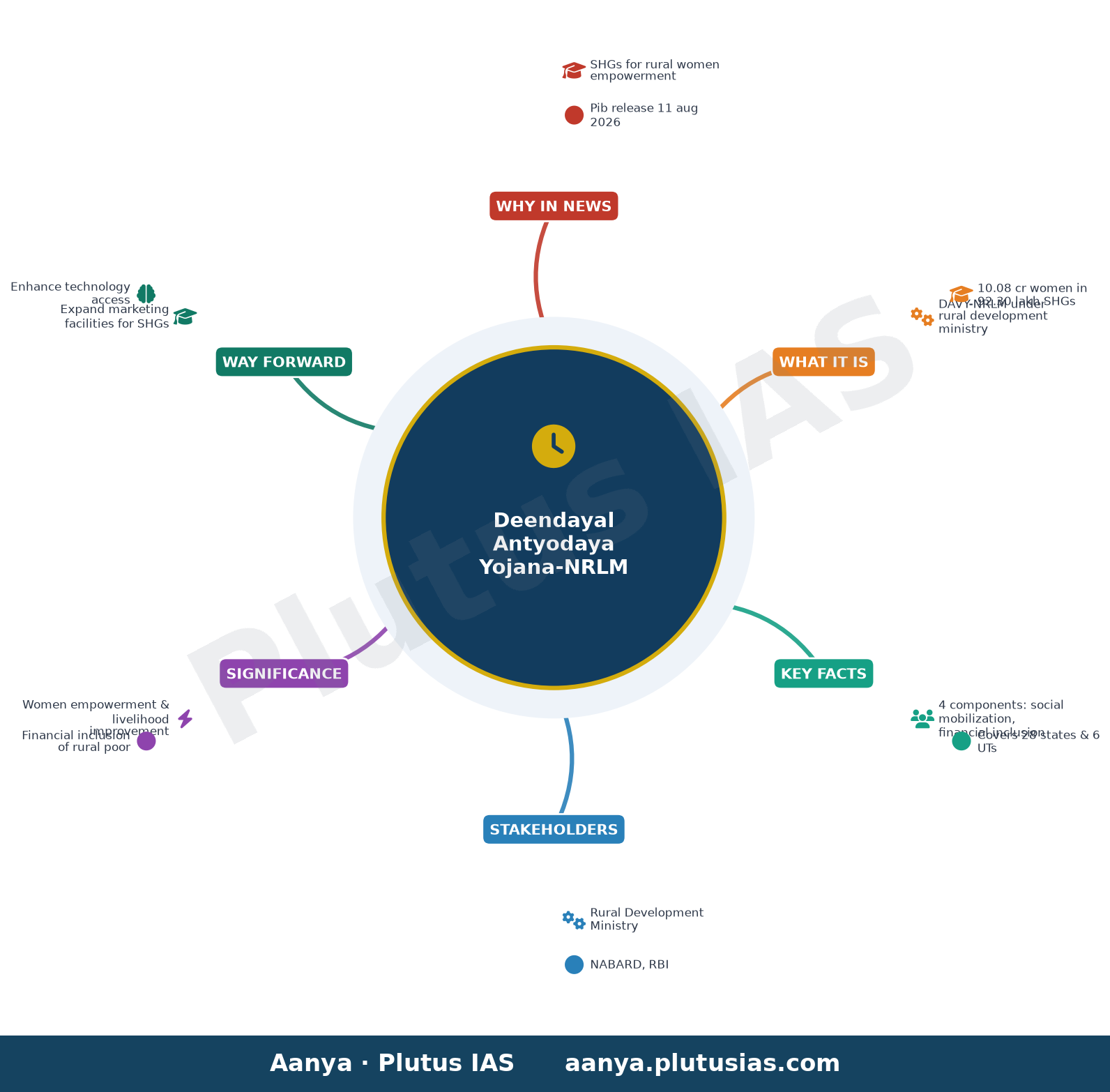
✎ DAVY-NRLM empowers rural women via SHGs, financial inclusion, and skill training for sustainable livelihoods.
Relevance for Banking, SSC & RBI Grade B exams: Polity & Governance
The **Deendayal Antyodaya Yojana-National Rural Livelihood Mission (DAY-NRLM)**, implemented by the Ministry of Rural Development, is a flagship scheme aimed at organizing rural households into **Self-Help Groups (SHGs)** to enhance their income and improve living standards. As of August 2026, over **10.08 crore women** are part of **92.30 lakh SHGs** across **28 states and 6 Union Territories**, with the mission focusing on four key pillars: strengthening community institutions, financial inclusion, sustainable livelihoods, and social development. For banking and financial services aspirants, this scheme is critical as it directly links SHGs to **collateral-free loans** from scheduled commercial banks and cooperative banks under RBI and NABARD guidelines, making it a key case study in **financial inclusion** and **priority sector lending**. SSC and RBI Grade B candidates should note how DAY-NRLM’s integration with **RSETIs (Rural Self-Employment Training Institutes)** and **Community-Managed Training Centers (CMTCs)** fosters skill development, entrepreneurship, and bank linkage, aligning with government initiatives like **Stand-Up India** and **MUDRA Yojana**.
The scheme’s impact is evident from independent evaluations, including a **3ie impact assessment (2025)**, which found a **9.5% rise in household income** in NRLM blocks and **12-33% in mature SHGs**, alongside improvements in consumption, women’s empowerment, and financial literacy. For **Bank PO and SSC exams**, DAY-NRLM exemplifies **women-led development**, **rural entrepreneurship**, and **multi-dimensional poverty alleviation**, with the **”Lakhpati Didi”** initiative—aiming to make SHG members earn **₹1 lakh+ annually**—highlighting its scalability. RBI Grade B aspirants should analyze how such schemes reduce credit gaps, enhance repayment culture, and contribute to **inclusive growth**, a recurring theme in monetary policy and financial stability reports. The scheme’s success in states like **West Bengal (11.67 lakh SHGs) and Bihar (13.53 lakh SHGs)** further underscores its role in **reducing regional disparities**, a key governance challenge for civil services aspirants.
Source: PIB (Press Information Bureau)
Generated by AanyaAi for educational purpose.
