
Relevance for Banking, SSC & RBI Grade B exams: Polity & Governance
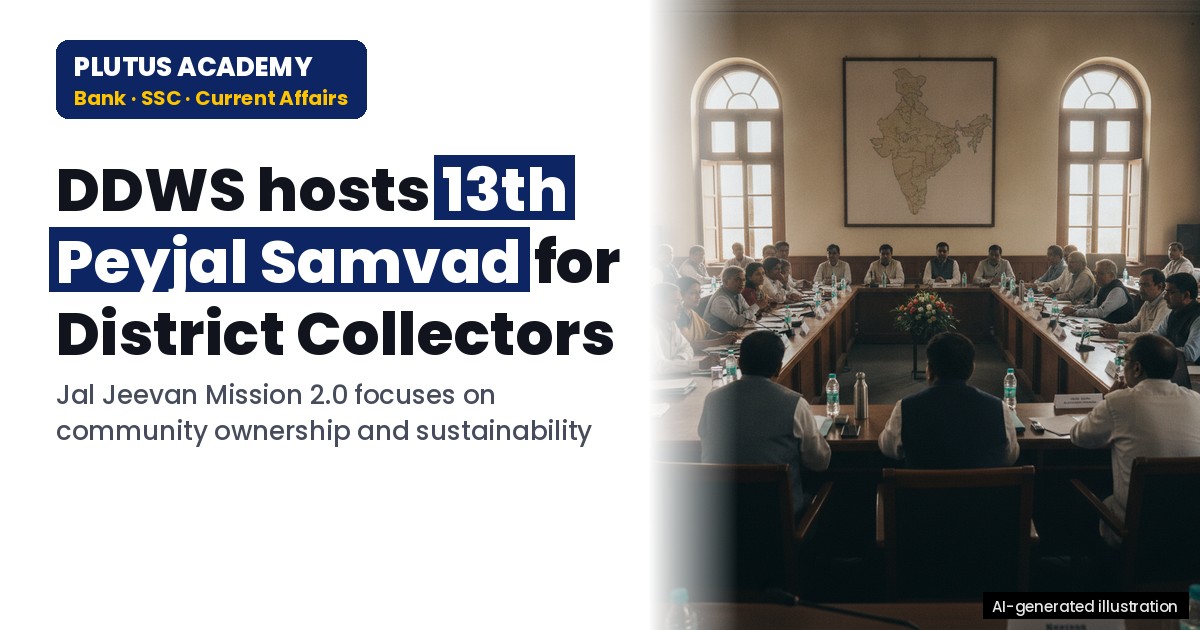
The Department of Drinking Water and Sanitation (DDWS) recently organized the 13th District Collectors’ Peyjal Samvad under the Jal Jeevan Mission (JJM) 2.0 to enhance community participation, water source sustainability, and efficient service delivery. The initiative brought together district collectors to discuss strategies for ensuring last-mile connectivity of tap water connections, addressing water quality issues, and promoting local ownership through gram panchayats and user groups. The focus on decentralized governance aligns with the mission’s goal of achieving ‘Har Ghar Jal’ by 2024, emphasizing grassroots-level accountability and resource management.
For banking and SSC aspirants, this initiative underscores the role of government schemes in rural development and water infrastructure, a recurring theme in exams like IBPS PO and SSC CGL. The Jal Jeevan Mission’s emphasis on community-driven models and inter-departmental coordination reflects broader governance principles tested in RBI Grade B’s economic and social awareness sections. Understanding such schemes helps aspirants analyze their economic impact, such as reduced water-borne diseases and improved agricultural productivity, which are critical for policy-based questions in competitive exams.
Source: PIB (Press Information Bureau)
Generated by AanyaAi for educational purpose.
