
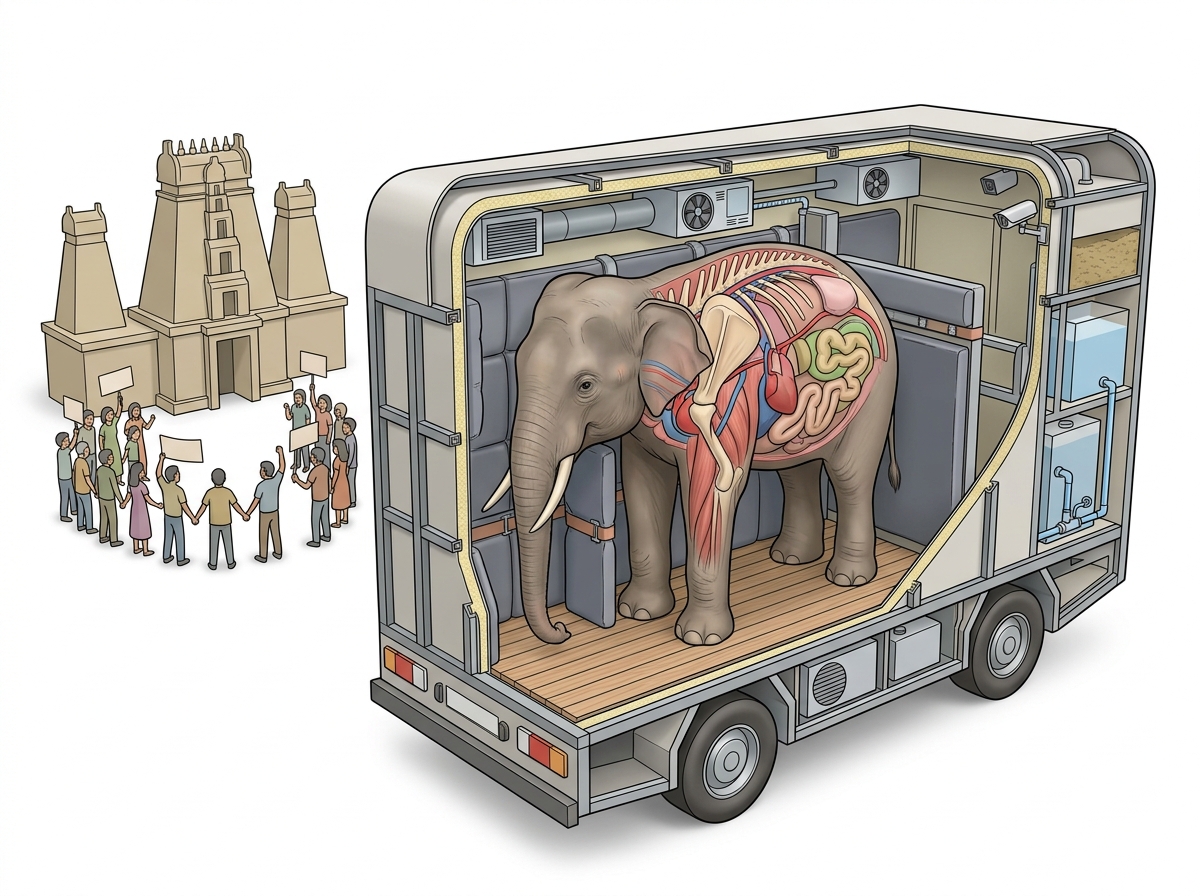
✎ Elephant transfers to temples require legal, welfare, and conservation checks as per Wildlife Protection Act and judicial oversight.
Relevance for Banking, SSC & RBI Grade B exams: Art & Culture
A five-year-old elephant named ‘Durga’ from Assam is being transported to the Madurai Meenakshi Amman Temple in Tamil Nadu, following the issuance of a ‘No Objection Certificate’ (NOC) by the Tamil Nadu Forest Department last week. The transfer, which comes amid ongoing legal scrutiny by the Madras High Court regarding the movement of captive elephants to temples, has sparked concerns among activists over the welfare of the young elephant during its nearly 3,000 km journey. The court had recently set aside statewide directions preventing temples from acquiring captive elephants, emphasizing that existing rules under the Tamil Nadu Captive Elephants (Management and Maintenance) Rules, 2011 already govern such transfers with necessary safeguards. However, activists question the speed of approvals and the circumstances behind the transfer, particularly the ownership and care of the elephants, as they are all young and being moved across long distances.
For Banking, SSC, and RBI Grade B aspirants, this issue highlights the intersection of environmental policy, animal welfare, and judicial intervention, which are often tested in exams. Questions related to wildlife conservation, the role of forest departments, and legal frameworks governing animal rights could be framed in the prelims or mains. Additionally, the socio-economic dimensions of temple management and religious practices, as seen in the temple elephant tradition, may appear in descriptive or analytical sections of exams like RBI Grade B Phase 2 or SSC CGL Tier 3. Understanding such current affairs ensures aspirants are well-prepared for questions on governance, ethics, and sustainable practices.
Source: The Hindu
Generated by AanyaAi for educational purpose.

1 comment on “Durga the Elephant’s Transfer to Madurai Meenakshi Temple: Key Facts for Competitive Exams”