
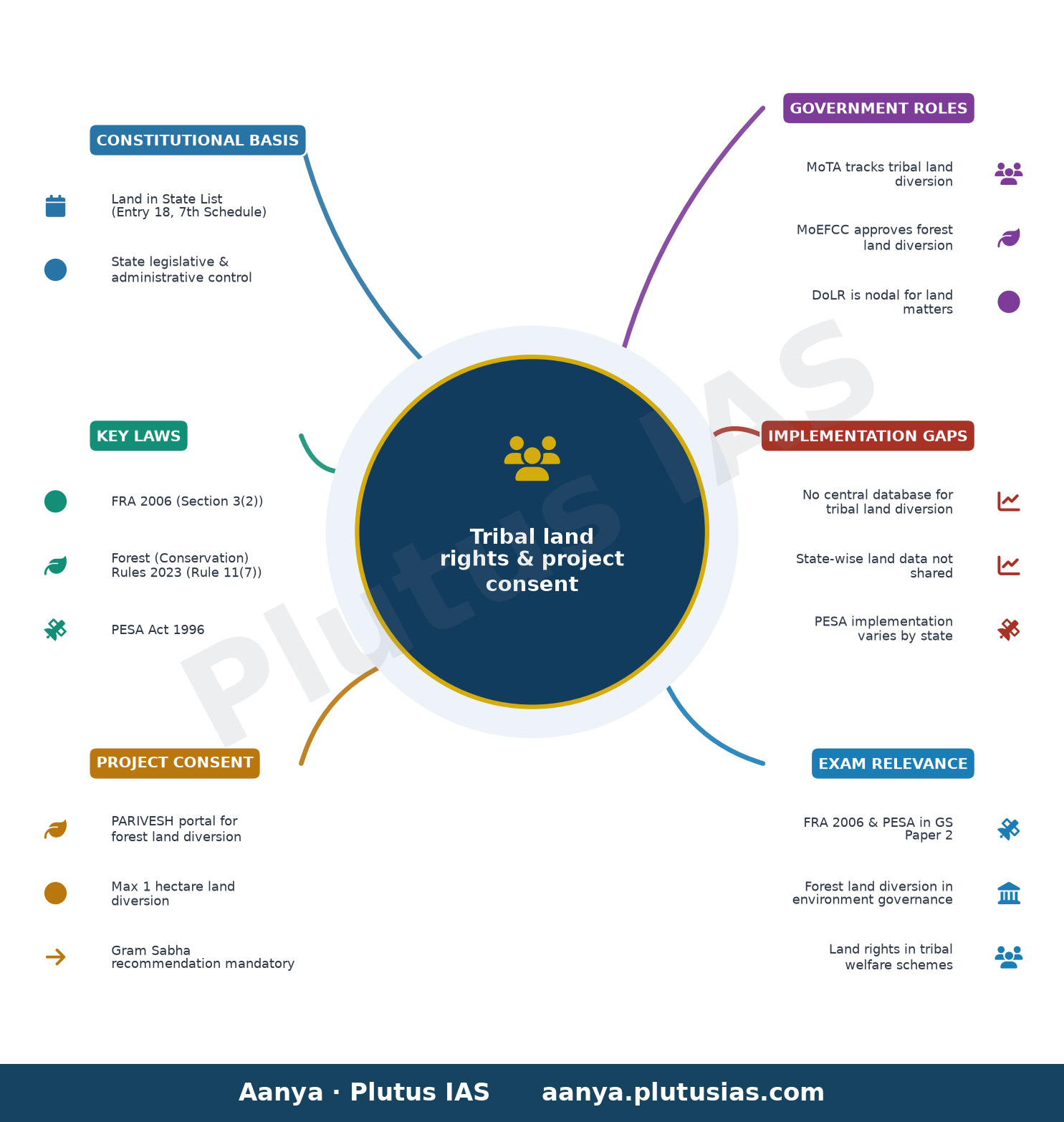
✎ Tribal land rights require Gram Sabha consent, FRA 2006 compliance, and state-level implementation under constitutional provisions.
Relevance for Banking, SSC & RBI Grade B exams: Polity & Governance
The recent PIB release highlights the constitutional and legal framework governing tribal land rights and consent in project clearances, a critical issue for governance and policy studies. Under the Seventh Schedule of the Constitution, land management falls under the State List (Entry 18), giving state governments exclusive legislative and administrative control over land-related matters, including acquisition and rehabilitation. However, central laws like the Scheduled Tribes and Other Traditional Forest Dwellers (Recognition of Forest Rights) Act, 2006 (FRA), impose safeguards to prevent tribal displacement without due process. The Ministry of Tribal Affairs (MoTA) ensures compliance with FRA’s Section 4(5), which prohibits eviction of claimants until their forest rights are verified. For non-forest land use, the Environment Ministry’s PARIVESH portal tracks diversion proposals, though tribal consent remains a state-level responsibility. This decentralized approach often leads to conflicts, as seen in pending cases like Odisha’s mining projects or Gujarat’s highway expansions, where tribal rights clash with developmental priorities. Such disputes underscore the need for balanced policy enforcement, a topic relevant for exams assessing governance and constitutional provisions.
For banking and SSC aspirants, understanding tribal land rights is crucial for framing questions on governance, constitutional amendments, and socio-economic policies. RBI Grade B exams may test awareness of how land disputes impact infrastructure financing or rural credit disbursal, where tribal land ownership complexities can delay project approvals. Similarly, SSC exams often include polity questions on forest rights, tribal welfare schemes, or constitutional provisions like the Fifth and Sixth Schedules. The FRA’s emphasis on gram sabha consent aligns with participatory governance models, a concept increasingly relevant in public administration and policy-making. Aspirants should note how tribal rights intersect with environmental laws (e.g., Forest Conservation Act, 1980) and land acquisition frameworks, as these themes frequently appear in descriptive and analytical sections of competitive exams.
Source: PIB (Press Information Bureau)
Generated by AanyaAi for educational purpose.
