
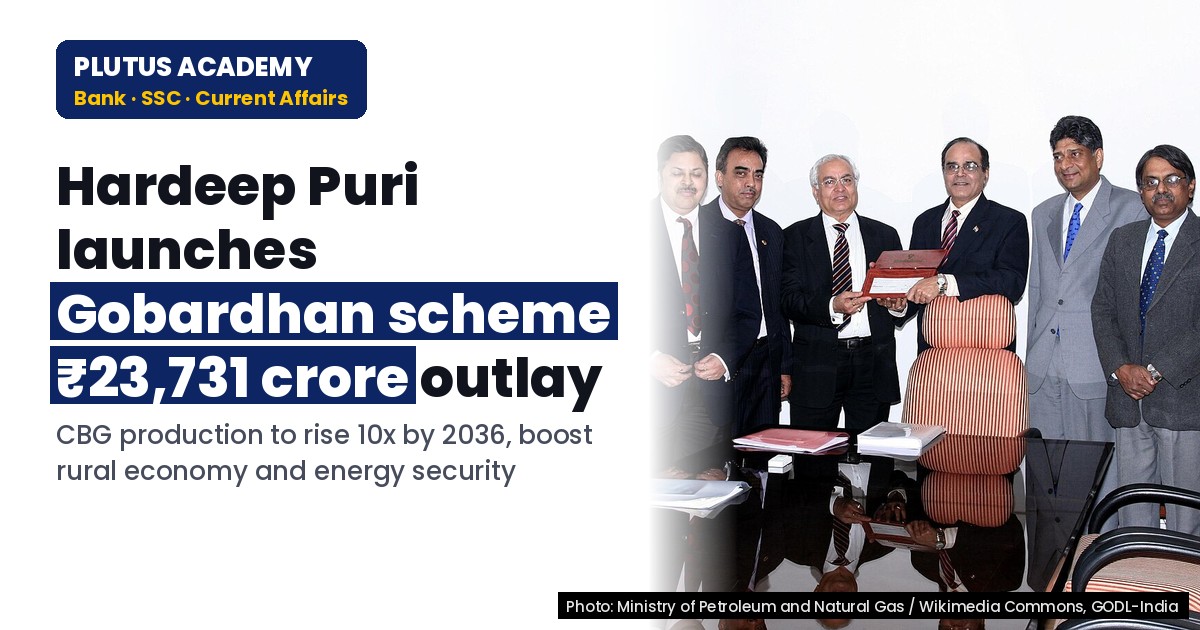
✎ GobarDhan Scheme (₹23,731 crore) launched in 2026 to boost Compressed Biogas (CBG) production in India, aiming for 5 MMSCMD (~10x increase) by 2036 with integrated procurement, pricing, and financial support.
Relevance for Banking, SSC & RBI Grade B exams: Polity & Governance
The launch of the **Gobardhan Scheme** by Union Minister for Petroleum and Natural Gas, Hardeep Singh Puri, marks a significant step toward accelerating India’s compressed biogas (CBG) sector, a key initiative under the **Government of India’s** push for clean energy transition. With a **₹23,731 crore outlay** approved by the Union Cabinet in August 2026, the scheme aims to boost domestic CBG production nearly **10-fold** (to ~5 MMSCMD) by **2035-36**, reducing reliance on imported natural gas and promoting circular economy principles. The integrated framework ensures **assured procurement, stable pricing, capital subsidies, pipeline connectivity, and loan guarantees**, addressing long-standing challenges like feedstock availability, revenue uncertainty, and fragmented policy support. For banking and financial services aspirants, this scheme highlights the **role of government-backed financing mechanisms** in scaling up renewable energy projects, a critical area for **priority sector lending (PSL)** under RBI norms. SSC and RBI Grade B candidates should note how such policies align with **India’s climate commitments (Paris Agreement, Net Zero by 2070)** and **energy security goals**, making them relevant for questions on **sustainable development, fiscal incentives, and infrastructure financing**.
The scheme’s **digital governance tools**—such as the **Integrated Gobardhan Portal**—demonstrate the government’s focus on **transparency and ease of doing business**, a recurring theme in governance-related exams. For **Bank PO and SSC aspirants**, this underscores the importance of **e-governance in policy implementation**, a topic often tested in **General Awareness sections**. The scheme also ties into **rural development and farmer welfare**, as it empowers stakeholders like **cooperatives, gaushalas, and MSMEs** to participate in the CBG value chain, generating **rural employment and additional income sources**. RBI Grade B candidates should analyze how such initiatives can **stimulate credit growth in agri-based industries** while mitigating risks through **credit guarantee mechanisms**, a concept relevant to **monetary policy and financial inclusion**. Furthermore, the scheme’s **multi-stakeholder approach**—involving ministries, state governments, oil companies, and financial institutions—reflects the **collaborative governance model** increasingly emphasized in **Polity & Governance** syllabi, making it a high-yield topic for exam preparation.
Source: PIB (Press Information Bureau)
Generated by AanyaAi for educational purpose.

2 comments on “Gobardhan Scheme Launched to Boost Compressed Biogas Production in India”