Relevance for Banking, SSC & RBI Grade B exams: Economy/Governance
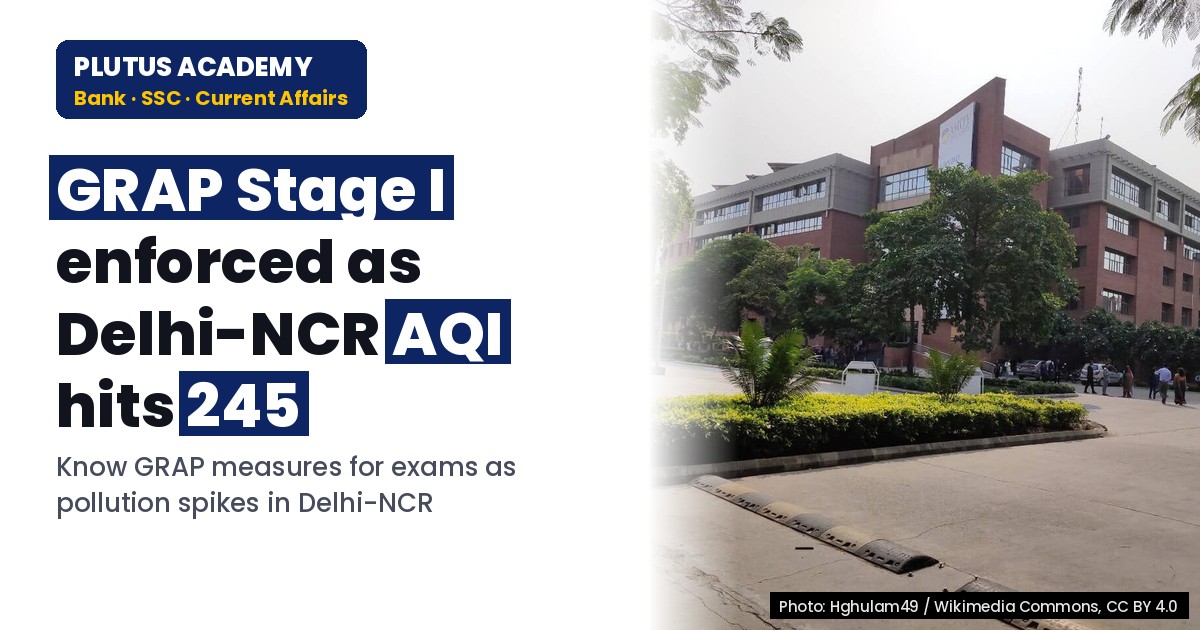
The Central Air Quality Management Commission (CAQM) has implemented **Stage I of the Graded Response Action Plan (GRAP)** in the Delhi-National Capital Region (NCR) with immediate effect due to a sharp rise in the Air Quality Index (AQI), which reached **245 (‘Poor’ category)** by evening, as per the Central Pollution Control Board (CPCB) data. The decision follows a review meeting assessing worsening air quality, weather forecasts, and pollution sources, including construction activities, waste burning, and vehicular emissions. GRAP Stage I, applicable when AQI ranges between **201-300**, mandates 25 stringent measures—such as enforcing dust suppression at construction sites, banning open waste burning, stricter vehicular pollution checks, and ensuring compliance with emission norms for industries and diesel generators—to prevent further deterioration.
For banking, SSC, and RBI Grade B aspirants, this development highlights **governance, environmental policy, and regulatory enforcement**—key areas in exams. Questions may test understanding of **GRAP’s phased implementation, AQI thresholds, and pollution control mechanisms**, linking them to **sustainable development goals (SDGs), urban governance, and public health policies**. The episode also underscores the role of **inter-agency coordination (CPCB, CAQM, state bodies)** and **judicial interventions (NGT/SC orders)** in policy execution, which aligns with governance syllabi. Additionally, it reflects **economic trade-offs** (e.g., construction slowdowns vs. health costs) and **regulatory challenges**, relevant for **RBI’s focus on environmental risks in financial stability** or **SSC’s general awareness sections**.
Source: PIB (Press Information Bureau)
Generated by AanyaAi for educational purpose.

1 comment on “GRAP Stage I Implemented in Delhi-NCR Due to Rising Air Pollution AQI”