✎ Manual scavenging eliminated per 2024-25 survey; government schemes like NAMASTE and cash assistance drive rehabilitation.
Relevance for Banking, SSC & RBI Grade B exams: Economy/Governance
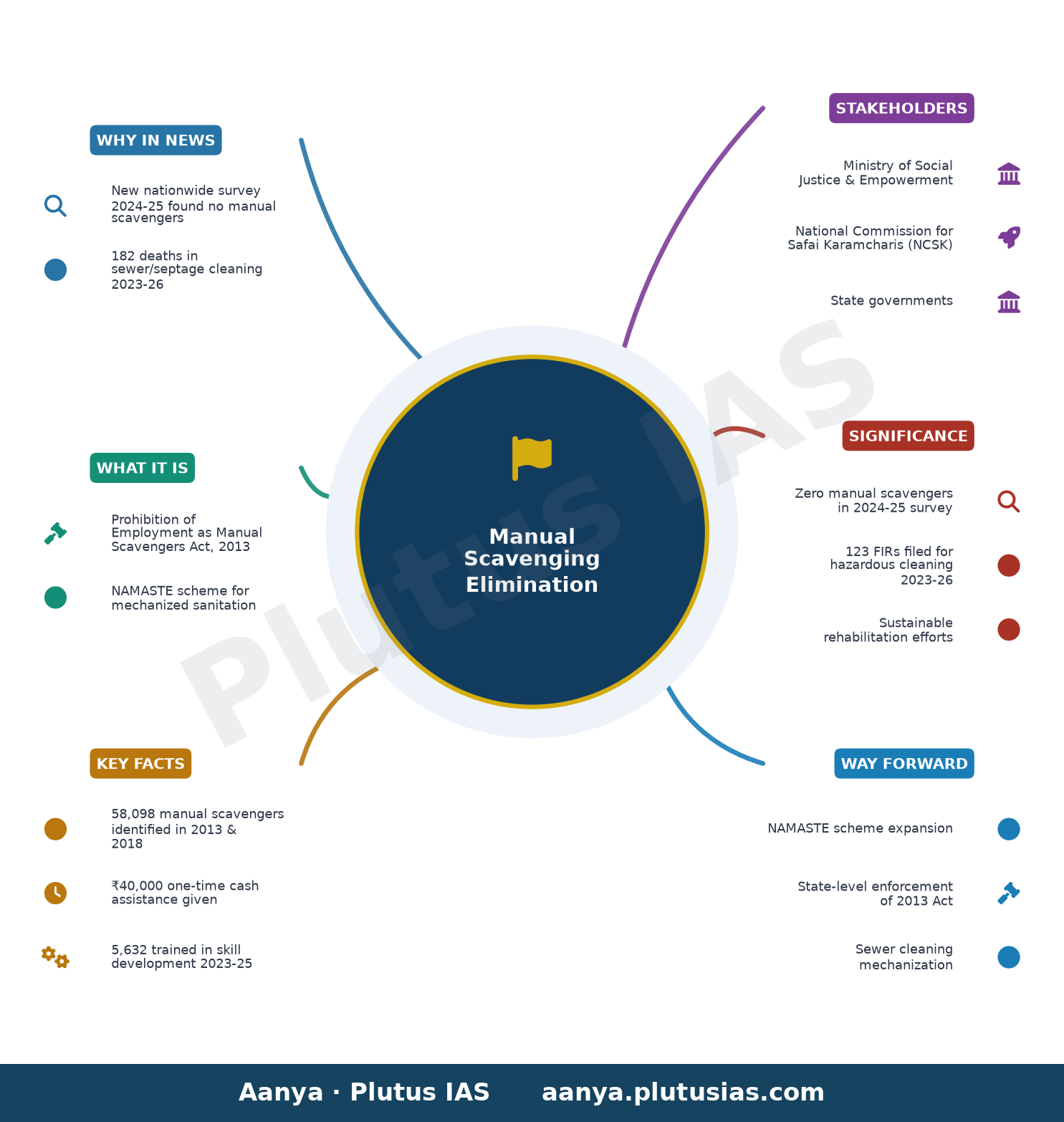
A recent nationwide survey conducted in 2024-25 under the Prohibition of Employment as Manual Scavengers and their Rehabilitation Act, 2013, has found no individuals engaged in manual scavenging across any district in India. This marks a significant milestone in the government’s efforts to eliminate the practice, following earlier surveys in 2013 and 2018 that identified 58,098 manual scavengers, all of whom have since received a one-time financial assistance of ₹40,000 each. The survey’s outcome underscores the impact of rehabilitation schemes like the Swachhata Udyami Swarozgar Yojana (SUSY), now integrated into the National Action for Mechanised Sanitation Ecosystem (NAMASTE) scheme launched in July 2023, which provides skill development training and capital subsidies to help former manual scavengers transition to sustainable livelihoods. Between 2023-24 and 2025-26, over 5,600 individuals received skill training, while 483 were given capital subsidies to start alternative self-employment ventures, reflecting a structured approach toward economic inclusion.
The development is particularly relevant for banking and governance aspirants preparing for exams like SBI PO, RBI Grade B, and SSC CGL, as it highlights the intersection of social welfare policies with economic empowerment and financial inclusion. The NAMASTE scheme, with its focus on mechanised sanitation and skill development, aligns with broader government initiatives aimed at reducing manual labor in hazardous occupations, which can be linked to themes like poverty alleviation, labor reforms, and sustainable development in exam syllabi. Additionally, the mention of 123 FIRs registered in cases of hazardous sewer cleaning between January 2023 and June 2026, despite 182 deaths reported, reflects ongoing challenges in enforcement and occupational safety—topics that may appear in current affairs sections of these exams. For candidates, understanding such policy interventions and their socio-economic implications can provide an edge in answering questions related to governance, social justice, and economic policies.
Source: PIB (Press Information Bureau)
Generated by AanyaAi for educational purpose.
