
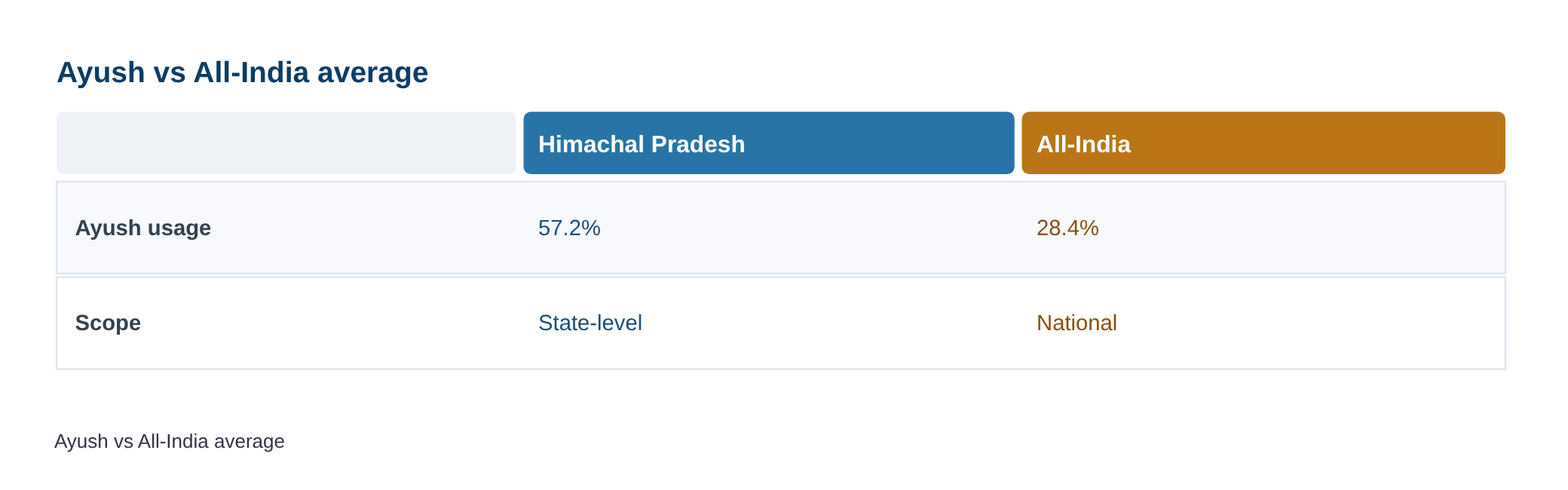
✎ Himachal Pradesh leads in AYUSH adoption with 57.2% households using alternative medicine, far above national average.
Relevance for Banking, SSC & RBI Grade B exams: Economy/Governance
A recent survey has revealed that **57.2% of households in Himachal Pradesh are now relying on Ayush (Ayurveda, Yoga, Unani, Siddha, and Homeopathy) systems for healthcare**, significantly higher than the national average of **28.4%**. The findings, part of the **79th All India AYUSH Survey (2022-23)**, highlight the state’s growing preference for traditional medicine due to its **cost-effectiveness, accessibility, and minimal side effects**. Himachal Pradesh’s **rich biodiversity of medicinal plants** and deep-rooted cultural affinity for natural therapies have further bolstered this trend, making it a model for other states. The survey, covering **1,81,298 households** across rural and urban areas, underscores how **Ayush systems are becoming a primary healthcare choice**, especially for chronic ailments and preventive care.
For **Banking, SSC, and RBI Grade B aspirants**, this development holds **policy and economic relevance**. The **expansion of Ayush infrastructure**—including wellness centers, specialized therapies like Panchakarma, and trained practitioners—reflects **government initiatives to integrate traditional medicine into mainstream healthcare**, a key aspect of **public health governance**. From an **economic perspective**, this shift could **reduce healthcare costs**, boost **local entrepreneurship in herbal medicine**, and align with **global wellness trends**, making it a potential area for **policy analysis, budgetary allocations, or even financial inclusion models** in exams. Additionally, the **data-driven insights** from such surveys are crucial for **policy formulation, monitoring SDG goals (SDG 3: Good Health and Well-being), and assessing socio-economic impacts**, which are often tested in **RBI Grade B’s economic and social issues sections** or **SSC’s general awareness papers**.
Source: amarujala.com
Generated by AanyaAi for educational purpose.

1 comment on “Himachal Pradesh Leads in Ayush Adoption: 57.2% Households Use Ayurveda, Survey Reveals”