
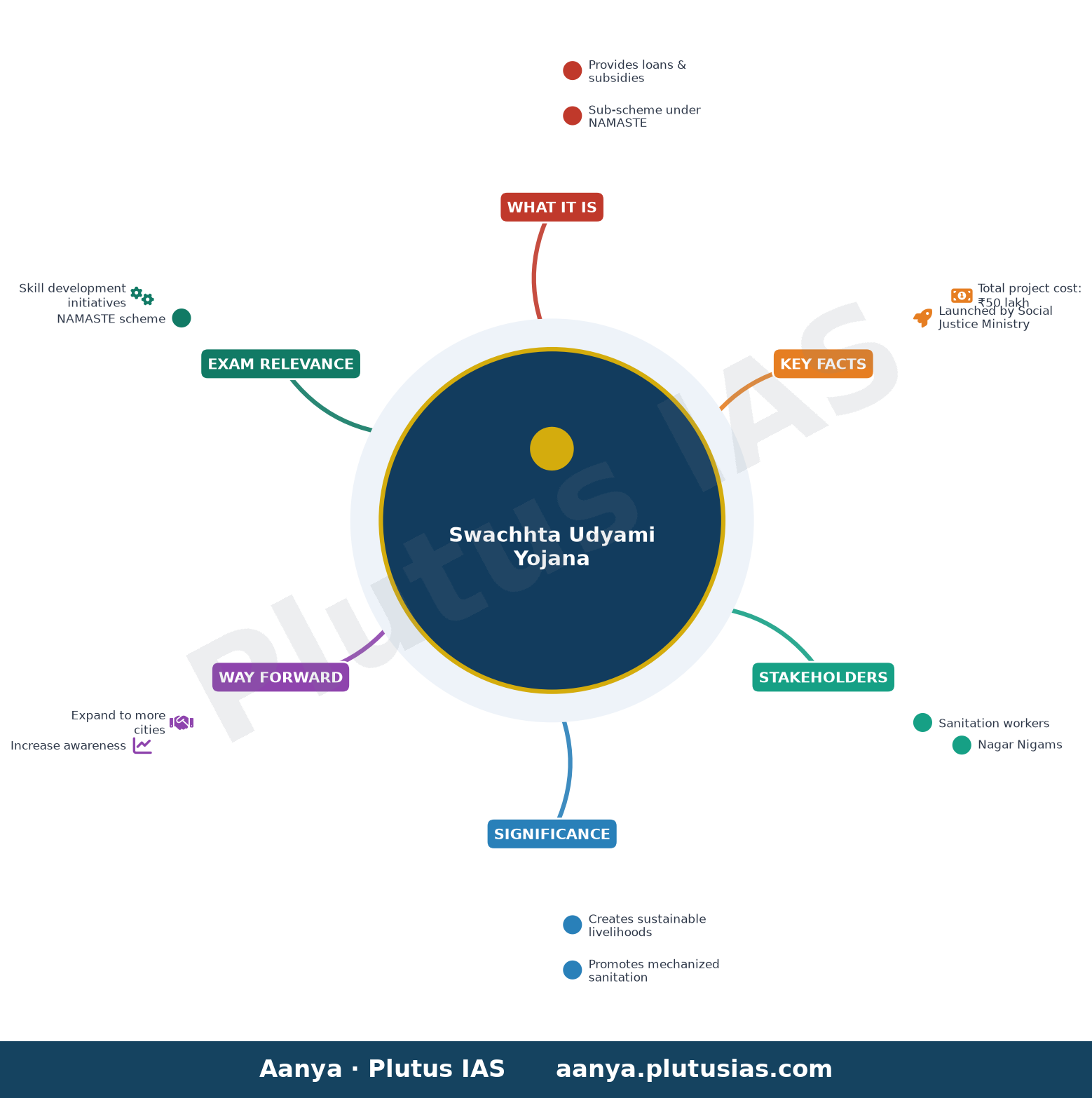
✎ Swachhta Udyami Yojana empowers sanitation workers with loans & subsidies to enhance livelihoods and financial security.
Relevance for Banking, SSC & RBI Grade B exams: International Relations
Karnati Srinivas Rao’s journey from a sanitation worker to an entrepreneur under the Swachhta Udyami Scheme highlights how targeted financial inclusion and mechanized sanitation solutions can transform livelihoods. His story underscores the critical role of affordable credit, capital subsidies, and skill development in enabling marginalized communities—especially those with limited education and low incomes—to break free from financial insecurity. The scheme’s provision of a mechanized desludging vehicle (Gulper 8 KL) not only enhanced his earning potential by ₹10,000 monthly but also provided a sustainable income stream, improving his family’s economic stability. This case exemplifies how government initiatives can bridge gaps in social security and promote dignified employment, aligning with broader goals of financial empowerment and poverty alleviation.
For Banking, SSC, and RBI Grade B aspirants, this narrative is a case study in socio-economic development, financial inclusion, and policy implementation. It reflects the importance of schemes like the *NAMASTE* (National Action for Mechanized Sanitation Ecosystem) in addressing occupational hazards and economic vulnerabilities among sanitation workers. Such initiatives often feature in exam questions on government welfare programs, rural development, or financial inclusion, testing candidates’ understanding of how policy frameworks translate into grassroots impact. Additionally, the role of subsidized loans and capital infusion in fostering entrepreneurship could be relevant for questions on the RBI’s priority sector lending or the government’s push for MSME growth, making it a pertinent example for exam preparation.
Source: PIB (Press Information Bureau)
Generated by AanyaAi for educational purpose.

1 comment on “How NAMASTE Scheme Transformed a Sweeper’s Financial Security & Livelihood”