✎ India rejects CoA award, citing illegality, and upholds sovereign rights over Indus basin projects.
Relevance for Banking, SSC & RBI Grade B exams: International Relations
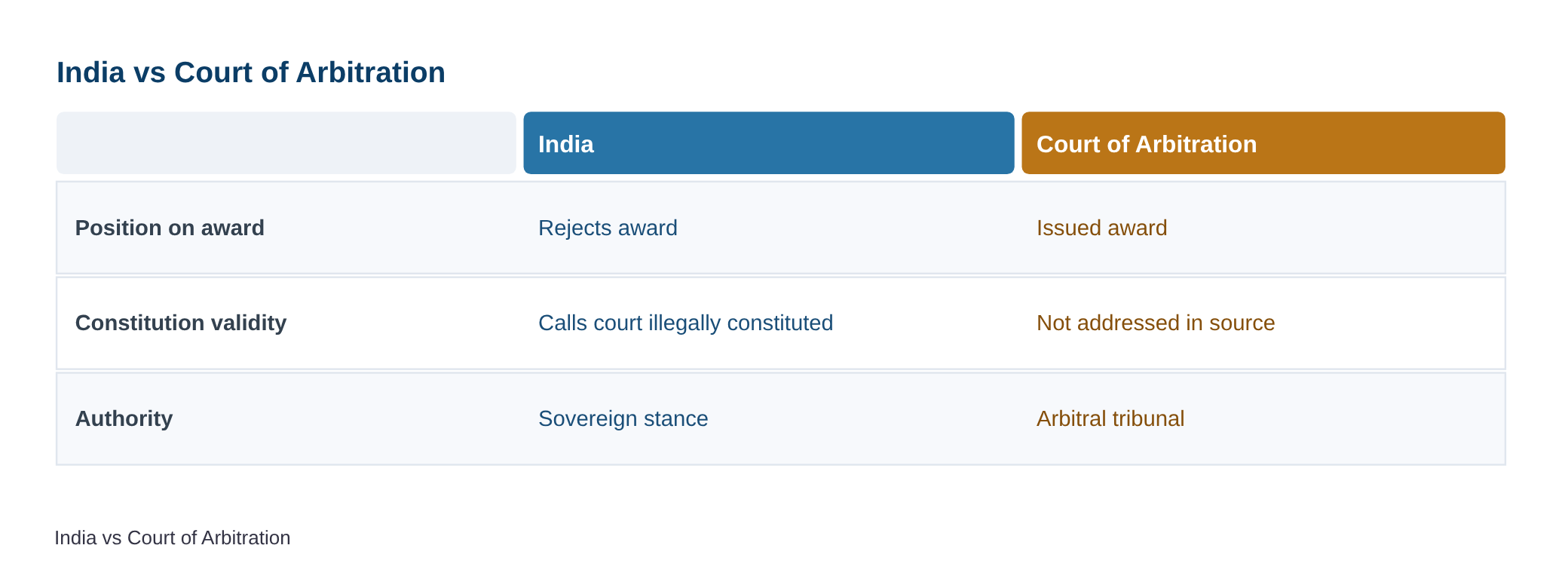
India has firmly rejected the “award” issued by the Court of Arbitration (CoA) regarding the Indus Waters Treaty (IWT), terming the tribunal “illegally constituted” and its proceedings as a violation of the treaty’s terms. The Ministry of External Affairs (MEA) stated that the CoA was set up by the World Bank without adhering to the IWT’s provisions, and India has never recognized its authority or participated in its proceedings. The MEA emphasized that the treaty remains in abeyance due to Pakistan’s alleged support for cross-border terrorism, particularly after the 2025 Pahalgam attack, and that India’s sovereign decisions on hydroelectric projects like the Ratle Hydro-Electric Plant (RHEP) will not be influenced by the CoA’s rulings.
This development holds significance for banking, SSC, and RBI Grade B aspirants as it touches upon key areas of international relations and diplomacy, which are often tested in competitive exams. Questions may arise on the IWT’s historical context, its provisions, and India’s stance on bilateral treaties amid geopolitical tensions. Additionally, the role of international arbitral bodies, such as the CoA, and their jurisdiction under treaties could be relevant for exams assessing knowledge of global governance frameworks. Understanding such geopolitical dynamics also aids in comprehending India’s foreign policy priorities, which may be reflected in current affairs sections of these exams.
Source: orissapost.com
Generated by AanyaAi for educational purpose.
