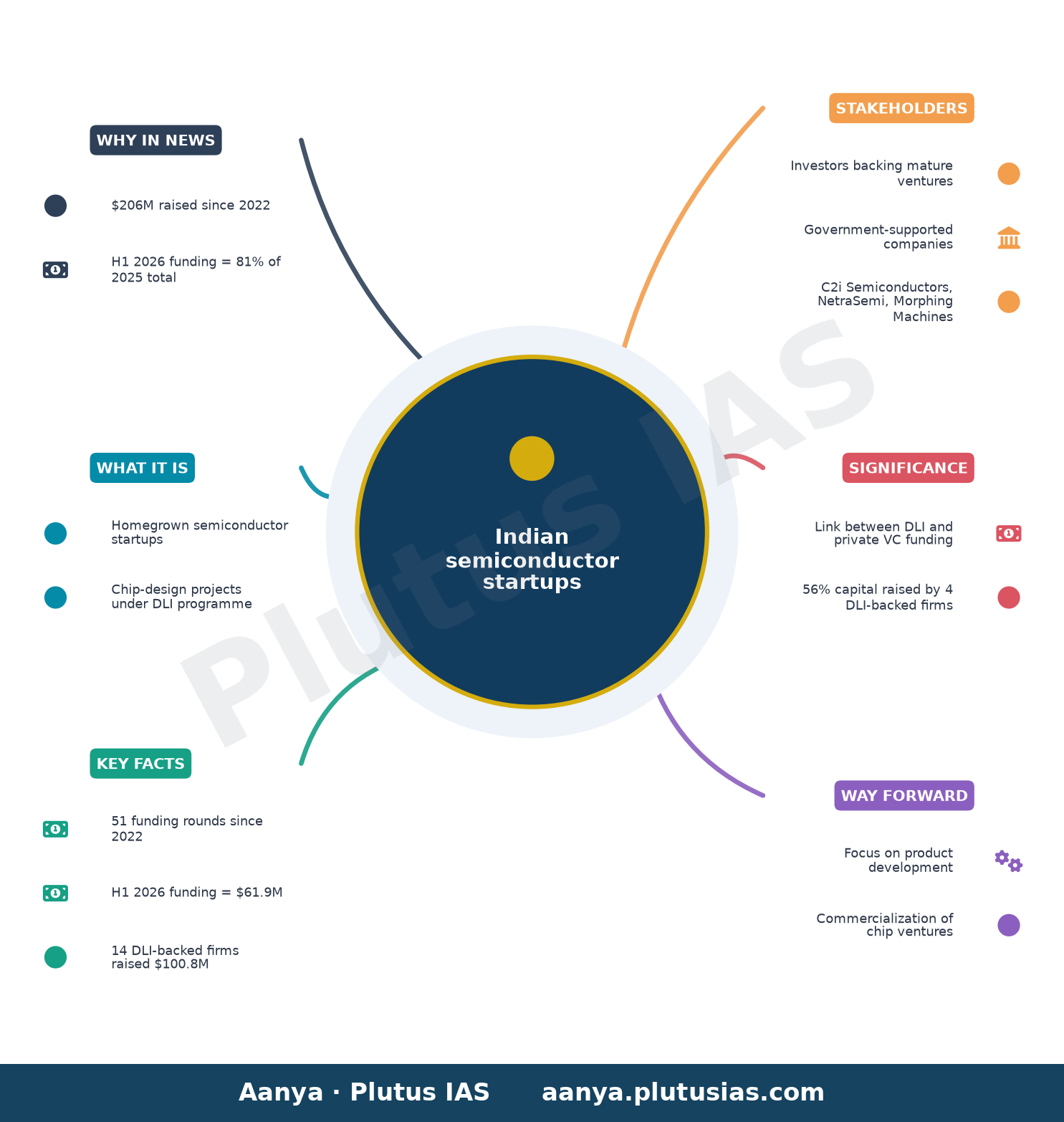
✎ Indian semiconductor startups raised $206M since 2022, with DLI-backed firms attracting private capital.
Relevance for Banking, SSC & RBI Grade B exams: Economy/Governance
Homegrown semiconductor startups have raised approximately $206 million across 51 funding rounds since 2022, according to a report by venture capital firm Speciale Invest and Startup Policy Forum. The funding momentum accelerated in 2026, with $61.9 million raised in the first half alone—nearly 81% of the $76.6 million secured in all of 2025. While the number of funding rounds declined from 16 in 2024 to just seven in H1 2026, the average capital per round increased, indicating investor preference for mature, commercially viable ventures over early-stage bets. The report highlights the growing role of government-backed programmes like the Design-Linked Incentive (DLI), which has helped 14 chip-design projects secure $100.8 million in venture capital, with four companies—C2i Semiconductors, NetraSemi, Morphing Machines, and Mindgrove Technologies—accounting for over half of this funding.
For banking and SSC aspirants, this trend underscores India’s push for self-reliance in critical technologies, aligning with government initiatives like the ₹76,000 crore Semiconductor Mission. The shift toward strategic investors, including global chip firms and Indian conglomerates like Zoho and TDK Ventures, signals deeper industry integration and potential job creation in R&D, manufacturing, and allied sectors. RBI Grade B candidates should note how such investments could influence monetary policy, inflation dynamics (via supply chain resilience), and credit flows to high-tech sectors. The broadening focus—from digital chips to photonics and AI-driven design—also reflects India’s evolving industrial strategy, making it relevant for questions on economic diversification and innovation-driven growth.
Source: Business Standard
Generated by AanyaAi for educational purpose.
